
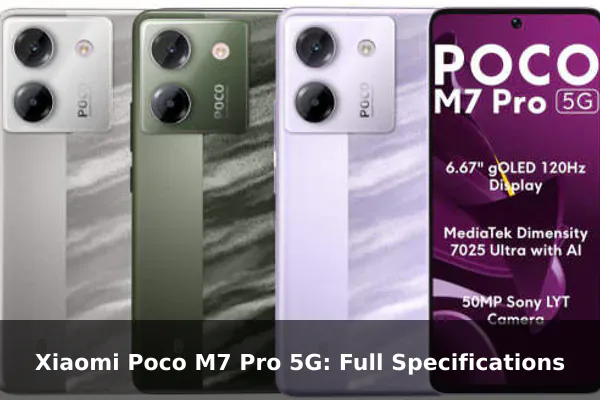
The Xiaomi Poco M7 Pro 5G is positioned as a practical mid-range phone for buyers who want an AMOLED screen, 5G support, stereo speakers, and a large battery without moving into flagship pricing. It brings several comfort-focused details, including high-frequency PWM dimming, an under-display fingerprint reader, Gorilla Glass 5, and a 3.5mm headphone jack.
Rather than chasing extreme camera counts or gaming-phone styling, this model is best understood as a value-first daily driver. Its strongest pitch is the combination of a bright 120Hz display, Dimensity 7025 Ultra chipset, expandable storage, and 45W wired charging in a body that remains reasonably slim and light.
Full Specifications
Network
| Technology: | GSM / HSPA / LTE / 5G |
| 2G bands: | GSM 850 / 900 / 1800 / 1900 |
| 3G bands: | HSDPA 800 / 850 / 900 / 1700(AWS) / 1900 / 2100 – International |
| HSDPA 850 / 900 / 2100 – India | |
| 4G bands: | 1, 2, 3, 4, 5, 7, 8, 12, 13, 17, 18, 19, 20, 26, 28, 32, 38, 40, 41, 42, 48, 66 – International |
| 1, 3, 5, 8, 28, 40, 41 – India | |
| 5G bands: | 1, 2, 3, 5, 7, 8, 12, 20, 26, 28, 38, 40, 41, 48, 66, 77, 78 SA/NSA – International |
| 1, 3, 5, 8, 28, 40, 78 SA/NSA – India | |
| Speed: | HSPA, LTE, 5G |
Launch
| Announced: | 2024, December 17 |
| Status: | Available. Released 2024, December 20 |
Body
| Dimensions: | 162.4 x 75.7 x 8 mm (6.39 x 2.98 x 0.31 in) |
| Weight: | 190 g (6.70 oz) |
| Build: | Glass front (Gorilla Glass 5), plastic back, plastic frame |
| SIM: | Nano-SIM + Nano-SIM |
| IP64 dust tight and water resistant (water splashes) |
Display
| Type: | AMOLED, 120Hz, 960Hz PWM, HDR10+, 2100 nits (peak), Dolby Vision (India only) |
| Size: | 6.67 inches, 107.4 cm2 (~87.4% screen-to-body ratio) |
| Resolution: | 1080 x 2400 pixels, 20:9 ratio (~395 ppi density) |
| Protection: | Corning Gorilla Glass 5, Mohs level 5 |
Platform
| OS: | Android 14, up to 2 (INT) / 4 (EU) major Android upgrades, HyperOS |
| Chipset: | Mediatek Dimensity 7025 Ultra (6 nm) |
| CPU: | Octa-core (2×2.5 GHz Cortex-A78 & 6×2.0 GHz Cortex-A55) |
| GPU: | IMG BXM-8-256 |
Memory
| Card slot: | microSDXC (uses shared SIM slot) |
| Internal: | 128GB 6GB RAM, 256GB 8GB RAM, 256GB 12GB RAM, 512GB 12GB RAM |
| UFS 2.2 |
Main Camera
| Dual: | 50 MP, f/1.5, 26mm (wide), 1/1.95″, 0.8µm, PDAF, OIS 2 MP, f/2.4, (depth) |
| Features: | LED flash, HDR, panorama |
| Video: | 1080p@30fps |
Selfie camera
| Single: | 20 MP, f/2.2, 21mm (wide), 1/4.0″, 0.7µm |
| Features: | Panorama, HDR |
| Video: | 1080p@30fps |
Sound
| Loudspeaker: | Yes, with stereo speakers (with Dolby Atmos) |
| 3.5mm jack: | Yes |
| 24-bit/192kHz Hi-Res audio |
Comms
| WLAN: | Wi-Fi 802.11 a/b/g/n/ac, dual-band |
| Bluetooth: | 5.0, A2DP, LE |
| Positioning: | GPS, GLONASS, GALILEO, BDS |
| NFC: | Yes (market/region dependent) |
| Infrared port: | Yes |
| Radio: | FM radio (market/region dependent) |
| USB: | USB Type-C |
Features
| Sensors: | Fingerprint (under display, optical), accelerometer, gyro, compass |
| Virtual proximity sensing |
Battery
| Type: | Li-Po 5110 mAh |
| Charging: | 45W wired |
Misc
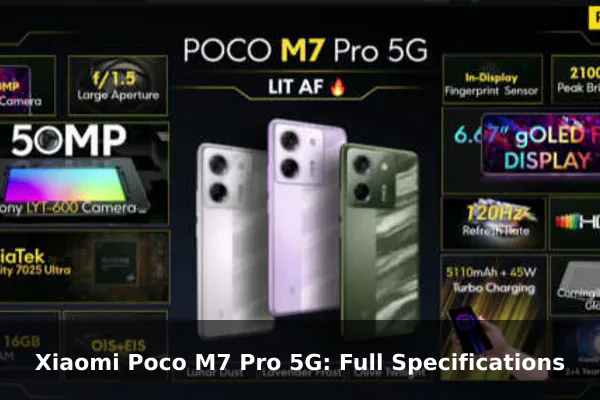
| Colors: | Lavender Frost, Lunar Dust, Olive Twilight, Classic Black |
| Models: | 2409FPCC4G, 2409FPCC4I |
| SAR: | 0.86 W/kg (head) 0.79 W/kg (body) |
| Price: | € 165.00 / $ 240.03 / £ 148.00 / ₹ 12,888 |
Our Tests
| Loudspeaker: | -23.3 LUFS (Very good) |
| Battery: | Active use score 11:21h |
EU LABEL
| Energy: | Class D |
| Battery: | 37:46h endurance, 1000 cycles |
| Free fall: | Class D (45 falls) |
| Repairability: | Class C |
Price and Availability
The Xiaomi Poco M7 Pro 5G offers a compelling combination of features and performance. While the base price is around €165, the actual cost may vary depending on your location and retailer. Below, you’ll find the approximate price of the Xiaomi Poco M7 Pro 5G converted into various currencies. Please note that these are estimates based on recent exchange rates as of July 20, 2026 and may not reflect the exact price you’ll find at a retailer.
- United States: $189
- Japan: ¥30,641
- United Kingdom: £140
- Australia: A$270
- Canada: C$264
- Taiwan: NT$6,101
- Denmark: kr1.231
- Saudi Arabia: ﷼707
- South Korea: ₩280,464
- Germany: €165
- Brazil: R$964
- Vietnam: ₫4.944.328
- Kenya: KSh 24,398
- India: ₹18,158
- Indonesia: Rp 3.376.735
- Nigeria: ₦259,761
- Pakistan: ₨52,458
- Philippines: ₱11,615
- Bangladesh: ৳২৩,২৬৮
Value Positioning
The Poco M7 Pro 5G sits in the busy affordable 5G category, where small hardware choices matter. Its value comes from using features that are easy to notice every day: a 120Hz AMOLED panel, optical in-display fingerprint sensor, stereo speakers, a large 5110mAh battery, and 45W wired charging. Those are more meaningful for many buyers than a long list of secondary cameras or cosmetic extras.
The raw source price places it in a competitive budget-to-midrange space, but availability and exact retail pricing can vary by market. For comparison-minded buyers, the important point is that this phone is not only about 5G access. It also tries to improve the screen, audio, battery life, and storage experience that shape regular use.
Design and Durability
The phone measures 162.4 x 75.7 x 8mm and weighs 190g, which makes it fairly manageable for a 6.67-inch device. It uses a glass front protected by Gorilla Glass 5, with a plastic frame and plastic back. That material mix is typical for the segment: it keeps weight and cost under control while still giving the front display a more resilient surface.
IP64 dust and splash resistance is another useful addition. It does not make the Poco M7 Pro 5G a waterproof phone, but it gives some added confidence against dust and light water splashes. The color options also give the model a wider personality range, from Classic Black to Lavender Frost, Lunar Dust, and Olive Twilight.
Display Experience
The display is one of the clearest highlights. The 6.67-inch AMOLED panel uses a 1080 x 2400 resolution, a 20:9 aspect ratio, and a pixel density of about 395ppi. That is sharp enough for browsing, video, social feeds, and document reading without the softer look often found on lower-resolution budget phones.
The 120Hz refresh rate should make scrolling and interface movement feel smoother, while the listed 2100-nit peak brightness helps the phone compete better outdoors. The inclusion of HDR10+ is welcome, and Dolby Vision support is listed for India only, so buyers should check their regional variant before treating that as a universal feature. The 960Hz PWM figure is also notable for users who care about display dimming behavior in low light.
Performance and Storage
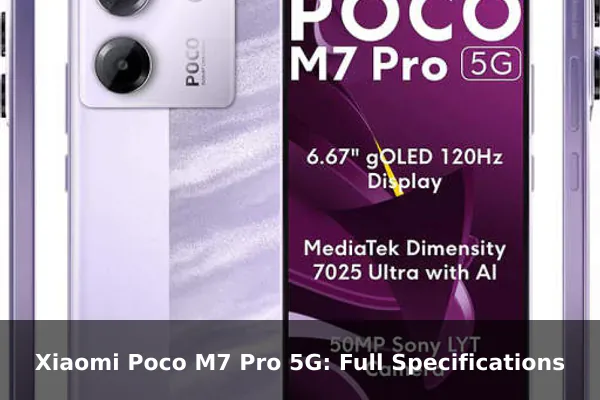
The Poco M7 Pro 5G uses the MediaTek Dimensity 7025 Ultra, a 6nm chipset with two Cortex-A78 performance cores and six Cortex-A55 efficiency cores. This is not a flagship processor, but it is a sensible platform for messaging, web use, streaming, maps, photography, and casual gaming. The GPU is the IMG BXM-8-256, which should be treated as mainstream rather than enthusiast-grade gaming hardware.
Storage options are generous for the class, with configurations listed from 128GB with 6GB RAM up to 512GB with 12GB RAM. UFS 2.2 storage is a stronger choice than older eMMC storage, especially for app loading and general responsiveness. The microSDXC slot is useful, although it shares the second SIM position, so users must choose between dual SIM use and expandable storage.
Camera Setup
The rear camera system is simple: a 50MP main camera with f/1.5 aperture, PDAF, and optical image stabilization, paired with a 2MP depth sensor. The main sensor is clearly the important camera here. OIS is a valuable inclusion because it can help reduce hand-shake in still photos and improve consistency in less-than-perfect lighting.
Video recording is capped at 1080p at 30fps, which is one of the phone’s more obvious limitations. Buyers who want 4K recording, higher frame-rate video, or an ultra-wide camera should look higher up the range. The 20MP front camera is more promising for selfies and video calls, and it also records at 1080p at 30fps.
Battery and Charging
The 5110mAh battery gives the Poco M7 Pro 5G a strong foundation for daily endurance. The listed active use score of 11:21h suggests it is built for a full day of mixed use, though real results will depend on signal strength, brightness, refresh-rate behavior, gaming, and camera use.
Charging is rated at 45W wired. That is fast enough to feel practical for top-ups during the day, even if it is not the fastest figure in Xiaomi’s broader catalog. The EU label data lists Class D energy rating, 37:46h endurance, 1000 battery cycles, Class D free-fall performance, and Class C repairability, which adds helpful context for buyers thinking beyond the first few months of ownership.
Software Support
The phone ships with Android 14 and HyperOS. The source data lists up to two major Android upgrades for the international model and up to four major Android upgrades for the EU model, which is an important regional difference. Buyers should verify the exact software policy for the variant sold in their country before purchase.
HyperOS brings Xiaomi’s current Android interface, so the experience will be familiar to recent Xiaomi, Redmi, and Poco users. The phone also includes an under-display optical fingerprint sensor, accelerometer, gyro, compass, and virtual proximity sensing.
Connectivity and Audio
Connectivity is broad for the segment, with GSM, HSPA, LTE, and 5G support. The phone lists separate international and India band support, so import buyers should check compatibility carefully with their local carrier. Wi-Fi 5, Bluetooth 5.0, GPS, GLONASS, Galileo, BDS, USB Type-C, and an infrared port are included.
NFC and FM radio are market-dependent, which means they should not be assumed on every retail unit. Audio is a strong point for practical users: the Poco M7 Pro 5G includes stereo speakers with Dolby Atmos, a 3.5mm headphone jack, and 24-bit/192kHz Hi-Res audio support. The tested loudspeaker result of -23.3 LUFS is rated very good.
Who Should Buy It?
The Poco M7 Pro 5G makes the most sense for buyers who want a balanced everyday Android phone with a bright AMOLED display, solid battery capacity, expandable storage, stereo sound, and 5G connectivity. It is especially appealing if display quality and charging speed matter more than advanced camera versatility.
It is less suitable for users who need 4K video recording, a dedicated ultra-wide camera, flagship gaming performance, or guaranteed feature parity across all regions. For its intended audience, however, the hardware mix is focused and practical, with fewer headline tricks and more everyday advantages.
Conclusion
The Xiaomi Poco M7 Pro 5G is a well-rounded affordable 5G phone built around a strong AMOLED display, dependable battery capacity, stereo audio, expandable storage, and practical durability. Its camera system and video recording are modest, but its everyday feature balance is strong. Recommended for buyers who want a display-first, battery-friendly 5G Android phone at a competitive price.
References
- POCO M7 Pro 5G Specs – Xiaomi Global – Primary official specification sheet for processor, memory, dimensions, display, cameras, battery, connectivity, sensors, OS, and box contents.
- POCO M7 Pro 5G Specs – POCO Global – Official POCO product specs page useful for cross-checking the Xiaomi-hosted global specifications and regional wording.
- POCO M7 Pro 5G FAQ – Xiaomi Support Philippines – Official support FAQ with deeper details on display, SoC, storage, network bands, cameras, package contents, and feature support.
- MediaTek Dimensity 7025 Official Product Page – Primary chipset reference for Dimensity 7025 CPU cores, GPU, display support, memory support, wireless capabilities, and 5G platform details.
- Gadgets 360 Poco M7 Pro 5G Specs – Established technology publication with an independent specs page and review context, useful for checking launch date, India variants, price, and practical feature summary.
