
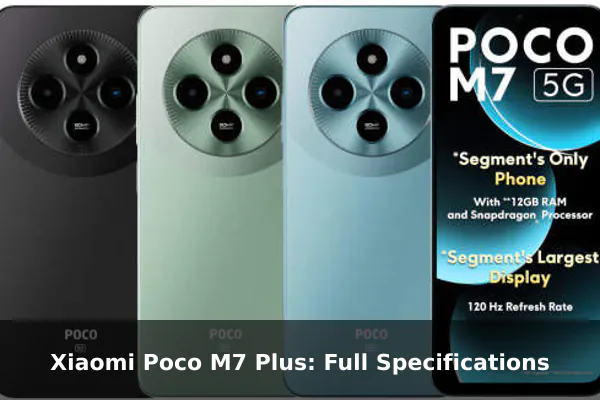
The Xiaomi Poco M7 Plus arrives as a budget-focused big-battery phone that leans hard into endurance and screen fluidity rather than flagship polish. Announced on August 13, 2025, with an expected release around August 19, it pairs a large 6.9-inch 144Hz IPS LCD with a substantial 7000 mAh silicon-carbon battery and Qualcomm’s Snapdragon 6s Gen 3 platform, all for roughly 140 EUR.
That combination places the M7 Plus squarely in the value tier, where buyers care more about all-day (and next-day) uptime, smooth scrolling, and a usable camera than about premium materials. This article breaks down what the specifications mean in daily use, where the phone makes sensible trade-offs, and which type of buyer it truly fits.
Full Specifications
Network
| Technology: | GSM / HSPA / LTE / 5G |
| 2G bands: | GSM 850 / 900 / 1800 / 1900 |
| 3G bands: | HSDPA 850 / 900 / 2100 |
| 4G bands: | 1, 3, 5, 8, 20, 28, 40, 41 |
| 5G bands: | 1, 3, 5, 8, 20, 28, 40, 78 SA/NSA |
| Speed: | HSPA, LTE, 5G |
Launch
| Announced: | 2025, August 13 |
| Status: | Coming soon. Exp. release 2025, August 19 |
Body
| Dimensions: | 168.5 x 80.5 x 8.4 mm (6.63 x 3.17 x 0.33 in) |
| Weight: | 217 g (7.65 oz) |
| SIM: | Nano-SIM + Nano-SIM |
| IP64 dust tight and water resistant (water splashes) |
Display
| Type: | IPS LCD, 144Hz, 700 nits (typ), 850 nits (HBM) |
| Size: | 6.9 inches, 116.9 cm2 (~86.2% screen-to-body ratio) |
| Resolution: | 1080 x 2340 pixels, 19.5:9 ratio (~374 ppi density) |
| Protection: | Corning Gorilla Glass 3 |
Platform
| OS: | Android 15, up to 2 major Android upgrades, HyperOS 2 |
| Chipset: | Qualcomm SM6375 Snapdragon 6s Gen 3 (6 nm) |
| CPU: | Octa-core (2×2.3 GHz Cortex-A78 & 6×2.0 GHz Cortex-A55) |
| GPU: | Adreno 619 |
Memory
| Card slot: | microSDXC (uses shared SIM slot) |
| Internal: | 128GB 6GB RAM, 128GB 8GB RAM |
Main Camera
| Dual: | 50 MP, f/1.8, (wide), PDAF Auxiliary lens |
| Features: | LED flash, HDR |
| Video: | 1080p@30fps |
Selfie camera
| Single: | 8 MP, f/2.0, (wide) |
| Features: | HDR |
| Video: | 1080p@30fps |
Sound
| Loudspeaker: | Yes |
| 3.5mm jack: | No |
Comms
| WLAN: | Wi-Fi 802.11 a/b/g/n/ac, dual-band |
| Bluetooth: | 5.1, A2DP, LE |
| Positioning: | GPS, GLONASS, GALILEO, BDS |
| NFC: | Yes (market/region dependent) |
| Infrared port: | Yes |
| Radio: | No |
| USB: | USB Type-C 2.0 |
Features
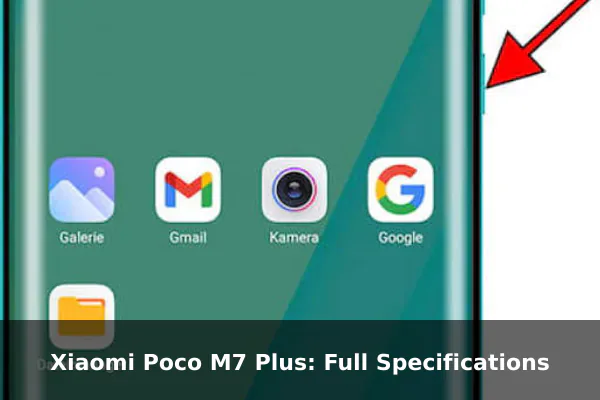
| Sensors: | Fingerprint (side-mounted), accelerometer, compass |
| Virtual proximity sensing |
Battery
| Type: | Si/C Li-Ion 7000 mAh |
| Charging: | 33W wired 18W reverse wired |
Misc
| Colors: | Chrome Silver, Aqua Blue, Carbon Black |
| SAR: | 0.86 W/kg (head) 0.81 W/kg (body) |
| Price: | About 140 EUR |
Price and Availability
The Xiaomi Poco M7 Plus offers a compelling combination of features and performance. While the base price is around €140, the actual cost may vary depending on your location and retailer. Below, you’ll find the approximate price of the Xiaomi Poco M7 Plus converted into various currencies. Please note that these are estimates based on recent exchange rates as of July 2, 2026 and may not reflect the exact price you’ll find at a retailer.
- United States: $159
- Japan: ¥25,913
- United Kingdom: £120
- Australia: A$231
- Canada: C$227
- Taiwan: NT$5,082
- Denmark: kr1.045
- Saudi Arabia: ﷼598
- South Korea: ₩247,958
- Germany: €140
- Brazil: R$827
- Vietnam: ₫4.183.785
- Kenya: KSh 20,628
- India: ₹15,167
- Indonesia: Rp 2.860.605
- Nigeria: ₦218,786
- Pakistan: ₨44,328
- Philippines: ₱9,821
- Bangladesh: ৳১৯,৬২৯
Why the Poco M7 Plus Is Built Around Value
At about 140 EUR, the Poco M7 Plus targets shoppers who want the essentials done well without paying for extras they may not need. The headline features—a massive battery, a high-refresh-rate screen, and 5G connectivity—are exactly the specifications entry-level buyers notice most. Xiaomi has clearly prioritized visible, everyday benefits over spec-sheet trophies, and that focus is what makes the phone easy to recommend on a tight budget. As always with launch pricing, exact figures and configurations may vary by region and over time, so it is worth confirming local availability before buying.
Design and Build Quality
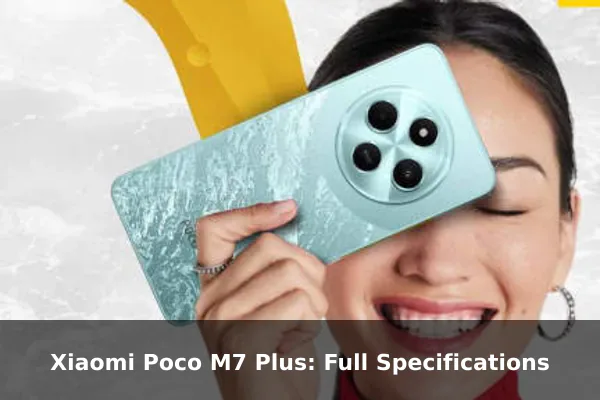
The M7 Plus is a large device, measuring 168.5 x 80.5 x 8.4 mm and weighing 217 g. That heft is a direct consequence of the 7000 mAh cell, and it is a fair trade for the endurance on offer, though smaller hands may find it unwieldy. An IP64 rating adds dust-tight protection and resistance to water splashes, which is reassuring at this price. Buyers can choose from Chrome Silver, Aqua Blue, and Carbon Black, and the side-mounted fingerprint reader is a practical, reliable choice for quick unlocks.
Display: Big, Bright, and Smooth
The 6.9-inch IPS LCD is the phone’s centerpiece for media lovers. It runs at a Full HD+ resolution of 1080 x 2340 pixels (~374 ppi) with a 19.5:9 aspect ratio, and the ~86.2% screen-to-body ratio keeps bezels reasonably tight. The standout number is the 144Hz refresh rate, which delivers noticeably smoother scrolling and animations than the 60Hz or 90Hz panels common in this segment. Peak brightness of 700 nits typical and 850 nits in high-brightness mode should keep the screen legible outdoors, while Corning Gorilla Glass 3 offers a basic layer of scratch protection.
Performance and Everyday Speed
Powering the M7 Plus is the Qualcomm Snapdragon 6s Gen 3, built on a 6 nm process with an octa-core CPU (2×2.3 GHz Cortex-A78 and 6×2.0 GHz Cortex-A55) and Adreno 619 graphics. This is a dependable mid-to-entry chipset tuned for efficiency and smooth day-to-day tasks rather than heavy gaming. Paired with 6GB or 8GB of RAM and 128GB of storage, it handles messaging, browsing, video, and casual games comfortably. A microSDXC slot (shared with the second SIM) lets you expand storage, a welcome touch for buyers who store lots of media locally.
Cameras for Casual Shooting
Imaging is where budget phones make their clearest compromises. The M7 Plus uses a 50 MP f/1.8 main sensor with PDAF plus an auxiliary lens, backed by an LED flash and HDR. In good light, the primary camera should produce sharp, usable shots for social media, though low-light results and the absence of an ultrawide are realistic limitations here. Video tops out at 1080p at 30fps front and back, and the 8 MP f/2.0 selfie camera covers video calls and everyday self-portraits. This is a functional camera system, not a photographic showcase.
Battery Life and Charging
The 7000 mAh Si/C battery is the phone’s defining feature. Silicon-carbon chemistry packs more capacity into a similar footprint, and a cell this large should comfortably deliver well over a day of mixed use—often stretching into a second day for lighter users. Charging is handled at 33W wired, which is adequate rather than fast for a battery this size, so expect a full top-up to take some time. The 18W reverse wired charging is a handy bonus, letting the M7 Plus act as a power bank for accessories or another phone in a pinch.
Software and Update Support
The phone ships with Android 15 under HyperOS 2, Xiaomi’s feature-rich interface. Xiaomi promises up to two major Android upgrades, which is modest but in line with expectations at this price. Buyers should weigh that support window against rivals if long-term software freshness matters to them, but for a device meant to serve reliably over a two-to-three-year span, it is acceptable.
Connectivity and Extras
Connectivity is well-rounded for the class. You get 5G (SA/NSA), dual-band Wi-Fi 802.11ac, Bluetooth 5.1, and a full set of positioning systems (GPS, GLONASS, Galileo, BDS). An infrared port adds remote-control convenience, and NFC is available depending on the market and region, so confirm it locally if contactless payments are important to you. Notable omissions include a 3.5mm headphone jack and FM radio, and the USB Type-C port is limited to the slower USB 2.0 standard.
Who Should Buy the Poco M7 Plus
The M7 Plus is ideal for budget buyers who prioritize battery endurance and a smooth, large screen for streaming and social media. It suits students, secondary-phone users, and anyone who wants dependable all-day power without spending much. Those who demand strong low-light photography, fast charging, or long-term software support will want to look further up the range.
Conclusion
The Xiaomi Poco M7 Plus delivers a focused, sensible package: an enormous 7000 mAh battery, a fluid 144Hz display, and reliable 5G performance at an affordable price. Its compromises—modest charging speed, a basic camera, USB 2.0, and a limited update window—are all understandable for the segment. If you want a big-screen phone that simply keeps going and going without straining your budget, the M7 Plus is an easy recommendation; buyers chasing photography or premium features should spend more elsewhere.
References
- POCO official website (po.co) – Primary manufacturer source to verify the exact POCO M7 Plus specs, storage variants, colors, launch market, and official feature claims. Use the official product/specs page if available.
- Xiaomi India Redmi 15 5G Specs – Official Xiaomi specs page for the closely related Redmi 15 5G hardware platform, useful for cross-checking chipset, display, battery, camera, dimensions, IP rating, software, and network bands.
- Qualcomm Snapdragon 6s Gen 3 Mobile Platform – Official chipset reference for Snapdragon 6s Gen 3 details such as CPU clock, modem, connectivity, process node, and platform capabilities.
- GSMArena (gsmarena.com) – Well-known smartphone specifications reference to cross-check full device specs, launch status, regional variants, and market availability against official sources.
- Cinco Días Smartlife / EL PAÍS – Established news outlet covering the POCO M7 Plus 5G launch and headline specs; useful as a secondary confirmation source, not as the primary specs authority.
