
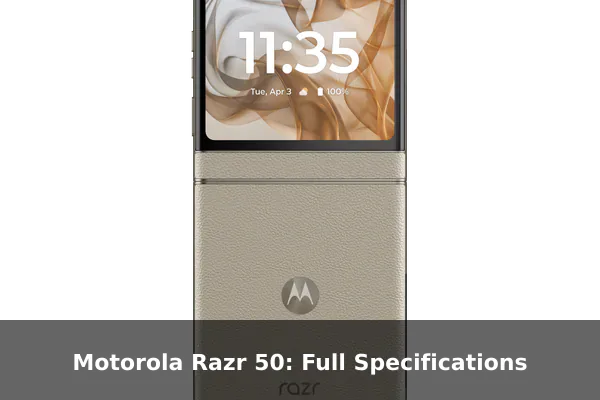
The Motorola Razr 50 brings the brand’s iconic clamshell foldable design to a more accessible price point, offering a compact flip phone experience without the flagship-tier cost. Announced on June 25, 2024, it pairs a large 6.9-inch foldable LTPO AMOLED panel with a useful 3.6-inch external display, all wrapped in a body that comfortably folds in half for pocketable convenience.
Powered by the MediaTek Dimensity 7300X and running Android 14, the Razr 50 targets buyers who want a stylish foldable with reliable everyday performance, decent cameras, and IPX8 water resistance. With launch pricing around £359.97, €493.99, or ₹49,999 depending on region, it positions itself as one of the more attainable foldables in the current market.
Full Specifications
Network
| Technology | GSM / CDMA / HSPA / EVDO / LTE / 5G |
| 2G bands | GSM 900 / 1800 / 1900 |
| CDMA 800 / 1900 | |
| 3G bands | HSDPA 850 / 900 / 1700(AWS) / 1900 / 2100 |
| CDMA2000 1xEV-DO | |
| 4G bands | 1, 2, 3, 4, 5, 7, 8, 12, 13, 17, 18, 19, 20, 25, 26, 28, 32, 38, 39, 40, 41, 42, 43, 66, 71 |
| 5G bands | 1, 2, 3, 5, 7, 8, 20, 26, 28, 38, 40, 41, 66, 71, 77, 78 SA/NSA/Sub6 |
| Speed | HSPA, LTE, 5G |
Launch
| Announced | 2024, June 25 |
| Status | Available. Released 2024, June 25 |
Body
| Dimensions | Unfolded: 171.3 x 74 x 7.3 mm Folded: 88.1 x 74 x 15.9 mm |
| Weight | 188.4 g (6.63 oz) |
| Build | Plastic front (unfolded), glass front (folded, Gorilla Glass Victus), silicone polymer back (eco leather), aluminum frame (6000 series), hinge (stainless steel) |
| SIM | · Nano-SIM + eSIM· Nano-SIM + Nano-SIM |
| IPX8 water resistant (up to 1.5m for 30 min) |
Display
| Type | Foldable LTPO AMOLED, 1B colors, 120Hz, HDR10+, 3000 nits (peak) |
| Size | 6.9 inches, 107.6 cm2 (~84.9% screen-to-body ratio) |
| Resolution | 1080 x 2640 pixels (~413 ppi density) |
| Second external AMOLED, 1B colors, 90Hz, HDR10+, 1700 nits (peak) 3.6 inches, 1056 x 1066 pixels, 413 ppi, Gorilla Glass Victus |
Platform
| OS | Android 14 |
| Chipset | Mediatek Dimensity 7300X (4 nm) |
| CPU | Octa-core (4×2.5 GHz Cortex-A78 & 4×2.0 GHz Cortex-A55) |
| GPU | Mali-G615 MC2 |
Memory
| Card slot | No |
| Internal | 256GB 8GB RAM, 512GB 12GB RAM |
| UFS 2.2 |
Main Camera
| Dual | 50 MP, f/1.7, 25mm (wide), 1/1.95", 0.8µm, dual pixel PDAF, OIS 13 MP, f/2.2, 120˚ (ultrawide), 1/3.0", 1.12µm, AF |
| Features | LED flash, panorama, HDR |
| Video | 4K@30fps, 1080p@30/60fps, gyro-EIS |
Selfie camera
| Single | 32 MP, f/2.4, 25mm (wide), 1/3.14", 0.7µm |
| Features | HDR |
| Video | 4K@30fps, 1080p@30/60fps |
Sound
| Loudspeaker | Yes, with stereo speakers |
| 3.5mm jack | No |
Comms
| WLAN | Wi-Fi 802.11 a/b/g/n/ac/6e, dual-band or tri-band (region dependent) |
| Bluetooth | 5.4, A2DP, LE |
| Positioning | GPS, GLONASS, BDS, GALILEO, QZSS |
| NFC | Yes |
| Radio | No |
| USB | USB Type-C 2.0 |
Features
| Sensors | Fingerprint (side-mounted), gyro, accelerometer, proximity, compass, barometer |
Battery
| Type | 4200 mAh |
| Charging | 30W wired 15W wireless |
Misc
| Colors | Koala Grey (Steel Wool), Beach Sand (Pumice Stone), Spritz Orange (Arabesque) |
| Models | XT2453-1 |
| Price | £ 359.97 / € 493.99 / ₹ 49,999 |
Our Tests
| Performance | AnTuTu: 657381 (v10) GeekBench: 3016 (v5) 3DMark: 856 (Wild Life Extreme) |
| Display | 1289 nits max brightness (measured) |
| Loudspeaker | -23.5 LUFS (Very good) |
| Battery | Active use score 11:46h |
Price and Availability
The Motorola Razr 50 offers a compelling combination of features and performance. While the base price is around €494, the actual cost may vary depending on your location and retailer. Below, you’ll find the approximate price of the Motorola Razr 50 converted into various currencies. Please note that these are estimates based on recent exchange rates as of June 4, 2026 and may not reflect the exact price you’ll find at a retailer.
- United States: $573
- Japan: ¥91,717
- United Kingdom: £427
- Australia: A$803
- Canada: C$796
- Taiwan: NT$18,041
- Denmark: kr3.687
- Saudi Arabia: ﷼2,150
- South Korea: ₩877,029
- Germany: €494
- Brazil: R$2.885
- Vietnam: ₫14.996.743
- Kenya: KSh 74,257
- India: ₹54,871
- Indonesia: Rp 10.306.523
- Nigeria: ₦779,729
- Pakistan: ₨159,865
- Philippines: ₱35,419
- Bangladesh: ৳৭০,৩৮৭
Value Proposition of the Razr 50
The Motorola Razr 50 stands out by lowering the entry barrier for clamshell foldables. While flagship flips often push past £900 or ₹99,999, the Razr 50 keeps things grounded with a launch price that makes the form factor approachable for a wider audience. You still get a proper foldable design, two AMOLED displays, IPX8 protection, and modern connectivity, which is rare combination at this tier. According to Motorola’s official product page, the device is positioned as a lifestyle-focused foldable rather than a spec chasing flagship, and that framing fits the pricing strategy.
Design and Build Quality
Unfolded, the Razr 50 measures 171.3 x 74 x 7.3 mm and folds down to a pocket-friendly 88.1 x 74 x 15.9 mm, weighing 188.4 grams. Motorola uses a silicone polymer eco-leather back combined with a 6000 series aluminum frame and a stainless steel hinge, which gives the phone a tactile, premium feel without resorting to a slippery glass back. The folded face is protected by Gorilla Glass Victus, and IPX8 water resistance rated up to 1.5 meters for 30 minutes adds peace of mind that earlier foldables lacked. The three color options, Koala Grey, Beach Sand, and Spritz Orange, lean into the fashion-forward identity the Razr line has cultivated since its revival.
Display Experience Inside and Out
The internal 6.9-inch foldable LTPO AMOLED runs at 1080 x 2640 with a 120Hz refresh rate and HDR10+ support, claiming a 3000 nits peak. In independent measurements the panel reached around 1289 nits, which is more than sufficient for outdoor use. The external 3.6-inch AMOLED is a standout feature for this price tier, offering 1056 x 1066 resolution, 90Hz refresh, and 1700 nits peak brightness. That cover display is genuinely useful for replying to messages, running widgets, controlling media, or framing selfies with the rear cameras.
Performance and Daily Use
Under the hood sits the MediaTek Dimensity 7300X, a 4nm chipset specifically tuned by MediaTek for foldable form factors as noted on its official product page. The octa-core CPU pairs four Cortex-A78 cores at 2.5 GHz with four efficiency-focused Cortex-A55 cores at 2.0 GHz, while a Mali-G615 MC2 handles graphics. Benchmark results include around 657,381 in AnTuTu v10, 3,016 in GeekBench v5, and 856 in 3DMark Wild Life Extreme. These figures place the Razr 50 firmly in upper mid-range territory, suitable for daily multitasking, social apps, and most popular games at moderate settings, but it is not aimed at peak gaming performance.
Camera Capabilities
The dual rear camera system pairs a 50 MP main sensor with f/1.7 aperture, OIS, and dual pixel PDAF alongside a 13 MP ultrawide with a 120-degree field of view and autofocus, enabling macro shots. Video tops out at 4K at 30fps with gyro-EIS, and 1080p is available at both 30 and 60fps. The 32 MP front camera handles selfies when the phone is unfolded, but the more interesting workflow involves using the cover display as a viewfinder for the higher-quality rear sensors. There is no telephoto lens, so zoom shots rely on cropping from the main sensor.
Battery Life and Charging
A 4200 mAh battery powers the Razr 50, which is generous for a clamshell foldable that has to fit inside a compact folded shell. Active use scores around 11 hours and 46 minutes suggest a full day of mixed use is realistic. Charging support includes 30W wired and 15W wireless, both of which are competitive at this price. Wireless charging in particular is not always guaranteed on mid-range phones, so its inclusion is welcome.
Software and Connectivity
The Razr 50 ships with Android 14 and Motorola’s typically light skin, which keeps the experience close to stock. Buyers should consult Motorola’s official support pages for current software update commitments in their region. Connectivity is well covered: 5G sub-6 SA and NSA, Wi-Fi 6e with optional tri-band, Bluetooth 5.4, NFC, and a broad set of 4G bands make it travel-friendly. USB Type-C is limited to USB 2.0 speeds, and there is no 3.5mm jack or microSD slot, so storage choice between 256GB and 512GB is permanent.
Who Should Buy the Razr 50
This phone makes the most sense for buyers who prioritize the foldable form factor, a stylish design, and an interactive cover display over raw performance or telephoto zoom. It is a strong pick for users upgrading from a regular slab phone who want something distinctive, social-focused content creators who will use the external screen for selfies, and anyone who has long admired flip foldables but balked at flagship pricing. Heavy mobile gamers or photography enthusiasts wanting periscope zoom should look elsewhere in the lineup.
Conclusion
The Motorola Razr 50 is one of the more sensible clamshell foldables on the market, delivering a polished design, useful dual-AMOLED setup, IPX8 protection, and reliable Dimensity 7300X performance at a price that undercuts most flagship flips. It is not the device for chasing benchmark records or zoom photography, but for shoppers who want a fashionable, pocketable foldable that handles everyday tasks comfortably, it is an easy recommendation within its segment.
Official references
- Motorola UK official Motorola Razr 50 product page – Official English product page for Motorola Razr 50 features, display, processor, battery, charging, and product positioning.
- Motorola India official Motorola Razr 50 specifications page – Official Motorola page with detailed specs including OS, processor, RAM, storage, displays, dimensions, cameras, ports, and battery; useful for checking market-specific variants.
- Motorola Support – motorola razr 50 product support – Official support hub for the device, including user guide and hardware/help references that can verify operational details and supported features.
- Motorola Support – motorola razr 50 SAR – Official Motorola SAR and radio-frequency exposure reference for compliance and safety details.
- MediaTek Dimensity 7300X official product page – Primary chipset manufacturer reference for the Dimensity 7300X platform used in the Motorola Razr 50.
