
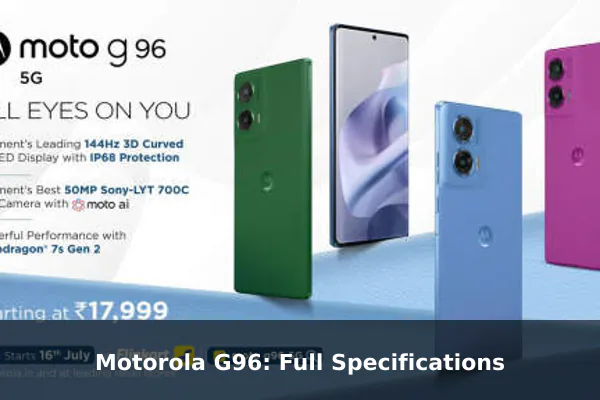
The Motorola G96 is positioned as a practical 5G mid-range phone for buyers who care about display quality, water resistance, battery life, and clean Android software more than headline-chasing extras.
Its key appeal is balance: a 144Hz pOLED screen, Snapdragon 7s Gen 2 chipset, IP68 protection, stereo speakers, a 50MP OIS main camera, and a large 5500mAh battery in a slim 7.9mm body.
Full Specifications
Network
| Technology: | GSM / HSPA / LTE / 5G |
| 2G bands: | GSM 850 / 900 / 1800 / 1900 |
| 3G bands: | HSDPA 850 / 900 / 1900 / 2100 |
| 4G bands: | 1, 2, 3, 5, 7, 8, 18, 19, 20, 26, 28, 32, 38, 40, 41, 42 |
| 5G bands: | 1, 3, 5, 7, 8, 20, 26, 28, 38, 40, 41, 77, 78 SA/NSA |
| Speed: | HSPA, LTE, 5G |
Launch
| Announced: | 2025, July 09 |
| Status: | Available. Released 2025, July 16 |
Body
| Dimensions: | 161.9 x 73.3 x 7.9 mm (6.37 x 2.89 x 0.31 in) |
| Weight: | 178 g (6.28 oz) |
| Build: | Glass front (Gorilla Glass 5), silicone polymer back (eco leather), plastic frame |
| SIM: | Nano-SIM + Nano-SIM |
| IP68 dust tight and water resistant (immersible up to 1.5m for 30 min) |
Display
| Type: | P-OLED, 1B colors, 144Hz, 1600 nits (peak) |
| Size: | 6.67 inches, 107.4 cm2 (~90.5% screen-to-body ratio) |
| Resolution: | 1080 x 2400 pixels, 20:9 ratio (~395 ppi density) |
| Protection: | Corning Gorilla Glass 5 |
Platform
| OS: | Android 15, up to 1 major Android upgrade |
| Chipset: | Qualcomm SM7435-AB Snapdragon 7s Gen 2 (4 nm) |
| CPU: | Octa-core (4×2.40 GHz Cortex-A78 & 4×1.95 GHz Cortex-A55) |
| GPU: | Adreno 710 |
Memory
| Card slot: | No |
| Internal: | 128GB 8GB RAM, 256GB 8GB RAM |
| UFS 2.2 |
Main Camera
| Dual: | 50 MP, f/1.9, (wide), 1/1.56″, 1.0µm, multi-directional PDAF, OIS 8 MP, f/2.2, 119˚ (ultrawide), 1/4.0″, 1.12µm, AF |
| Features: | LED flash, HDR, panorama |
| Video: | 4K@30fps, 1080p@30/60/120fps, gyro-EIS, OIS |
Selfie camera
| Single: | 32 MP, f/2.2, (wide), 1/3.14″, 0.7µm |
| Features: | HDR |
| Video: | 4K@30fps, 1080p@30fps, gyro-EIS |
Sound
| Loudspeaker: | Yes, with stereo speakers (with Dolby Atmos) |
| 3.5mm jack: | No |
| 24-bit/192kHz Hi-Res audio |
Comms
| WLAN: | Wi-Fi 802.11 a/b/g/n/ac, dual-band |
| Bluetooth: | 5.2, A2DP, LE |
| Positioning: | GPS, GALILEO, GLONASS, BDS, QZSS |
| NFC: | No |
| Radio: | No |
| USB: | USB Type-C 2.0, OTG |
Features
| Sensors: | Fingerprint (under display, optical), accelerometer, gyro, proximity, compass |
| Smart Connect 2.0 |
Battery
| Type: | 5500 mAh |
| Charging: | 30W wired |
Misc
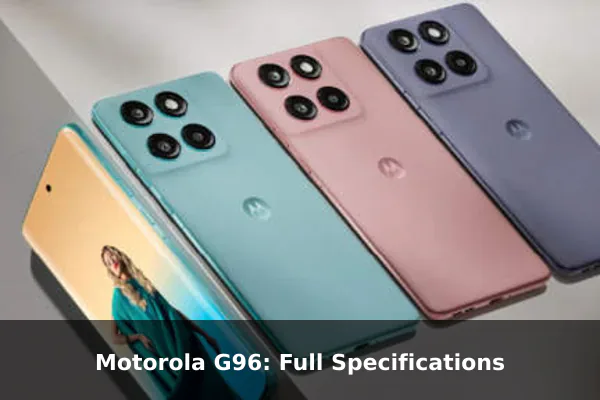
| Colors: | Pantone (Greener Pastures, Cattleya Orchid, Dresden Blue, Ashleigh Blue) |
| Price: | ₹ 18,309 |
Price and Availability
The Motorola G96 offers a compelling combination of features and performance. While the base price is around ₹18,309, the actual cost may vary depending on your location and retailer. Below, you’ll find the approximate price of the Motorola G96 converted into various currencies. Please note that these are estimates based on recent exchange rates as of September 20, 2026 and may not reflect the exact price you’ll find at a retailer.
- United States: $191
- Japan: ¥30,057
- United Kingdom: £143
- Australia: A$268
- Canada: C$267
- Taiwan: NT$6,073
- Denmark: kr1.245
- Saudi Arabia: ﷼716
- South Korea: ₩264,663
- Germany: €166
- Brazil: R$980
- Vietnam: ₫4.940.753
- Kenya: KSh 24,726
- India: ₹18,309
- Indonesia: Rp 3.389.424
- Nigeria: ₦260,037
- Pakistan: ₨52,961
- Philippines: ₱11,989
- Bangladesh: ৳২৩,৪৫৯
Value Positioning
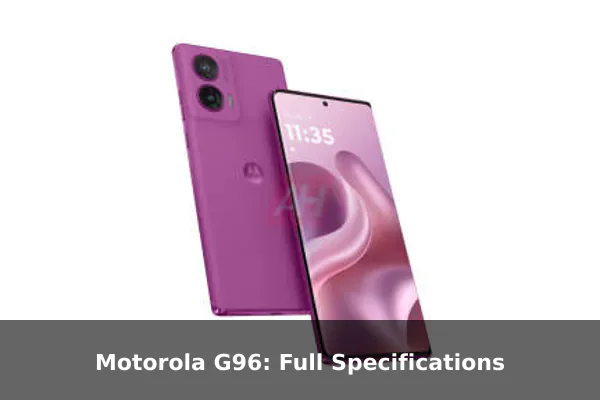
The Motorola G96 sits in the busy mid-range segment, but its value story is not built around one oversized number. Instead, it combines several features that are still not guaranteed at this level: an IP68 rating, a high-refresh pOLED display, optical image stabilization on the main camera, stereo speakers with Dolby Atmos, and 5G band coverage for both SA and NSA networks. Based on the supplied source price of ₹ 18,309, it targets buyers who want a polished daily phone without stepping into upper mid-range pricing.
The strongest value angle is that Motorola has not treated durability and screen quality as optional extras. Many affordable 5G phones focus on chipset and battery first, then compromise on display protection, water resistance, or camera stabilization. The G96 looks more rounded than that, though buyers should still note the missing microSD card slot, missing 3.5mm headphone jack, and lack of NFC.
Design and Build
The Motorola G96 measures 161.9 x 73.3 x 7.9 mm and weighs 178 g, which is light for a phone with a 5500mAh battery. The slim profile makes it more pocket-friendly than many endurance-focused phones, while the silicone polymer eco-leather back gives it a softer grip than plain glossy plastic. The plastic frame is expected at this class, but Gorilla Glass 5 on the front adds useful scratch and drop resistance.
The IP68 rating is a major practical advantage. It means the phone is dust tight and rated for immersion in up to 1.5m of water for 30 minutes under test conditions. This does not make the phone invincible, but it does give useful peace of mind for rain, splashes, and everyday accidents. The Pantone color options also help the G96 stand apart visually, with Greener Pastures, Cattleya Orchid, Dresden Blue, and Ashleigh Blue giving the phone a softer lifestyle-oriented identity.
Display Experience
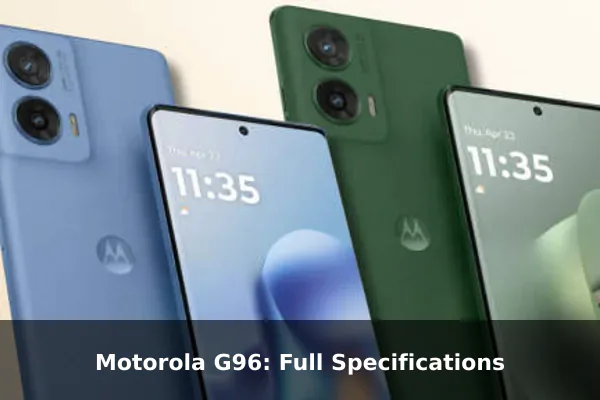
The 6.67-inch P-OLED panel is one of the clearest reasons to consider the Motorola G96. It supports 1 billion colors, a 144Hz refresh rate, and a 1600-nit peak brightness rating. The 1080 x 2400 resolution gives it about 395 ppi, which is sharp enough for streaming, reading, social media, and gaming without pushing battery demand as hard as a higher-resolution panel.
For comparison-minded buyers, the 144Hz refresh rate gives the phone a smoother ceiling than the 120Hz displays often found in this segment. That does not mean every app or game will always run at 144fps, but it helps the interface feel fluid when supported. Gorilla Glass 5 protection is also welcome, especially because curved or near-edge displays can be expensive to repair.
Performance and Storage
The Snapdragon 7s Gen 2 is a 4nm chipset with four Cortex-A78 performance cores and four Cortex-A55 efficiency cores, paired with the Adreno 710 GPU. This is a sensible platform for a mid-range Android phone: strong enough for daily multitasking, camera processing, streaming, and popular games at reasonable settings, while still being efficient enough to support good battery life.
Motorola lists the G96 with 8GB RAM and either 128GB or 256GB of internal storage. Storage uses UFS 2.2, which is a practical improvement over older eMMC storage for app loading and file handling. The trade-off is that there is no card slot, so the 256GB version is the safer pick for users who keep many offline videos, large games, or years of photos on-device.
Camera Setup
The rear camera system is straightforward: a 50MP wide camera with a large 1/1.56-inch sensor, multi-directional PDAF, and OIS, plus an 8MP ultrawide camera with autofocus and a 119-degree field of view. This is a better combination than phones that add low-value depth or macro sensors just to increase the camera count.
The main camera should be the dependable everyday shooter, especially because OIS helps reduce blur in lower light and steadies video capture. The ultrawide camera is useful for landscapes, interiors, and group shots, and autofocus gives it more flexibility than fixed-focus ultrawides. Video support is also strong for the class, with 4K at 30fps and 1080p recording up to 120fps on the rear camera. The 32MP front camera supports 4K at 30fps too, which is helpful for creators, video notes, and sharper selfie footage.
Battery and Charging
The 5500mAh battery is one of the Motorola G96’s biggest strengths. Combined with a 4nm chipset and Full HD+ OLED display, it should suit users who want a phone that can comfortably handle long days of messaging, navigation, streaming, photography, and hotspot use. Actual endurance will still depend on brightness, 5G signal strength, gaming, and refresh-rate behavior.
The supplied spec data lists 30W wired charging. That is serviceable rather than class-leading, especially when some rivals advertise faster charging speeds. The upside is that the larger battery may reduce the need for frequent top-ups. Buyers who prioritize the fastest possible charging may want to compare alternatives, while buyers who care more about all-day reliability should find the capacity reassuring.
Software and Everyday Features
The Motorola G96 ships with Android 15 and is listed with up to one major Android upgrade. Motorola’s own support information also points to an ongoing security-update cycle for the model, which is important for buyers planning to keep the phone for several years. The software promise is not the longest in the Android market, but Motorola’s lighter interface remains a plus for users who prefer a cleaner feel.
Smart Connect 2.0 adds extra ecosystem value, especially for people who use their phone alongside a PC, tablet, or external display workflow. The under-display optical fingerprint sensor keeps the front design clean, while the sensor list covers the expected basics: accelerometer, gyroscope, proximity sensor, and compass.
Connectivity and Audio
Network support is broad, with GSM, HSPA, LTE, and 5G connectivity, including SA and NSA 5G bands. The listed 5G bands include n1, n3, n5, n7, n8, n20, n26, n28, n38, n40, n41, n77, and n78, making the phone better equipped for travel and carrier compatibility than models with narrower band support.
Wireless connectivity includes dual-band Wi-Fi 802.11 a/b/g/n/ac, Bluetooth 5.2, and satellite positioning through GPS, GALILEO, GLONASS, BDS, and QZSS. The omissions are clear: there is no NFC and no FM radio. Audio is more encouraging, with stereo speakers, Dolby Atmos support, and 24-bit/192kHz Hi-Res audio, though wired headphone users will need USB-C audio or an adapter because there is no 3.5mm jack.
Who Should Buy It
The Motorola G96 is best for buyers who want a slim 5G Android phone with a premium-feeling display, dependable battery life, proper water resistance, and a camera setup that favors useful hardware over filler lenses. It is especially appealing for students, commuters, casual gamers, and streaming-heavy users who want a balanced phone rather than a specialist gaming or camera device.
It is less ideal for users who need expandable storage, NFC payments, a headphone jack, or multiple years of major Android version upgrades. The 128GB model will be enough for lighter users, but the 256GB model is the smarter long-term option because storage cannot be expanded later.
References
Reference sources used for verification and context include the official Motorola India specifications page for the moto g96 5G, the official Motorola product support page, and Gadgets 360 device coverage for market context.
Conclusion
The Motorola G96 is a well-balanced mid-range 5G phone with a bright 144Hz OLED display, IP68 protection, clean Android software, a stabilized 50MP camera, and a large battery. If you can live without NFC, expandable storage, and a headphone jack, it is easy to recommend as a practical everyday Android phone.
