
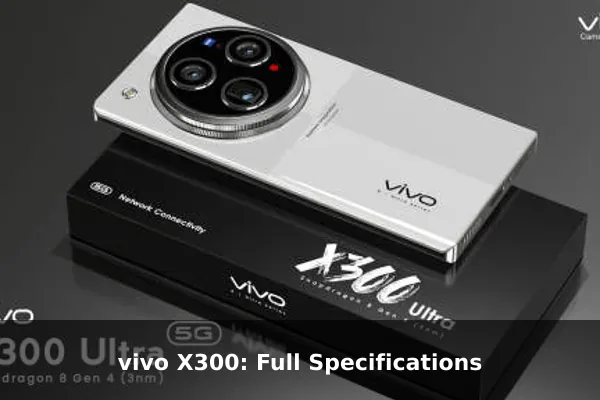
The vivo X300 is a compact flagship built around a 6.31-inch LTPO AMOLED display, a MediaTek Dimensity 9500 chipset, and a triple rear camera system led by a 200 MP ZEISS-branded main camera. It sits in the premium Android segment, but its smaller footprint gives it a different appeal from the oversized flagship phones that dominate this price class.
Based on the supplied specification data and official vivo source anchors, the X300 is best understood as a high-end camera phone for users who want strong performance, long battery life, and serious imaging tools without moving to a tablet-sized body. The separate Full Specifications table should be used for every raw band, dimension, and variant detail.
Full Specifications
Network
| Technology: | GSM / HSPA / LTE / 5G |
| 2G bands: | GSM 850 / 900 / 1800 / 1900 |
| 3G bands: | HSDPA 850 / 900 / 1700(AWS) / 1900 / 2100 – International |
| HSDPA 850 / 900 / 2100 – Malaysia, India | |
| HSDPA 800 / 850 / 900 / 1700(AWS) / 1900 / 2100 – China | |
| 4G bands: | 1, 2, 3, 4, 5, 7, 8, 18, 19, 20, 25, 26, 28, 34, 38, 39, 40, 41, 42, 43, 48, 66 |
| 5G bands: | 1, 2, 3, 5, 7, 8, 18, 20, 25, 26, 28, 34, 38, 39, 40, 41, 48, 66, 77, 78 SA/NSA/Sub6 |
| Speed: | HSPA, LTE, 5G |
Launch
| Announced: | 2025, October 13 |
| Status: | Available. Released 2025, October 17 |
Body
| Dimensions: | 150.6 x 71.9 x 8 mm (5.93 x 2.83 x 0.31 in) |
| Weight: | 190 g (6.70 oz) |
| Build: | Glass front, aluminum alloy frame, glass back |
| SIM: | · Nano-SIM + Nano-SIM + eSIM (max 2 at a time) – International· Nano-SIM + Nano-SIM – China |
| IP68/IP69 dust tight and water resistant (high pressure water jets; immersible up to 1.5m for 30 min) |
Display
| Type: | LTPO AMOLED, 1B colors, 120Hz, 2160Hz PWM, HDR10+, HDR Vivid, 4500 nits (peak) |
| Size: | 6.31 inches, 98.0 cm2 (~90.5% screen-to-body ratio) |
| Resolution: | 1216 x 2640 pixels, 19.5:9 ratio (~460 ppi density) |
| Protection: | Reinforced Glass, Mohs level 4 |
| Ultra HDR image support |
Platform
| OS: | Android 16, up to 5 major Android upgrades, OriginOS 6 |
| Chipset: | Mediatek Dimensity 9500 (3 nm) |
| CPU: | Octa-core (1×4.21 GHz C1-Ultra & 3×3.5 GHz C1-Premium & 4×2.7 GHz C1-Pro) |
| GPU: | Arm G1-Ultra |
Memory
| Card slot: | No |
| Internal: | 256GB 12GB RAM, 256GB 16GB RAM, 512GB 12GB RAM, 512GB 16GB RAM, 1TB 16GB RAM |
| UFS 4.1 |
Main Camera
| Triple: | 200 MP, f/1.7, 23mm (wide), 1/1.4″, 0.56µm, PDAF, OIS 50 MP, f/2.6, 70mm (periscope telephoto), 1/1.95″, PDAF, OIS, 3x optical zoom 50 MP, f/2.0, 15mm, 119˚ (ultrawide), 1/2.76″, 0.64µm, AF |
| Features: | Laser AF, Zeiss optics, Zeiss T* lens coating, LED flash, panorama, HDR, 3D LUT import |
| Video: | 4K@30/60/120fps, 1080p@30/60/120/240fps, gyro-EIS, 4K@120fps HDR |
Selfie camera
| Single: | 50 MP, f/2.0, 20mm (wide), 1/2.76″, 0.64µm, AF |
| Features: | HDR |
| Video: | 4K@30/60fps, 1080p@30/60fps |
Sound
| Loudspeaker: | Yes, with stereo speakers |
| 3.5mm jack: | No |
Comms
| WLAN: | Wi-Fi 802.11 a/b/g/n/ac/6/7, dual-band |
| Bluetooth: | 5.4, A2DP, LE, aptX HD, LHDC 5 |
| Positioning: | GPS (L1+L5), GLONASS (L1), BDS (B1I+B1c+B2a+B2b), GALILEO (E1+E5a+E5b), QZSS (L1+L5), NavIC (L5) |
| NFC: | Yes |
| Infrared port: | Yes |
| Radio: | No |
| USB: | USB Type-C 3.2, OTG |
Features
| Sensors: | Fingerprint (under display, ultrasonic), accelerometer, gyro, proximity, compass |
Battery
| Type: | · Si/C Li-Ion 6040 mAh (Global)· Si/C Li-Ion 5360 mAh (EU markets) |
| Charging: | 90W wired 40W wireless Reverse wired |
Misc
| Colors: | Phantom Black, Mist Blue, Summit Red, Iris Purple, Halo Pink |
| Models: | V2515, V2509A |
| Price: | € 949.35 / ₹ 75,999 |
Our Tests
| Performance: | AnTuTu: 2346352 (v10), 3416530 (v11) GeekBench: 9843 (v6) 3DMark: 7510 (Wild Life Extreme) |
| Display: | 1930 nits max brightness (measured) |
| Loudspeaker: | -24.8 LUFS (Very good) |
| Battery: | Active use score 17:31h |
EU LABEL
| Energy: | Class A |
| Battery: | 52:15h endurance, 1200 cycles |
| Free fall: | Class B (180 falls) |
| Repairability: | Class C |
Price and Availability
The vivo X300 offers a compelling combination of features and performance. While the base price is around €949, the actual cost may vary depending on your location and retailer. Below, you’ll find the approximate price of the vivo X300 converted into various currencies. Please note that these are estimates based on recent exchange rates as of August 25, 2026 and may not reflect the exact price you’ll find at a retailer.
- United States: $1,107
- Japan: ¥176,238
- United Kingdom: £812
- Australia: A$1,548
- Canada: C$1,533
- Taiwan: NT$35,251
- Denmark: kr7.097
- Saudi Arabia: ﷼4,153
- South Korea: ₩1,531,995
- Germany: €949
- Brazil: R$5.704
- Vietnam: ₫28.745.184
- Kenya: KSh 143,380
- India: ₹1,06,028
- Indonesia: Rp 19.625.405
- Nigeria: ₦1,501,394
- Pakistan: ₨307,763
- Philippines: ₱68,335
- Bangladesh: ৳১,৩৫,৮৭৯
Why Should You Buy the vivo X300?
The strongest reason to consider the vivo X300 is its mix of flagship hardware and compact handling. A 150.6 mm-tall body, 190 g weight, aluminum alloy frame, glass back, and IP68/IP69 rating make it feel more practical than many large premium phones while still keeping the durability and finish expected at this level. The phone is not positioned as a budget value model; it is a compact premium device for buyers who care about cameras, display quality, battery endurance, and fast storage.
The raw price data places it in a serious flagship bracket, so the value argument depends on priorities. If you want the largest possible screen or a gaming phone aesthetic, this is not the obvious choice. If you want a smaller Android flagship with a 200 MP main camera, a periscope telephoto camera, high measured brightness, and 90W wired charging, the X300 has a clearer identity.
Design and Durability
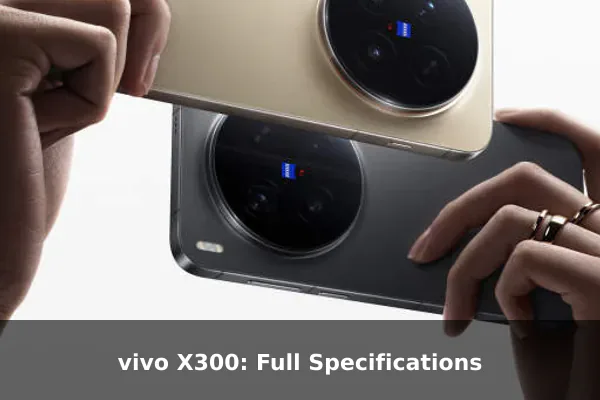
The X300’s design stands out because it avoids the usual tradeoff where compact phones feel like downgraded models. The glass front and back, aluminum alloy frame, and slim 8 mm profile support a premium feel, while the 190 g weight is reasonable for a phone with this camera hardware and battery capacity. Color options such as Phantom Black, Mist Blue, Summit Red, Iris Purple, and Halo Pink also make the lineup broader than the typical black-and-silver flagship palette.
The IP68/IP69 rating is important for users who keep a phone for several years. It indicates dust-tight construction and water resistance that includes immersion and high-pressure water jets under controlled test conditions. That does not make water damage impossible, but it does raise confidence for travel, outdoor use, and daily accidents. The ultrasonic under-display fingerprint sensor is another premium touch, usually offering more reliable unlocking than basic optical readers.
Display Experience
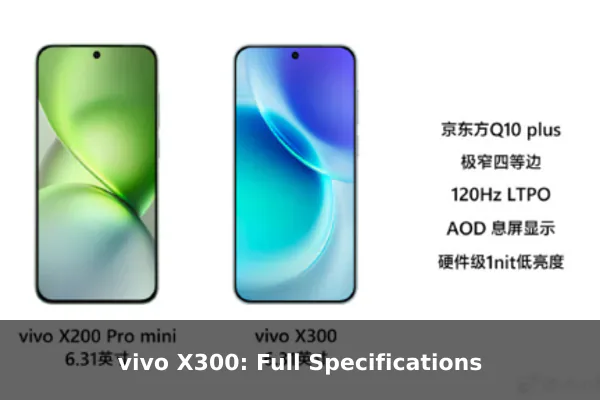
The 6.31-inch LTPO AMOLED screen is one of the X300’s defining features. It combines a sharp 1216 x 2640 resolution with an adaptive 120Hz refresh rate, HDR10+, HDR Vivid, 1 billion colors, and a high quoted peak brightness. The measured 1930 nits maximum brightness from the test data is especially useful because it suggests the phone should remain readable outdoors instead of relying only on marketing peak numbers.
This display also includes 2160Hz PWM dimming and Ultra HDR image support, which makes it more attractive for users who read at night, review photos, or watch HDR content. The 19.5:9 aspect ratio and roughly 90.5 percent screen-to-body ratio help the phone feel immersive without making the body too wide. It is a good fit for people who want a premium screen but do not want a 6.7-inch or larger phone.
Performance and Storage
The MediaTek Dimensity 9500 is the performance engine here, built on a 3 nm process and paired with UFS 4.1 storage. The supplied test results are flagship-grade: AnTuTu scores above two million in v10 and above three million in v11, GeekBench 6 at 9843, and a 3DMark Wild Life Extreme score of 7510. These figures point to a phone built for heavy multitasking, demanding games, high-resolution video capture, and long-term software use.
Memory options run from 256GB with 12GB RAM up to 1TB with 16GB RAM, but there is no card slot. That makes the storage decision more important at purchase time. For most users, 512GB is the safer long-term tier if the phone will be used for 4K video, RAW-style photo workflows, offline media, and large apps. The 1TB variant is more specialized, but it makes sense for creators who shoot frequently and dislike cloud cleanup.
Camera System
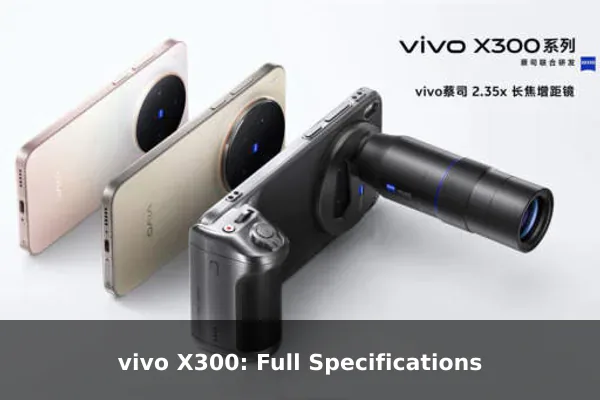
The camera setup is the headline feature: a 200 MP wide camera with OIS, a 50 MP periscope telephoto camera with 3x optical zoom and OIS, and a 50 MP ultrawide camera with autofocus. That combination is more flexible than a simple wide-ultrawide-macro layout, especially because the telephoto lens gives the phone real portrait and travel-photo reach. ZEISS optics, ZEISS T* lens coating, Laser AF, HDR, panorama, and 3D LUT import show that vivo is aiming at users who edit, grade, and share images seriously.
Video support is also strong, with 4K recording up to 120fps and HDR at 4K/120fps according to the supplied data. The front camera is not an afterthought either: a 50 MP autofocus unit with 4K recording at 30/60fps. That makes the X300 useful for vlog clips, video calls, social content, and front-facing portraits where fixed-focus selfie cameras often struggle.
Battery and Charging
Battery capacity depends on region, and this is one of the most important details for buyers to notice. The supplied data lists a 6040 mAh silicon-carbon Li-Ion battery for global markets and a 5360 mAh battery for EU markets. That regional split can affect endurance, so buyers should check the local retail model instead of assuming every X300 has the same cell size.
Even with that caution, the test result is strong: a 17:31h active use score. The EU label data also lists Class A energy rating, 52:15h endurance, 1200 battery cycles, Class B free-fall rating, and Class C repairability. Charging is competitive at 90W wired, 40W wireless, plus reverse wired support. For a compact flagship, this battery and charging package is one of the X300’s most persuasive advantages.
Software and Updates
The X300 ships with Android 16 and OriginOS 6, with up to five major Android upgrades listed in the supplied data. That upgrade promise matters because premium phones are now judged not only by launch hardware, but by how long they remain secure, compatible, and feature-current. A buyer paying flagship money should expect multi-year support, and this specification helps the X300 look more durable as a purchase.
OriginOS will appeal most to users who like a feature-rich Android skin with many customization options. Users who prefer very plain Android should consider the software style before buying, because the hardware package is only one part of daily satisfaction. Still, the combination of new Android version, flagship chipset, fast storage, and long update support gives the phone a strong long-term base.
Connectivity and Everyday Features
The X300 covers modern flagship connectivity well, including 5G, Wi-Fi 7, NFC, an infrared port, USB Type-C 3.2 with OTG, extensive satellite positioning support, and stereo speakers. The international SIM setup supports Nano-SIM plus Nano-SIM plus eSIM with a maximum of two active at a time, while the China model uses dual Nano-SIM. That distinction is worth checking before importing.
There is no 3.5 mm headphone jack and no radio, which is normal for this segment but still relevant for wired-audio users. The loudspeaker test result of -24.8 LUFS is rated very good in the supplied data, so speaker output should be a strength for video, calls, and casual music playback. With USB 3.2, the phone is also better suited to cable transfers than models limited to older USB speeds.
Who Should Buy the vivo X300?
The vivo X300 is best for buyers who want a smaller flagship Android phone without giving up camera ambition. It suits travel shooters, portrait fans, mobile video creators, and users who want a bright premium display in a body that is easier to hold than larger Ultra-style phones. The 200 MP main camera, periscope telephoto lens, 50 MP autofocus selfie camera, and strong video modes give it a creative angle that goes beyond simple spec chasing.
It is less suitable for buyers who want expandable storage, a headphone jack, the biggest screen available, or the lowest possible flagship price. It also requires attention to regional battery capacity and SIM support. If those details match your market and use case, the X300 is one of vivo’s more focused premium phones: compact, camera-heavy, and built around high-end daily performance.
Conclusion
The vivo X300 is a compact flagship with a rare mix of high-end imaging hardware, strong measured battery life, a bright LTPO AMOLED display, fast Dimensity 9500 performance, and premium durability. Check the local battery version and storage variant before buying, but for users who want a smaller Android flagship with serious cameras, the vivo X300 is easy to recommend.
References
- vivo Global X300 Specifications – Primary source for global vivo X300 specifications including dimensions, display, chipset, battery, cameras, network bands, OS, and regional battery notes.
- vivo Global X300 Product Page – Official product overview for key marketed features such as ZEISS cameras, Dimensity 9500, display, battery, charging, and IP ratings.
- vivo China X300 Specifications – Primary China-market specification page with detailed model V2509A data, storage variants, pricing, network bands, and network access license details.
- MediaTek Dimensity 9500 Official Product Page – Official chipset reference for verifying Dimensity 9500 CPU, GPU, connectivity, memory, storage, camera, and AI platform capabilities.
- GSMArena vivo X300 5G Specifications – Established independent phone-spec reference useful for cross-checking release status, variants, network bands, and hardware specifications against official sources.
