
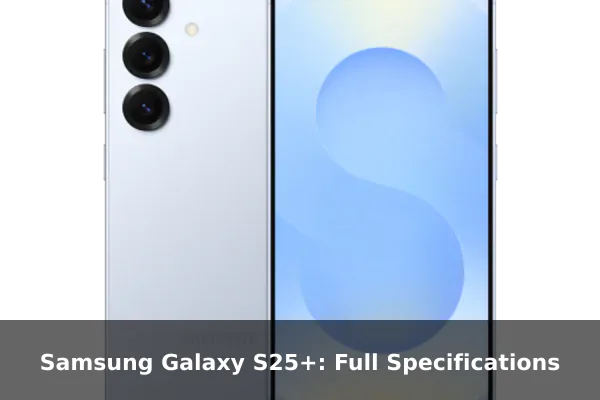
The Samsung Galaxy S25+ is the middle member of Samsung’s 2025 flagship lineup, positioned between the compact Galaxy S25 and the camera-heavy Galaxy S25 Ultra. Its appeal is straightforward: a large high-resolution display, flagship Snapdragon hardware, long software support, and a lighter, simpler design than the Ultra model.
This article looks at the Galaxy S25+ from a practical specs-first angle, focusing on where its hardware matters in daily use. The dedicated specifications table will cover every raw detail separately, so the analysis below concentrates on value, trade-offs, and who this phone fits best.
Full Specifications
Network
| Technology: | GSM / CDMA / HSPA / EVDO / LTE / 5G |
| 2G bands: | GSM 850 / 900 / 1800 / 1900 |
| CDMA 800 / 1900 & TD-SCDMA | |
| 3G bands: | HSDPA 850 / 900 / 1700(AWS) / 1900 / 2100 |
| CDMA2000 1xEV-DO | |
| 4G bands: | 1, 2, 3, 4, 5, 7, 8, 12, 13, 17, 18, 19, 20, 25, 26, 28, 32, 38, 39, 40, 41, 66 – International |
| 1, 2, 3, 4, 5, 7, 8, 12, 13, 14, 18, 19, 20, 25, 26, 28, 29, 30, 38, 39, 40, 41, 48, 66, 71 – USA unlocked | |
| 5G bands: | 1, 2, 3, 5, 7, 8, 12, 20, 25, 26, 28, 38, 40, 41, 66, 75, 77, 78 SA/NSA/Sub6 – International |
| 1, 2, 5, 7, 25, 28, 41, 66, 71, 77, 78, 257, 258, 260, 261 SA/NSA/Sub6/mmWave – USA unlocked | |
| Speed: | HSPA, LTE (up to 7CA), 5G |
Launch
| Announced: | 2025, January 22 |
| Status: | Available. Released 2025, February 03 |
Body
| Dimensions: | 158.4 x 75.8 x 7.3 mm (6.24 x 2.98 x 0.29 in) |
| Weight: | 190 g (6.70 oz) |
| Build: | Glass front (Gorilla Glass Victus 2), glass back (Gorilla Glass Victus 2), aluminum frame |
| SIM: | Nano-SIM + Nano-SIM + eSIM + eSIM (max 2 at a time) – INT Nano-SIM + eSIM + eSIM (max 2 at a time) – USA Nano-SIM + Nano-SIM – CN |
| IP68 dust tight and water resistant (immersible up to 1.5m for 30 min) Armor aluminum 2 frame |
Display
| Type: | Dynamic LTPO AMOLED 2X, 120Hz, 480Hz PWM, HDR10+, 2600 nits (peak) |
| Size: | 6.7 inches, 110.2 cm2 (~91.8% screen-to-body ratio) |
| Resolution: | 1440 x 3120 pixels, 19.5:9 ratio (~513 ppi density) |
| Protection: | Corning Gorilla Glass Victus 2, Mohs level 5 |
Platform
| OS: | Android 15, up to 7 major Android upgrades, One UI 7 |
| Chipset: | Qualcomm SM8750-AC Snapdragon 8 Elite (3 nm) |
| CPU: | Octa-core (2×4.47 GHz Oryon V2 Phoenix L + 6×3.53 GHz Oryon V2 Phoenix M) |
| GPU: | Adreno 830 (1200 MHz) |
Memory
| Card slot: | No |
| Internal: | 256GB 12GB RAM, 512GB 12GB RAM |
| UFS 4.0 |
Main Camera
| Triple: | 50 MP, f/1.8, 24mm (wide), 1/1.56″, 1.0µm, dual pixel PDAF, OIS 10 MP, f/2.4, 67mm (telephoto), 1/3.94″, 1.0µm, PDAF, OIS, 3x optical zoom 12 MP, f/2.2, 13mm, 120˚ (ultrawide), 1/2.55″ 1.4µm, Super Steady video |
| Features: | Best Face, LED flash, auto-HDR, panorama |
| Video: | 8K@24/30fps, 4K@30/60fps, 1080p@30/60/120/240fps, 10-bit HDR, HDR10+, stereo sound rec., gyro-EIS |
Selfie camera
| Single: | 12 MP, f/2.2, 26mm (wide), 1/3.2″, 1.12µm, dual pixel PDAF |
| Features: | HDR, HDR10+ |
| Video: | 4K@30/60fps, 1080p@30fps |
Sound
| Loudspeaker: | Yes, with stereo speakers |
| 3.5mm jack: | No |
| 32-bit/384kHz audio Tuned by AKG |
Comms
| WLAN: | Wi-Fi 802.11 a/b/g/n/ac/6e/7, tri-band, Wi-Fi Direct |
| Bluetooth: | 5.4, A2DP, LE |
| Positioning: | GPS, GLONASS, BDS, GALILEO, QZSS |
| NFC: | Yes |
| Radio: | No |
| USB: | USB Type-C 3.2, DisplayPort 1.2, OTG |
Features
| Sensors: | Fingerprint (under display, ultrasonic), accelerometer, gyro, proximity, compass, barometer |
| Samsung DeX, Samsung Wireless DeX (desktop experience support) Ultra Wideband (UWB) support Circle to Search |
Battery
| Type: | Li-Ion 4900 mAh |
| Charging: | 45W wired, PD3.0, 65% in 30 min 15W wireless (Qi2 Ready) 4.5W reverse wireless |
Misc
| Colors: | Icy Blue, Mint, Navy, Silver Shadow, Pink Gold, Coral Red, Blue Black |
| Models: | SM-S936B, SM-S936B/DS, SM-S936U, SM-S936U1, SM-S936W, SM-S936N, SM-S9360, SM-S936E, SM-S936E/DS |
| SAR: | 1.16 W/kg (head) 0.81 W/kg (body) |
| SAR EU: | 1.26 W/kg (head) 1.26 W/kg (body) |
| Price: | € 750.00 / $ 600.00 / £ 790.00 / ₹ 104,999 |
Our Tests
| Performance: | AnTuTu: 2133477 (v10) GeekBench: 9669 (v6) 3DMark: 6601 (Wild Life Extreme) |
| Display: | 1449 nits max brightness (measured) |
| Loudspeaker: | -25.1 LUFS (Very good) |
| Battery: | Active use score 14:26h |
EU LABEL
| Energy: | Class B |
| Battery: | 43:38h endurance, 2000 cycles |
| Free fall: | Class A (270 falls) |
| Repairability: | Class C |
Price and Availability
The Samsung Galaxy S25+ offers a compelling combination of features and performance. While the base price is around €750, the actual cost may vary depending on your location and retailer. Below, you’ll find the approximate price of the Samsung Galaxy S25+ converted into various currencies. Please note that these are estimates based on recent exchange rates as of August 9, 2026 and may not reflect the exact price you’ll find at a retailer.
- United States: $866
- Japan: ¥136,799
- United Kingdom: £643
- Australia: A$1,228
- Canada: C$1,209
- Taiwan: NT$27,957
- Denmark: kr5.596
- Saudi Arabia: ﷼3,248
- South Korea: ₩1,225,144
- Germany: €750
- Brazil: R$4.418
- Vietnam: ₫22.551.205
- Kenya: KSh 112,128
- India: ₹82,459
- Indonesia: Rp 15.476.406
- Nigeria: ₦1,180,151
- Pakistan: ₨240,634
- Philippines: ₱52,663
- Bangladesh: ৳১,০৭,২৮৭
Value Position
The Galaxy S25+ is best understood as Samsung’s big-screen flagship for buyers who do not need the Ultra’s S Pen, heavier body, or more advanced zoom camera system. It keeps the premium essentials: a 6.7-inch QHD-class Dynamic LTPO AMOLED 2X display, Snapdragon 8 Elite power, 12GB of RAM, UFS 4.0 storage, IP68 protection, and a 4900 mAh battery. That combination makes it more than a stretched version of the standard S25, especially for users who care about screen sharpness, battery capacity, and desktop-style productivity features.
At the listed source pricing, the phone competes aggressively for a current-generation Samsung flagship, although real market pricing can vary by region, storage tier, carrier, and promotion. The main value question is whether you prefer balanced flagship hardware over specialist features. If you want a top Samsung experience without stepping up to the Ultra, the S25+ is the most logical model in the series.
Design and Durability
The design follows Samsung’s clean slab-style flagship formula, with Gorilla Glass Victus 2 on the front and back and an Armor Aluminum 2 frame. At 7.3 mm thick and 190 g, it is relatively slim for a 6.7-inch phone, which should make it easier to handle than many larger flagships. The flat-sided build also gives it a familiar modern Samsung feel without adding unusual moving parts or decorative hardware.
Durability is a strong point on paper. The IP68 rating covers dust tightness and water resistance up to 1.5 meters for 30 minutes under rated conditions, while the EU label lists Class A free-fall resistance and a Class C repairability grade. Buyers should still use a case if long-term appearance matters, because glass remains glass, but the materials and ratings are appropriate for a premium Android phone.
Display Experience
The display is one of the S25+’s clearest advantages over the smaller Galaxy S25. The 6.7-inch panel uses Dynamic LTPO AMOLED 2X technology with a 120Hz refresh rate, HDR10+ support, 480Hz PWM, and a 1440 x 3120 resolution. With roughly 513 pixels per inch, it is noticeably sharper than many large phones that settle for lower-resolution panels.
The source test data lists 1449 nits of measured maximum brightness, while the panel is rated for up to 2600 nits peak brightness. In practical terms, this should support strong outdoor readability, crisp text, and polished HDR playback. The high screen-to-body ratio also helps the S25+ feel immersive without crossing into tablet-like size.
Performance and Storage
The Snapdragon 8 Elite for Galaxy is the key performance story. Built on a 3 nm process and paired with the Adreno 830 GPU, it gives the Galaxy S25+ true flagship headroom for gaming, video processing, multitasking, and AI-heavy features. The listed benchmark results are also high: AnTuTu v10 at 2,133,477, GeekBench 6 at 9,669, and 3DMark Wild Life Extreme at 6,601.
Samsung pairs the chipset with 12GB of RAM across both listed storage options, which is a sensible choice for a phone expected to last several Android generations. Storage comes in 256GB and 512GB versions using UFS 4.0, but there is no memory card slot. That makes the 512GB model the safer choice for users who record 4K or 8K video, keep large offline media libraries, or plan to use the phone for many years.
Camera System
The rear camera setup is practical rather than experimental. It combines a 50MP wide camera with optical image stabilization, a 10MP 3x telephoto camera with OIS, and a 12MP ultrawide camera with a 120-degree field of view. This gives the phone the three focal ranges most people actually use: everyday wide shots, landscapes or interiors, and portrait-friendly optical zoom.
Video support is strong, with recording up to 8K at 24 or 30fps, 4K at 30 or 60fps, and high-frame-rate 1080p modes. Features such as 10-bit HDR, HDR10+, stereo sound recording, gyro-EIS, and Super Steady video make the camera package more useful for creators than the megapixel count alone suggests. The 12MP selfie camera also supports dual pixel autofocus and 4K video at up to 60fps, which is useful for calls, vlogging, and social video.
Battery and Charging
The 4900 mAh battery is a major reason to choose the Plus model over the smaller S25. The source test data reports a 14:26h active use score, while the EU label lists 43:38h endurance and 2000 battery cycles. Those figures point to a phone designed for long-term daily use, not just short benchmark bursts.
Charging is competitive but not extreme. The Galaxy S25+ supports 45W wired charging with PD3.0, with the supplied source data listing up to 65% in 30 minutes under compatible conditions. It also supports 15W wireless charging, Qi2 Ready compatibility, and 4.5W reverse wireless charging. Buyers who want the fastest charging in the Android market can find quicker options elsewhere, but Samsung’s approach balances speed, standards support, and ecosystem convenience.
Software and Long-Term Support
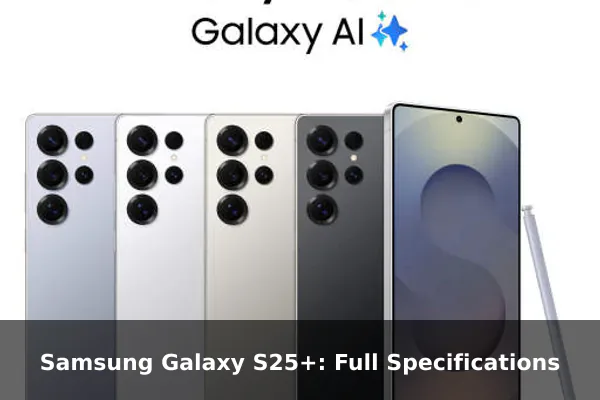
The phone ships with Android 15 and One UI 7, with support for up to seven major Android upgrades. That long update window is one of the most important specifications on the page because it directly affects ownership value. A powerful chipset and 12GB of RAM matter more when the software policy is designed to keep the device current for years.
Samsung also includes productivity and AI-oriented features such as Samsung DeX, Wireless DeX, Circle to Search, and Ultra Wideband support. DeX is especially valuable on the Plus model because the larger battery, fast USB Type-C 3.2 port, and DisplayPort 1.2 output make it more credible as a travel productivity device.
Connectivity and Regional Differences
Connectivity is broad, but buyers should pay attention to regional variants. The international model supports extensive Sub-6 5G bands, while the USA unlocked version adds mmWave bands including n257, n258, n260, and n261. The listed 4G and 5G support is wide enough for serious roaming, but exact compatibility still depends on the model number and carrier.
Other connectivity features are firmly flagship-grade: Wi-Fi 7, Bluetooth 5.4, NFC, multi-system positioning, USB Type-C 3.2, OTG, and DisplayPort output. The SIM setup also varies by market, with international, USA, and China configurations listed differently. Anyone importing the phone should verify the exact model before buying.
Who Should Buy the Galaxy S25+
The Galaxy S25+ is for buyers who want a large premium Samsung phone without the extra size, price, and specialist camera hardware of the Ultra. It makes sense for users who stream video, read often, game, multitask, travel, or want a phone that can remain useful across many software generations.
It is less ideal for people who want expandable storage, a 3.5 mm headphone jack, the most advanced zoom system Samsung offers, or the smallest possible flagship. For most users choosing within the S25 family, however, the Plus model is the balanced option: bigger and longer-lasting than the standard S25, but cleaner and easier to justify than the Ultra.
Conclusion
The Samsung Galaxy S25+ delivers the core 2025 Samsung flagship experience with a sharp 6.7-inch AMOLED display, Snapdragon 8 Elite performance, strong battery life, premium materials, and long Android support. It is the Galaxy S25 model to buy if you want a large, polished flagship without paying mainly for Ultra-specific extras.
References
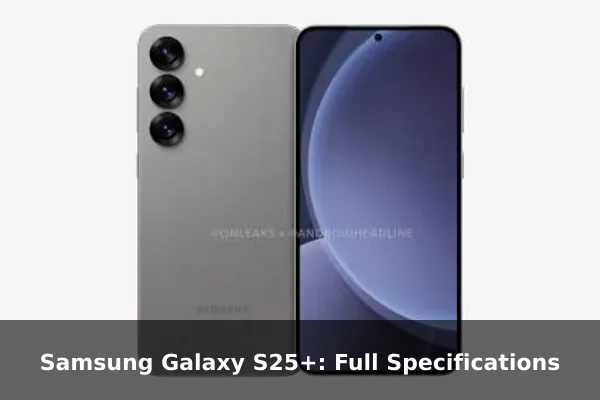
- Samsung Galaxy S25 & S25+ Official Specifications – Official Samsung specs page for Galaxy S25 and S25+, covering display, dimensions, cameras, memory, battery, colors, and model variants.
- Samsung Global Newsroom Galaxy S25 Series Announcement – Official launch article with announcement date, availability context, feature claims, and specification table for the Galaxy S25 series.
- Samsung Mobile Press Galaxy S25 Tech Specs – Samsung's official press asset hub with technical specifications and media resources for the Galaxy S25 series.
- Qualcomm Snapdragon 8 Elite for Galaxy Press Note – Primary chipset source confirming Snapdragon 8 Elite Mobile Platform for Galaxy powers the Galaxy S25, S25 Plus, and S25 Ultra globally.
- Corning Gorilla Glass: Samsung Galaxy S25/S25+ – Primary materials source verifying Gorilla Glass Victus 2 use on the Galaxy S25 and S25+.
