
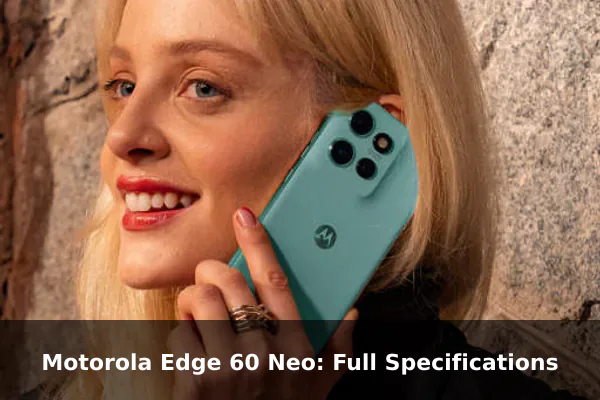
The Motorola Edge 60 Neo is positioned as a compact premium Android phone with a strong focus on display quality, durability, camera flexibility, and long-term software support. It combines a 6.36-inch LTPO P-OLED panel, a MediaTek Dimensity 7400 chipset, and a triple rear camera system with both ultrawide and telephoto coverage.
Based on the supplied source data and official Motorola reference material, this article looks beyond the raw specification sheet to explain where the Edge 60 Neo fits, what its strongest hardware choices mean in daily use, and which buyers are most likely to appreciate it.
Full Specifications
Network
| Technology: | GSM / CDMA / HSPA / LTE / 5G |
| 2G bands: | GSM 850 / 900 / 1800 / 1900 |
| CDMA 800 | |
| 3G bands: | HSDPA 800 / 850 / 900 / 1700(AWS) / 1900 / 2100 |
| 4G bands: | 1, 2, 3, 4, 5, 7, 8, 12, 13, 17, 18, 19, 20, 25, 26, 28, 32, 38, 39, 40, 41, 42, 43, 66 |
| 5G bands: | 1, 2, 3, 5, 7, 8, 20, 26, 28, 38, 40, 41, 66, 75, 77, 78 SA/NSA/Sub6 |
| Speed: | HSPA, LTE, 5G |
Launch
| Announced: | 2025, September 05 |
| Status: | Available. Released 2025, October 17 |
Body
| Dimensions: | 154.1 x 71.2 x 8.1 mm (6.07 x 2.80 x 0.32 in) |
| Weight: | 174.5 g (6.17 oz) |
| Build: | Glass front (Gorilla Glass 7i), plastic frame, silicone polymer (eco leather) back |
| SIM: | · Nano-SIM + eSIM· Nano-SIM + Nano-SIM |
| IP68/IP69 dust tight and water resistant (high pressure water jets; immersible up to 1.5m for 30 min) MIL-STD-810H compliant* * does not guarantee ruggedness or use in extreme conditions |
Display
| Type: | LTPO P-OLED, 1B colors, 120Hz, HDR10+, 3000 nits (peak) |
| Size: | 6.36 inches, 97.6 cm2 (~88.9% screen-to-body ratio) |
| Resolution: | 1200 x 2670 pixels, 20:9 ratio (~460 ppi density) |
| Protection: | Corning Gorilla Glass 7i |
Platform
| OS: | Android 15, up to 5 major Android upgrades |
| Chipset: | Mediatek Dimensity 7400 (4 nm) |
| CPU: | Octa-core (4×2.6 GHz Cortex-A78 & 4×2.0 GHz Cortex-A55) |
| GPU: | Mali-G615 MC2 |
Memory
| Card slot: | No |
| Internal: | 128GB 8GB RAM, 256GB 8GB RAM, 256GB 12GB RAM, 512GB 12GB RAM |
| uMCP |
Main Camera
| Triple: | 50 MP, f/1.8, 24mm (wide), 1/1.56″, 1.0µm, multi-directional PDAF, OIS 10 MP, f/2.0, 73mm (telephoto), 1/3.94″, 1.0µm, PDAF, OIS, 3x optical zoom 13 MP, f/2.2, 13mm, 120˚ (ultrawide), 1/3.0″, 1.12µm, PDAF |
| Features: | LED flash, HDR, panorama |
| Video: | 4K@30fps, 1080p@30/60/120/240fps, gyro-EIS |
Selfie camera
| Single: | 32 MP, f/2.4, (wide), 1/3.14″, 0.7µm |
| Features: | HDR |
| Video: | 4K@30fps, 1080p@30/60/120fps |
Sound
| Loudspeaker: | Yes, with stereo speakers |
| 3.5mm jack: | No |
Comms
| WLAN: | Wi-Fi 802.11 a/b/g/n/ac/6e, dual-band |
| Bluetooth: | 5.4, A2DP, LE |
| Positioning: | GPS, GLONASS, GALILEO |
| NFC: | Yes |
| Radio: | No |
| USB: | USB Type-C 2.0 |
Features
| Sensors: | Fingerprint (under display, optical), accelerometer, gyro, proximity, compass |
| Smart Connect (Ready For) support |
Battery
| Type: | · 5200 mAh (Global)· 5000 mAh (Brazil) |
| Charging: | 68W wired 15W wireless |
Misc
| Colors: | Pantone: Latte, Frostbite, Poinciana, Grisaille |
| Models: | XT2509-1 |
| Price: | $ 845.00 |
Price and Availability
The Motorola Edge 60 Neo offers a compelling combination of features and performance. While the base price is around $845, the actual cost may vary depending on your location and retailer. Below, you’ll find the approximate price of the Motorola Edge 60 Neo converted into various currencies. Please note that these are estimates based on recent exchange rates as of August 7, 2026 and may not reflect the exact price you’ll find at a retailer.
- United States: $845
- Japan: ¥133,683
- United Kingdom: £628
- Australia: A$1,201
- Canada: C$1,184
- Taiwan: NT$27,218
- Denmark: kr5.469
- Saudi Arabia: ﷼3,169
- South Korea: ₩1,202,841
- Germany: €733
- Brazil: R$4.321
- Vietnam: ₫22.095.369
- Kenya: KSh 109,359
- India: ₹80,500
- Indonesia: Rp 15.156.178
- Nigeria: ₦1,152,766
- Pakistan: ₨234,764
- Philippines: ₱51,387
- Bangladesh: ৳১,০৪,৫৮৫
Why Should You Buy the Motorola Edge 60 Neo?
The strongest reason to consider the Motorola Edge 60 Neo is its unusually complete feature mix in a compact body. Many smaller Android phones ask buyers to compromise on battery capacity, camera range, charging, or display quality, but this model keeps several premium touches together. The 120Hz LTPO P-OLED display, 3x optical telephoto camera, IP68/IP69 rating, wireless charging, and promised Android upgrade path all help it feel more rounded than a basic mid-range device.
It is especially interesting for users who want a phone that is easier to handle than large 6.7-inch models without dropping important extras. The 174.5 g weight and 154.1 mm height make it relatively manageable, while the 5200 mAh global battery specification suggests Motorola did not treat compact size as an excuse for a small cell.
Design and Durability
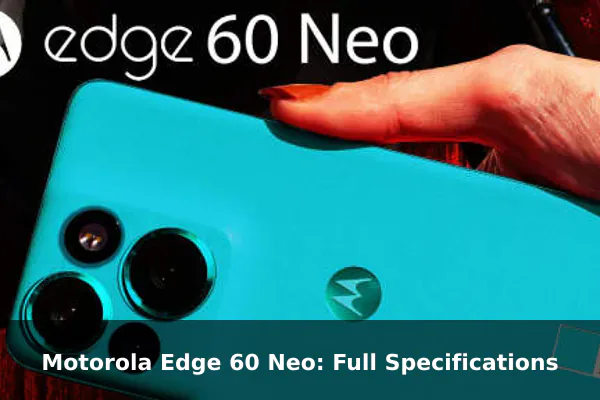
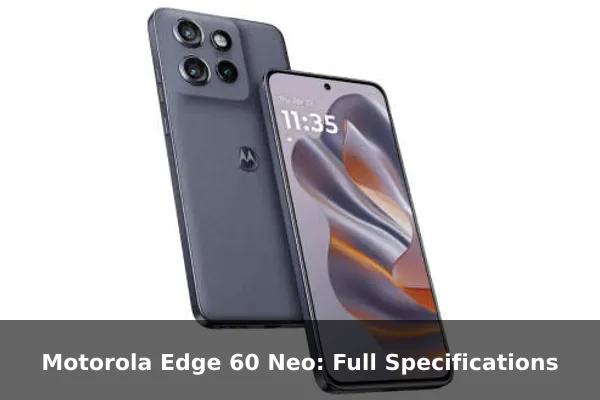
The Edge 60 Neo uses a glass front with Gorilla Glass 7i, a plastic frame, and a silicone polymer eco leather back. That combination gives the phone a softer rear texture than standard glossy glass and should make it more resistant to fingerprints. The listed Pantone colors, Latte, Frostbite, Poinciana, and Grisaille, also give the device a clearer style identity than typical black-and-silver finishes.
Durability is one of the headline strengths. The phone is rated IP68/IP69 for dust tightness, water immersion up to 1.5 m for 30 minutes, and resistance to high-pressure water jets. The MIL-STD-810H compliance note should be read carefully, because Motorola also states that it does not guarantee ruggedness or use in extreme conditions. In practical terms, this is a well-protected everyday phone rather than a true rugged worksite device.
Display Quality
The 6.36-inch LTPO P-OLED screen is one of the most important parts of the package. It supports 1 billion colors, HDR10+, a 120Hz refresh rate, and a claimed 3000 nits peak brightness. The 1200 x 2670 resolution works out to roughly 460 ppi, so text, maps, photos, and interface elements should appear sharp.
The LTPO panel is also important because it allows more adaptive refresh behavior than a basic fixed-refresh OLED. For users who switch between reading, scrolling, video, and navigation, that can help balance smoothness and efficiency. The size is another advantage: it is large enough for media and multitasking, but not so large that one-handed use becomes impossible for many people.
Performance and Storage
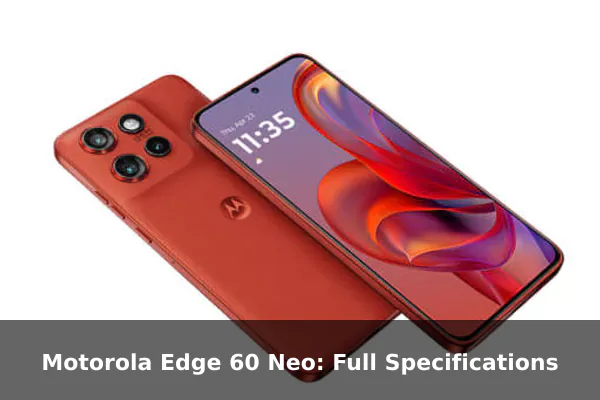
The Motorola Edge 60 Neo runs on the MediaTek Dimensity 7400, a 4 nm chipset with four Cortex-A78 performance cores and four Cortex-A55 efficiency cores. This is not positioned as an ultra-flagship gaming platform, but the architecture should be well suited to everyday Android tasks, 5G use, streaming, social apps, camera processing, and moderate gaming.
Memory options start at 128GB with 8GB RAM and go up to 512GB with 12GB RAM. There is no memory card slot, so buyers should choose storage carefully at purchase. The 256GB and 512GB versions make more sense for people who record 4K video, download offline media, or keep large app libraries. The listed uMCP storage standard also points to an integrated memory and storage package aimed at efficient mainstream performance.
Camera System
The rear camera setup is more versatile than the average compact Android phone. The 50 MP main camera includes optical image stabilization and multi-directional PDAF, which are useful for sharper stills and steadier handheld shooting. The 10 MP telephoto camera adds 3x optical zoom with OIS, giving users a proper portrait and distant-subject option rather than relying only on digital crop.
The 13 MP ultrawide camera covers a 120-degree field of view and includes PDAF, so it can be useful for landscapes, architecture, group shots, and close-range framing flexibility. Video support reaches 4K at 30 fps and 1080p at up to 240 fps on the rear camera, with gyro-EIS for stabilization. The 32 MP front camera also supports 4K recording at 30 fps, which is useful for creators, video calls, and higher-quality selfie clips.
Battery and Charging
Battery capacity depends on market, with the source listing 5200 mAh for the global version and 5000 mAh for Brazil. Either figure is solid for a phone of this size, and the global capacity is particularly competitive when compared with many compact models. Real endurance will still depend on brightness, 5G signal quality, camera use, and refresh-rate behavior.
Charging support is another advantage. The phone supports 68W wired charging and 15W wireless charging. Wireless charging is still not guaranteed in many mid-range Android phones, so its inclusion helps the Edge 60 Neo feel more convenient on a desk, bedside table, or in a car mount. The wired charging rating should also be fast enough for quick top-ups during the day.
Software and Updates
The Edge 60 Neo ships with Android 15 and is listed with support for up to five major Android upgrades. That commitment is important because hardware value is not only about launch-day specifications. A longer upgrade window helps the phone remain useful, secure, and compatible with newer apps for more years.
Motorola also lists Smart Connect, previously associated with Ready For functionality, which can help connect the phone with external displays, PCs, and companion workflows. For users who like a cleaner Android interface but still want desktop-style features when needed, this adds practical value beyond the normal app experience.
Connectivity and Everyday Features
The network support is broad, covering GSM, CDMA, HSPA, LTE, and 5G with SA and NSA Sub-6 bands. Wi-Fi 6e, Bluetooth 5.4, NFC, GPS, GLONASS, and GALILEO are also included. The SIM setup supports either Nano-SIM with eSIM or dual Nano-SIM, depending on version or market configuration.
There are a few limitations to note. The USB-C port is USB 2.0, there is no FM radio, and there is no 3.5 mm headphone jack. Stereo speakers are included, and the fingerprint reader sits under the display using an optical sensor. For most buyers, the overall connectivity package is modern, but wired-audio users and people who want faster USB data transfer should take note.
Who Should Buy It?
The Motorola Edge 60 Neo is best suited to buyers who want a compact Android phone with premium display quality, strong durability credentials, flexible cameras, and modern charging. It is a particularly good match for people who travel, commute, take a mix of wide, zoom, and selfie photos, and prefer a phone that is easier to carry than oversized flagship models.
It is less ideal for users who need expandable storage, a headphone jack, or top-tier gaming performance. Buyers who mainly care about maximum chipset power may find stronger alternatives elsewhere, but those who care about balance may find the Edge 60 Neo more appealing than raw benchmark-focused phones.
Conclusion
The Motorola Edge 60 Neo stands out as a compact, well-equipped Android phone with a sharp LTPO OLED display, useful triple cameras, strong water and dust protection, wireless charging, and a long software-upgrade promise. It is recommended for buyers who want a smaller premium-feeling phone with balanced features rather than the largest screen or the fastest flagship chip.
References
- Motorola Support – Specifications for motorola edge 60 neo – Official Motorola specifications page for core hardware details including processor, memory, display, cameras, battery, charging, dimensions, bands, and connectivity.
- Motorola GB – motorola edge 60 neo product page – Official product page useful for launch positioning, marketed features, colors, display, durability, camera, battery, storage, and software-support claims.
- Motorola Support – About your hardware for motorola edge 60 neo – Official hardware guide confirming physical layout, camera placement, USB-C port, NFC touchpoint, SIM tray, fingerprint sensor, and wireless charging area.
- Motorola Support – Declarations of Conformity – Official compliance page listing motorola edge 60 neo model XT2509-1/type MC451, useful for model identification and regulatory documentation.
- European Commission EPREL (eprel.ec.europa.eu) – Official EU product registry for energy-label data; search by edge 60 neo or XT2509-1 to verify energy class, battery endurance, rated capacity, repairability, and ingress-protection label data.
