
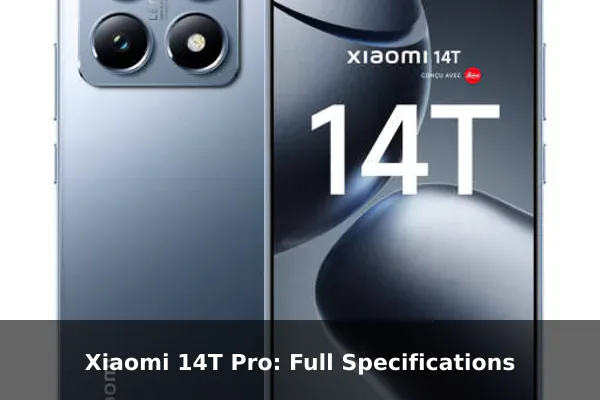
The Xiaomi 14T Pro is a performance-focused Android flagship built around a high-end Dimensity chipset, a fast AMOLED display, Leica-branded cameras, and unusually quick wired and wireless charging.
This specs-focused guide looks beyond the raw table to explain where the Xiaomi 14T Pro stands out, where it makes practical compromises, and which buyers are most likely to appreciate its mix of speed, imaging, and value.
Full Specifications
Network
| Technology: | GSM / HSPA / LTE / 5G |
| 2G bands: | GSM 850 / 900 / 1800 / 1900 |
| 3G bands: | HSDPA 800 / 850 / 900 / 1700(AWS) / 1900 / 2100 |
| 4G bands: | 1, 2, 3, 4, 5, 7, 8, 12, 13, 17, 18, 19, 20, 25, 26, 28, 32, 38, 39, 40, 41, 42, 48, 66 |
| 5G bands: | 1, 2, 3, 5, 7, 8, 12, 20, 25, 26, 28, 38, 40, 41, 48, 66, 75, 77, 78 SA/NSA |
| Speed: | HSPA, LTE, 5G |
Launch
| Announced: | 2024, September 26 |
| Status: | Available. Released 2024, September 26 |
Body
| Dimensions: | 160.4 x 75.1 x 8.4 mm (6.31 x 2.96 x 0.33 in) |
| Weight: | 209 g (7.37 oz) |
| Build: | Glass front, aluminum frame, glass back (Panda X) |
| SIM: | Nano-SIM + eSIMeSIM + eSIMNano-SIM + Nano-SIM |
| IP68 dust tight and water resistant (immersible up to 2m for 30 min) 6M13 aluminium alloy, 281 N/mm frame rigidity, 260 N/mm device rigidity |
Display
| Type: | AMOLED, 68B colors, 144Hz, 3840Hz PWM, Dolby Vision, HDR10+, 1600 nits (HBM), 4000 nits (peak) |
| Size: | 6.67 inches, 107.4 cm2 (~89.1% screen-to-body ratio) |
| Resolution: | 1220 x 2712 pixels, 20:9 ratio (~446 ppi density) |
| Protection: | Corning Gorilla Glass 5 |
Platform
| OS: | Android 14, HyperOS |
| Chipset: | Mediatek Dimensity 9300+ (4 nm) |
| CPU: | Octa-core (1×3.4 GHz Cortex-X4 & 3×2.85 GHz Cortex-X4 & 4×2.0 GHz Cortex-A720) |
| GPU: | Immortalis-G720 MC12 |
Memory
| Card slot: | No |
| Internal: | 256GB 12GB RAM, 512GB 12GB RAM, 512GB 16GB RAM, 1TB 12GB RAM |
| UFS 4.0 |
Main Camera
| Triple: | 50 MP, f/1.6, 23mm (wide), 1/1.31″, 1.2µm, PDAF, OIS 50 MP, f/2.0, 60mm (telephoto), 1/2.88″, 0.61µm, PDAF, 2.6x optical zoom 12 MP, f/2.2, 15mm (ultrawide), 1/3.06″, 1.12µm |
| Features: | Leica lens, Ultra HDR, LED flash, HDR, panorama |
| Video: | 8K@24/30fps, 4K@24/30/60fps, 1080p@30/60/120/240/960fps, gyro-EIS, 10-bit Rec. 2020, HDR10+ |
Selfie camera
| Single: | 32 MP, f/2.0, 25mm (wide), 1/3.44″, 0.64µm |
| Features: | HDR |
| Video: | 4K@30fps, 1080p@30/60fps, HDR10+ |
Sound
| Loudspeaker: | Yes, with stereo speakers |
| 3.5mm jack: | No |
| 24-bit/192kHz Hi-Res & Hi-Res Wireless audio |
Comms
| WLAN: | Wi-Fi 802.11 a/b/g/n/ac/6e/7, dual-band, Wi-Fi Direct |
| Bluetooth: | 5.4, A2DP, LE, LHDC |
| Positioning: | GPS (L1+L5), BDS (B1I+B1C+B2a+B2b), GALILEO (E1+E5a+E5b), QZSS (L1+L5), NavIC (L5), GLONASS |
| NFC: | Yes (market/region dependent) |
| Infrared port: | Yes |
| Radio: | No |
| USB: | USB Type-C 2.0, OTG |
Features
| Sensors: | Fingerprint (under display, optical), accelerometer, gyro, proximity, compass |
| Circle to Search |
Battery
| Type: | Li-Po 5000 mAh |
| Charging: | 120W wired, PD3.0, QC4, 100% in 19 min 50W wireless, 100% in 45 min |
Misc
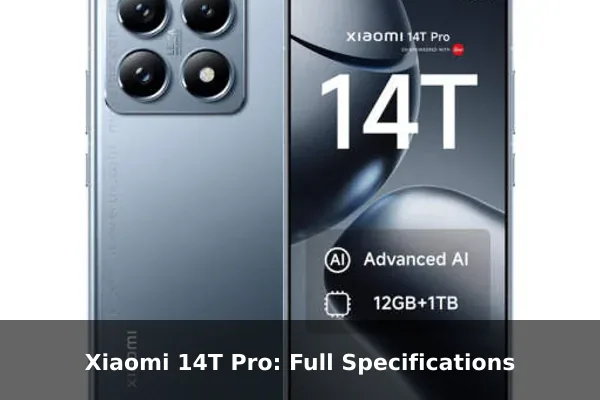
| Colors: | Titan Gray, Titan Blue, Titan Black |
| Models: | 2407FPN8EG |
| SAR EU: | 0.99 W/kg (head) 1.00 W/kg (body) |
| Price: | € 459.05 / $ 499.00 / £ 479.00 |
Our Tests
| Performance: | AnTuTu: 2015655 (v10) GeekBench: 7081 (v6) 3DMark: 3998 (Wild Life Extreme) |
| Display: | Maximum brightness: 1228nits (measured) |
| Loudspeaker: | -26.0 LUFS (Very good) |
| Battery: | Active use score 12:32h |
Price and Availability
The Xiaomi 14T Pro offers a compelling combination of features and performance. While the base price is around €459, the actual cost may vary depending on your location and retailer. Below, you’ll find the approximate price of the Xiaomi 14T Pro converted into various currencies. Please note that these are estimates based on recent exchange rates as of August 3, 2026 and may not reflect the exact price you’ll find at a retailer.
- United States: $530
- Japan: ¥83,670
- United Kingdom: £393
- Australia: A$752
- Canada: C$742
- Taiwan: NT$17,102
- Denmark: kr3.425
- Saudi Arabia: ﷼1,986
- South Korea: ₩761,004
- Germany: €459
- Brazil: R$2.674
- Vietnam: ₫13.826.348
- Kenya: KSh 68,324
- India: ₹50,395
- Indonesia: Rp 9.524.361
- Nigeria: ₦718,214
- Pakistan: ₨147,001
- Philippines: ₱32,414
- Bangladesh: ৳৬৫,৩১১
Value Position
The Xiaomi 14T Pro sits in an interesting part of the market: it is not positioned as Xiaomi’s most expensive Ultra-style camera flagship, but its core hardware is much closer to a premium phone than a typical midrange device. The Dimensity 9300+ platform, UFS 4.0 storage, high-refresh AMOLED panel, IP68 rating, 120W wired charging, and 50W wireless charging give it a specification mix that competes well above the basic upper-midrange category.
Its value depends heavily on local pricing, because Xiaomi phones often vary by region, bundle, memory version, and retailer. If the price stays close to the source listing level, the phone is strongest for buyers who want flagship speed and fast charging without moving into the most expensive camera-phone tier. The lack of microSD support and the USB 2.0 port are worth noting, but they do not erase the broader hardware advantage.
Design And Durability
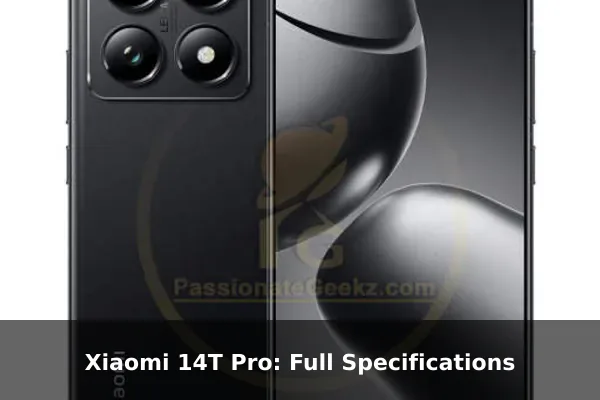
The Xiaomi 14T Pro uses a glass front, aluminum frame, and Panda X glass back, giving it a more premium structure than plastic-backed alternatives. At 160.4 x 75.1 x 8.4 mm and 209 g, it is not a lightweight phone, but the size is reasonable for a 6.67-inch display and a 5000 mAh battery. The weight should feel substantial rather than oversized for users already comfortable with modern large-screen phones.
Durability is one of its stronger practical points. The IP68 rating means the phone is dust tight and rated for immersion up to 2 meters for 30 minutes under test conditions. Xiaomi also highlights structural details such as 6M13 aluminum alloy and rigidity figures, which support the idea that this model is built for daily use rather than just spec-sheet appeal. As always, water resistance should be treated as protection against accidents, not a reason to intentionally use the phone underwater.
Display Experience
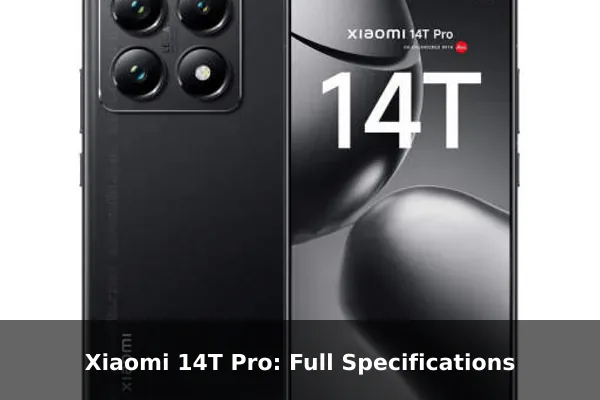
The 6.67-inch AMOLED display is one of the Xiaomi 14T Pro’s biggest selling points. It combines a 1220 x 2712 resolution, about 446 ppi density, a 20:9 aspect ratio, 68 billion colors, Dolby Vision, HDR10+, and a 144Hz refresh rate. That makes it well suited for fast scrolling, gaming, HDR video, and general media consumption.
The brightness claims are also aggressive, with 1600 nits high-brightness mode and 4000 nits peak brightness listed in the source data. Independent test data in the supplied source shows 1228 nits measured maximum brightness, which is still very strong for outdoor readability. The inclusion of 3840Hz PWM dimming may also matter to users who are sensitive to display flicker, though comfort can vary from person to person.
Performance Hardware
The MediaTek Dimensity 9300+ is the main reason the Xiaomi 14T Pro deserves attention from performance buyers. Its octa-core CPU layout uses one Cortex-X4 prime core at up to 3.4GHz, three additional Cortex-X4 cores at up to 2.85GHz, and four Cortex-A720 cores at up to 2.0GHz. Paired with the Immortalis-G720 MC12 GPU, this is a serious flagship-class platform for gaming, multitasking, editing, and heavy app use.
The supplied benchmark results reinforce that positioning: AnTuTu v10 at 2,015,655, GeekBench 6 at 7,081, and 3DMark Wild Life Extreme at 3,998. Benchmarks do not describe every part of daily performance, but they make clear that the phone has enough headroom for demanding users. Storage is also modern, with UFS 4.0 and configurations up to 1TB, although there is no card slot for expansion.
Camera System
The rear camera system is built around three useful focal lengths rather than a filler-heavy setup. The main camera is a 50 MP wide unit with a large 1/1.31-inch sensor, f/1.6 aperture, PDAF, and optical image stabilization. That is the camera most buyers will rely on for night scenes, portraits, travel photos, and everyday shooting.
The 50 MP telephoto camera adds a 60mm field of view and 2.6x optical zoom, which is valuable for portraits, details, and tighter street or travel compositions. The 12 MP ultrawide camera covers a 15mm perspective for landscapes, interiors, and group shots. Leica branding, Ultra HDR, LED flash, HDR, and panorama support round out the camera feature list. Video is another strong point, with up to 8K recording, 4K at up to 60fps, high-frame-rate 1080p options, gyro-EIS, 10-bit Rec. 2020, and HDR10+.
Selfie And Video Calling
The front camera is a 32 MP wide unit with HDR support and video recording up to 4K at 30fps. That makes it more capable than many phones that still limit the selfie camera to 1080p video. For users who record short-form video, join frequent video calls, or want higher-resolution front-camera clips, this is a useful advantage.
The sensor size and pixel size are not as ambitious as the rear main camera, so expectations should stay realistic in low light. Still, the ability to capture 4K selfie video and HDR10+ front-camera video gives the Xiaomi 14T Pro a stronger content-creation profile than many similarly priced Android phones.
Battery And Charging
The 5000 mAh battery is a sensible match for the display size and flagship-class chipset. The supplied active use score of 12 hours and 32 minutes suggests the phone is competitive for a full day of mixed use, though gaming, 5G use, navigation, high brightness, and camera recording will reduce runtime more quickly.
Charging is one of the phone’s headline strengths. Xiaomi lists 120W wired charging with PD3.0 and QC4 support, with a claimed 100 percent charge in 19 minutes. The phone also supports 50W wireless charging, with a claimed 100 percent charge in 45 minutes. Those figures make the Xiaomi 14T Pro especially appealing for users who charge in short bursts rather than leaving a phone plugged in overnight.
Software And AI Features
The phone ships with Android 14 and Xiaomi HyperOS. That means users get Xiaomi’s current interface approach, including its own system styling, app ecosystem, customization options, and device integration features. Buyers who prefer a cleaner Android interface should consider whether HyperOS matches their taste, because the software experience is a major part of long-term satisfaction.
Circle to Search is included in the feature list, giving the phone a modern AI-assisted search function for identifying text, images, products, or on-screen content. The under-display optical fingerprint sensor, accelerometer, gyro, proximity sensor, and compass cover the expected sensor set for a premium Android phone.
Connectivity And Audio
Connectivity is broad, with GSM, HSPA, LTE, and 5G support across a long list of bands. The 5G list includes both SA and NSA support, which helps the phone remain flexible across different carrier deployments. Wi-Fi support is also strong, covering Wi-Fi 6e and Wi-Fi 7 alongside older standards, while Bluetooth 5.4 includes A2DP, LE, and LHDC.
Navigation support is extensive, with dual-frequency GPS and multiple satellite systems including BDS, Galileo, QZSS, NavIC, and GLONASS. NFC is listed as market dependent, so buyers should confirm the exact regional version before purchase. The phone also includes an infrared port, stereo speakers, Hi-Res and Hi-Res Wireless audio support, and USB-C with OTG. The main audio compromise is the missing 3.5mm headphone jack.
Who Should Buy It
The Xiaomi 14T Pro is best for buyers who care about speed, display quality, camera flexibility, and charging more than having the absolute most premium brand positioning. It is a strong fit for mobile gamers, frequent travelers, heavy multitaskers, and users who want a Leica-branded triple camera system without stepping up to the highest Xiaomi Ultra model.
It is less ideal for users who need expandable storage, a headphone jack, or a faster USB standard for large wired file transfers. It also may not be the first choice for people who prefer compact phones, since the 6.67-inch body and 209 g weight are firmly in large-phone territory. For most performance-focused Android buyers, however, the balance is very competitive.
Conclusion
The Xiaomi 14T Pro combines flagship-level performance, a sharp 144Hz AMOLED display, a practical Leica triple camera system, IP68 durability, and some of the fastest charging in its class. Its biggest compromises are the lack of microSD, no 3.5mm jack, and USB 2.0, but the overall package is strong. Recommended for buyers who want high-end Android hardware and fast everyday usability at a more value-conscious price point.
References
- Xiaomi 14T Pro Specs – Xiaomi Global – Official manufacturer specification sheet for processor, RAM/storage, dimensions, display, cameras, battery, charging, connectivity, OS, sensors, and package contents.
- Xiaomi 14T Pro – Xiaomi Global – Official product page for feature claims, design details, camera system, display, charging, IP68 notes, and Xiaomi footnotes/disclaimers.
- Xiaomi Unveils Xiaomi 14T Series with Exceptional Night Photography and Advanced AI – Official launch announcement with release context, availability, pricing, colors, and quick specifications for Xiaomi 14T Pro.
- GCF – Xiaomi 14T Pro – Independent certification listing for model 2407FPN8EG, confirming the marketing name and certified cellular bands/connectivity capabilities.
- MediaTek Dimensity 9300+ – Official chipset reference for Dimensity 9300+ CPU, GPU, NPU, modem, Wi-Fi, Bluetooth, camera, video, and display capabilities.
