
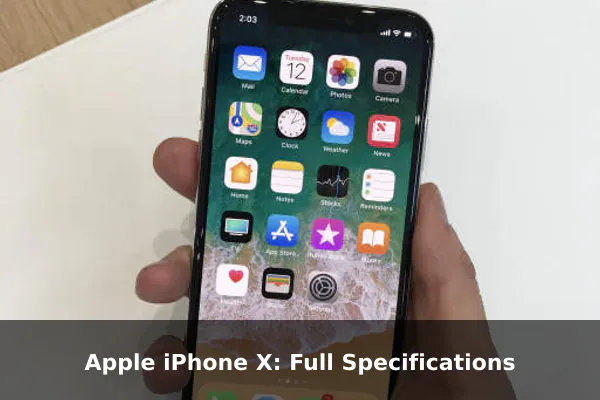
The Apple iPhone X marked a major turning point for the iPhone line, moving Apple from the classic Home button design to a gesture-based interface built around Face ID and a nearly edge-to-edge OLED display.
This specifications-focused article looks at the iPhone X from a practical used-phone perspective, highlighting where its hardware still feels premium, where it now shows its age, and what buyers should check before choosing one.
Full Specifications
Network
| Technology: | GSM / HSPA / LTE |
| 2G bands: | GSM 850 / 900 / 1800 / 1900 |
| 3G bands: | HSDPA 850 / 900 / 1700(AWS) / 1900 / 2100 |
| 4G bands: | 1, 2, 3, 4, 5, 7, 8, 12, 13, 17, 18, 19, 20, 25, 26, 28, 29, 30, 34, 38, 39, 40, 41, 66 |
| Speed: | HSPA 42.2/5.76 Mbps, LTE (3CA) Cat12 600/150 Mbps, EV-DO Rev.A 3.1 Mbps |
Launch
| Announced: | 2017, September 12. Released 2017, November 03 |
| Status: | Discontinued |
Body
| Dimensions: | 143.6 x 70.9 x 7.7 mm (5.65 x 2.79 x 0.30 in) |
| Weight: | 174 g (6.14 oz) |
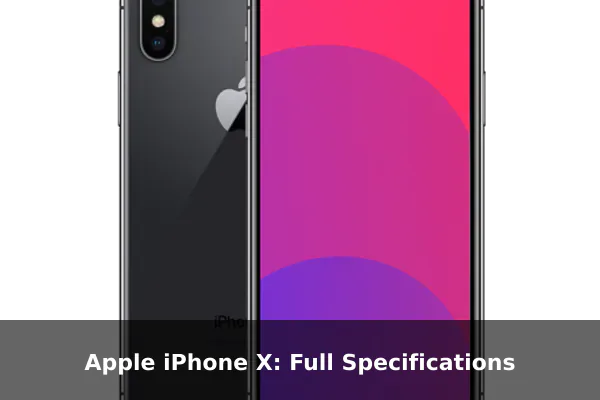
| Build: | Glass front (Corning-made glass), glass back (Corning-made glass), stainless steel frame |
| SIM: | Nano-SIM |
| IP67 dust/water resistant (up to 1m for 30 min) Apple Pay (Visa, MasterCard, AMEX certified) |
Display
| Type: | Super Retina OLED, HDR10, Dolby Vision, 625 nits (HBM) |
| Size: | 5.8 inches, 84.4 cm2 (~82.9% screen-to-body ratio) |
| Resolution: | 1125 x 2436 pixels, 19.5:9 ratio (~458 ppi density) |
| Protection: | Scratch-resistant glass |
| 3D Touch |
Platform
| OS: | iOS 11.1.1, up to iOS 16.7.7 |
| Chipset: | Apple A11 Bionic (10 nm) |
| CPU: | Hexa-core 2.39 GHz (2x Monsoon + 4x Mistral) |
| GPU: | Apple GPU (three-core graphics) |
Memory
| Card slot: | No |
| Internal: | 64GB 3GB RAM, 256GB 3GB RAM |
| NVMe |
Main Camera
| Dual: | 12 MP, f/1.8, 28mm (wide), 1/3.0″, 1.22µm, dual pixel PDAF, OIS 12 MP, f/2.4, 52mm (telephoto), 1/3.4″, 1.0µm, PDAF, OIS, 2x optical zoom |
| Features: | Quad-LED dual-tone flash, HDR (photo/panorama), panorama, HDR |
| Video: | 4K@24/30/60fps, 1080p@30/60/120/240fps |
Selfie camera
| Single: | 7 MP, f/2.2, 32mm (standard) SL 3D, (depth/biometrics sensor) |
| Features: | HDR |
| Video: | 1080p@30fps |
Sound
| Loudspeaker: | Yes, with stereo speakers |
| 3.5mm jack: | No |
Comms
| WLAN: | Wi-Fi 802.11 a/b/g/n/ac, dual-band, hotspot |
| Bluetooth: | 5.0, A2DP, LE |
| Positioning: | GPS, GLONASS, GALILEO, QZSS |
| NFC: | Yes |
| Radio: | No |
| USB: | Lightning, USB 2.0 |
Features
| Sensors: | Face ID, accelerometer, gyro, proximity, compass, barometer |
Battery
| Type: | Li-Ion 2716 mAh, non-removable (10.35 Wh) |
| Charging: | 15W wired, PD2.0, 50% in 30 min Wireless (Qi) |
| Talk time: | Up to 21 h (3G) |
Misc
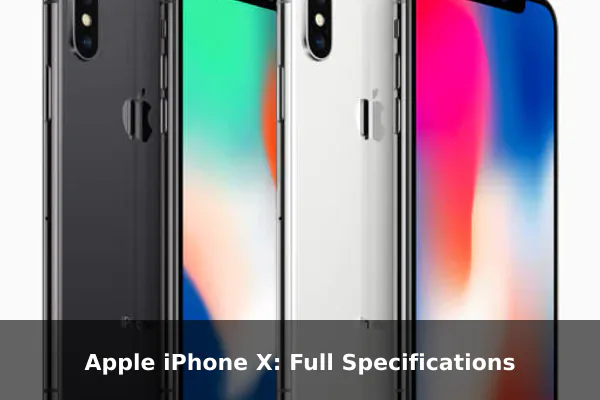
| Colors: | Space Gray, Silver |
| Models: | A1865, A1901, A1902, A1903, iPhone10,3, iPhone10,6 |
| SAR: | 1.09 W/kg (head) 1.17 W/kg (body) |
| Price: | About 100 EUR |
Our Tests
| Performance: | AnTuTu: 233100 (v7) GeekBench: 10215 (v4.4) GFXBench: 28fps (ES 3.1 onscreen) |
| Display: | Contrast ratio: Infinity (nominal), 5.013 (sunlight) |
| Camera: | Photo / Video |
| Loudspeaker: | Voice 68dB / Noise 74dB / Ring 76dB |
| Audio quality: | Noise -93.7dB / Crosstalk -82.8dB |
| Battery (old): | Endurance rating 74h |
Price and Availability
The Apple iPhone X offers a compelling combination of features and performance. While the base price is around €100, the actual cost may vary depending on your location and retailer. Below, you’ll find the approximate price of the Apple iPhone X converted into various currencies. Please note that these are estimates based on recent exchange rates as of July 28, 2026 and may not reflect the exact price you’ll find at a retailer.
- United States: $114
- Japan: ¥18,627
- United Kingdom: £86
- Australia: A$163
- Canada: C$161
- Taiwan: NT$3,676
- Denmark: kr746
- Saudi Arabia: ﷼427
- South Korea: ₩167,126
- Germany: €100
- Brazil: R$580
- Vietnam: ₫2.986.233
- Kenya: KSh 14,755
- India: ₹10,910
- Indonesia: Rp 2.053.608
- Nigeria: ₦155,182
- Pakistan: ₨31,612
- Philippines: ₱7,025
- Bangladesh: ৳১৪,০৪৪
Why Should You Buy the Apple iPhone X?
The main reason to consider the Apple iPhone X today is not raw power or long-term software freshness, but the combination of premium construction, compact size, OLED quality, and familiar iOS behavior at a much lower market value than newer flagship iPhones. It was Apple’s first mainstream iPhone with Face ID, a Super Retina OLED panel, and the modern gesture interface, so it still feels closer to recent iPhones than older models such as the iPhone 8 series.
For users who want a smaller iPhone with a stainless steel frame, glass back, wireless charging, stereo speakers, and a capable dual camera system, the iPhone X remains interesting as a budget secondary phone, backup device, or entry point into iOS. The trade-off is clear: it is discontinued, limited to iOS 16.7.7, and lacks 5G, modern battery endurance, and the camera improvements found in newer iPhones.
Design and Build Quality
The iPhone X still has a premium physical character. Its glass front and glass back are paired with a stainless steel frame, giving it a more flagship-like feel than many midrange phones. At 143.6 x 70.9 x 7.7 mm and 174 g, it is compact by modern standards, making it easier to use one-handed than many large-screen phones released later.
Durability is helped by IP67 dust and water resistance, rated for up to 1 meter for 30 minutes, but buyers should remember that water resistance can degrade with age, repairs, impacts, or worn seals. The Nano-SIM setup is simple, and the presence of Apple Pay support keeps the phone useful for contactless payments where supported. The Space Gray and Silver color options also keep the design clean and understated.
Display Experience
The 5.8-inch Super Retina OLED display is one of the iPhone X’s strongest specifications. It supports HDR10 and Dolby Vision, reaches 625 nits in high brightness mode, and uses a sharp 1125 x 2436 resolution with about 458 ppi density. The 19.5:9 aspect ratio and roughly 82.9 percent screen-to-body ratio helped define the modern iPhone layout.
For video, reading, maps, messaging, and social apps, the panel remains a major advantage over older LCD iPhones. OLED contrast gives deeper blacks and stronger perceived image depth, while HDR support helps compatible content look more dynamic. The display also includes scratch-resistant glass and 3D Touch, a pressure-sensitive feature that Apple later removed from newer iPhones. The main buyer caution is screen condition: burn-in, replaced panels, True Tone behavior, and touch response should all be checked carefully on a used unit.
Performance and Storage
The Apple A11 Bionic chipset is built on a 10 nm process and uses a hexa-core CPU with two Monsoon performance cores and four Mistral efficiency cores. It is paired with Apple’s three-core GPU and 3 GB of RAM. In the supplied test data, the phone records AnTuTu 233100 on version 7, GeekBench 10215 on version 4.4, and 28 fps in GFXBench ES 3.1 onscreen.
In everyday use, that hardware is still suitable for calls, messaging, web browsing, navigation, banking apps, streaming, and light photo editing. The NVMe storage helps the phone feel more responsive than the numbers alone suggest. Storage choices are 64 GB and 256 GB, with no card slot. For a used purchase, 256 GB is the safer configuration if the phone will store many photos, videos, offline music, or app data.
Camera System
The rear camera setup uses two 12 MP sensors: a 28 mm wide camera with f/1.8 aperture, dual pixel PDAF, and optical image stabilization, plus a 52 mm telephoto camera with f/2.4 aperture, PDAF, optical image stabilization, and 2x optical zoom. Features include Quad-LED dual-tone flash, HDR, panorama, and 4K video recording at 24, 30, or 60 fps.
The iPhone X camera remains useful because it offers a real telephoto lens rather than relying only on digital zoom. Video is also a strength, with 1080p recording up to 240 fps for slow motion. However, buyers should set expectations carefully: newer iPhones offer larger sensors, stronger night processing, improved HDR, better stabilization, and more advanced computational photography. The 7 MP front camera supports HDR and 1080p video, while the SL 3D depth and biometrics sensor enables Face ID.
Battery and Charging
The iPhone X has a 2716 mAh non-removable Li-Ion battery rated at 10.35 Wh. Charging support includes 15W wired charging with PD2.0, with the supplied data listing up to 50 percent in 30 minutes when using compatible fast-charging equipment. Wireless charging is also supported through Qi, which adds convenience for desks, nightstands, and cars with compatible pads.
The original endurance rating is listed at 74 hours, and Apple’s talk-time claim is up to 21 hours on 3G. In 2026, the actual battery experience depends heavily on battery health, charge cycles, replacement history, temperature exposure, and app workload. A used iPhone X with a worn battery can feel dramatically worse than the specification sheet suggests, so battery health should be treated as a core buying criterion rather than a minor detail.
Software and Face ID
The iPhone X launched with iOS 11.1.1 and is upgradeable up to iOS 16.7.7. That gives it access to a mature iOS experience, Face ID authentication, gesture navigation, App Store apps, iCloud services, and Apple ecosystem features. It also means the phone is no longer on the same major iOS track as newer models.
For basic use, iOS 16 remains functional, but users who care about the longest app support window, the newest iOS features, or extended security coverage should consider a newer iPhone. Face ID is still one of the defining features, but it should be tested before purchase because repairs, drops, water exposure, or damaged sensor components can affect biometric authentication.
Connectivity and Audio
Connectivity covers GSM, HSPA, and LTE, with broad 4G band support and LTE Cat12 speeds listed at up to 600 Mbps down and 150 Mbps up under ideal network conditions. The phone also supports Wi-Fi 802.11 a/b/g/n/ac, Bluetooth 5.0, GPS, GLONASS, GALILEO, QZSS, NFC, and Lightning over USB 2.0.
The biggest connectivity limitation is the absence of 5G. For many users, 4G LTE remains adequate for browsing, messaging, maps, and streaming, but buyers expecting the fastest mobile data or better future network support should look newer. Audio is handled by stereo speakers, while the 3.5 mm headphone jack is absent. The supplied loudspeaker test figures list 68 dB for voice, 74 dB for noise, and 76 dB for ringing.
Who Should Buy This Phone?
The Apple iPhone X makes the most sense for buyers who want an inexpensive iPhone with OLED, Face ID, a premium body, wireless charging, and a compact footprint. It is also suitable as a backup iPhone, a family device, a travel phone, or a low-cost way to stay inside the Apple ecosystem without buying a newer model.
It is less suitable for heavy mobile gamers, long-day travelers, 5G-focused users, advanced camera users, or anyone who wants the longest possible software support. Before buying, inspect the display, battery health, Face ID, cameras, speakers, charging port, wireless charging, SIM function, and model number. The listed models include A1865, A1901, A1902, A1903, iPhone10,3, and iPhone10,6, so regional compatibility should be checked against local carriers.
Conclusion
The Apple iPhone X is no longer a modern flagship, but it remains a distinctive used iPhone with a premium build, sharp OLED display, Face ID, capable dual cameras, stereo speakers, and wireless charging. Its main weaknesses are aging battery life, no 5G, limited software ceiling, and the risk of worn or repaired components. Recommended only if the unit is in excellent condition, priced fairly, and bought with clear expectations about its age.
References
- Apple Support – iPhone X Technical Specifications – Primary source for iPhone X dimensions, weight, display, chip, cameras, video recording, cellular bands, wireless features, sensors, SIM, battery-life claims, and included accessories.
- Apple Support – Identify your iPhone model – Primary source for confirming iPhone X model numbers, storage capacities, colors, release year, and visible hardware identifiers.
- Apple Regulatory Information – iPhone X RF Exposure – Official Apple regulatory source for iPhone X RF exposure and SAR values by model number.
- Apple iPhone X Environmental Report – Official Apple report with iPhone X introduction date, materials, battery chemistry and cycle rating, energy efficiency, packaging, and environmental claims.
- iFixit – iPhone X Teardown – Reputable independent teardown for internal details Apple does not list in public specs, including RAM, battery capacity, modem variants, and component identification.
