
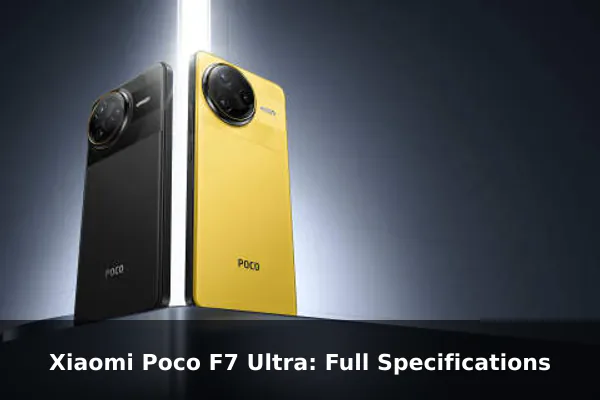
The Xiaomi Poco F7 Ultra arrives as the most ambitious phone the sub-brand has ever shipped, pairing Qualcomm’s flagship Snapdragon 8 Elite with a sharp QHD+ AMOLED panel and a genuine triple-camera system. Announced on 27 March 2025, it pushes Poco beyond its traditional “value performance” reputation and squarely into flagship-killer territory, where it competes with devices that often cost considerably more.
What makes the F7 Ultra interesting is how few obvious compromises it makes. You get an ultrasonic in-display fingerprint reader, IP68 protection, 120W wired charging, wireless charging, and a periscope-free but still useful 2.5x telephoto lens. This article looks past the spec sheet to explain what those numbers mean in daily use and who the phone is really built for.
Full Specifications
Network
| Technology: | GSM / HSPA / LTE / 5G |
| 2G bands: | GSM 850 / 900 / 1800 / 1900 |
| 3G bands: | HSDPA 800 / 850 / 900 / 1700(AWS) / 2100 |
| 4G bands: | 1, 2, 3, 4, 5, 7, 8, 18, 19, 20, 26, 28, 38, 40, 41, 42, 48, 66 |
| 5G bands: | 1, 2, 3, 5, 7, 8, 20, 26, 28, 38, 40, 41, 48, 66, 77, 78 SA/NSA |
| Speed: | HSPA, LTE, 5G |
Launch
| Announced: | 2025, March 27 |
| Status: | Available. Released 2025, March 27 |
Body
| Dimensions: | 160.3 x 75 x 8.4 mm (6.31 x 2.95 x 0.33 in) |
| Weight: | 212 g (7.48 oz) |
| Build: | Glass front (Shield Glass), glass back, aluminum frame |
| SIM: | Nano-SIM + Nano-SIM |
| IP68 dust tight and water resistant (immersible up to 2.5m for 30 min) |
Display
| Type: | AMOLED, 68B colors, 120Hz, 3840Hz PWM, Dolby Vision, HDR10+, 1800 nits (HBM), 3200 nits (peak) |
| Size: | 6.67 inches, 107.4 cm2 (~89.3% screen-to-body ratio) |
| Resolution: | 1440 x 3200 pixels, 20:9 ratio (~526 ppi density) |
| Protection: | Poco Shield Glass, Mohs level 5 |
Platform
| OS: | Android 15, HyperOS 2 |
| Chipset: | Qualcomm SM8750-AB Snapdragon 8 Elite (3 nm) |
| CPU: | Octa-core (2×4.32 GHz Oryon V2 Phoenix L + 6×3.53 GHz Oryon V2 Phoenix M) |
| GPU: | Adreno 830 |
Memory
| Card slot: | No |
| Internal: | 256GB 12GB RAM, 512GB 16GB RAM |
| UFS 4.1 |
Main Camera
| Triple: | 50 MP, f/1.6, 24mm (wide), 1/1.55″, 1.0µm, multi-directional PDAF, OIS 50 MP, f/2.0, 60mm (telephoto), 1/2.76″, 0.64µm, multi-directional PDAF (10cm – ∞), OIS, 2.5x optical zoom 32 MP, f/2.2, 15mm, 120˚ (ultrawide), 1/3.42″, 0.64µm |
| Features: | Color spectrum sensor, LED flash, HDR, panorama |
| Video: | 8K@24fps, 4K@24/30/60fps, 1080p@30/60/120/240/960fps, 720p@1920fps, gyro-EIS |
Selfie camera
| Single: | 32 MP, f/2.0, 24mm, (wide), 1/3.42″, 0.64µm |
| Features: | HDR |
| Video: | 1080p@30/60fps, gyro-EIS |
Sound
| Loudspeaker: | Yes, with stereo speakers |
| 3.5mm jack: | No |
| 24-bit/192kHz Hi-Res & Hi-Res Wireless audio Snapdragon Sound |
Comms
| WLAN: | Wi-Fi 802.11 a/b/g/n/ac/6e/7, dual-band, Wi-Fi Direct |
| Bluetooth: | 6.0, A2DP, LE, aptX HD, aptX Adaptive, aptX Lossless, LHDC 5 |
| Positioning: | GPS (L1+L5), GLONASS (G1), BDS (B1I+B1c+B2a), GALILEO (E1+E5a), QZSS (L1+L5), NavIC (L5) |
| NFC: | Yes |
| Infrared port: | Yes |
| Radio: | No |
| USB: | USB Type-C, OTG |
Features
| Sensors: | Fingerprint (under display, ultrasonic), accelerometer, proximity, gyro, compass |
Battery
| Type: | 5300 mAh |
| Charging: | 120W wired, PD3.0, QC3+, 100% in 34 min 50W wireless |
Misc
| Colors: | Black, Yellow |
| Models: | 24122RKC7G |
| Price: | € 549.90 / $ 792.50 / £ 518.00 |
Our Tests
| Performance: | AnTuTu: 2580520 (v10) GeekBench: 8887 (v6) 3DMark: 6204 (Wild Life Extreme) |
| Display: | 1506 nits max brightness (measured) |
| Loudspeaker: | -24.7 LUFS (Very good) |
| Battery: | Active use score 13:32h |
EU LABEL
| Energy: | Class A |
| Battery: | 62:53h endurance, 1000 cycles |
| Free fall: | Class D (45 falls) |
| Repairability: | Class C |
Price and Availability
The Xiaomi Poco F7 Ultra offers a compelling combination of features and performance. While the base price is around €550, the actual cost may vary depending on your location and retailer. Below, you’ll find the approximate price of the Xiaomi Poco F7 Ultra converted into various currencies. Please note that these are estimates based on recent exchange rates as of June 29, 2026 and may not reflect the exact price you’ll find at a retailer.
- United States: $626
- Japan: ¥101,288
- United Kingdom: £474
- Australia: A$908
- Canada: C$888
- Taiwan: NT$19,953
- Denmark: kr4.103
- Saudi Arabia: ﷼2,348
- South Korea: ₩962,528
- Germany: €550
- Brazil: R$3.243
- Vietnam: ₫16.422.176
- Kenya: KSh 81,170
- India: ₹59,111
- Indonesia: Rp 11.207.988
- Nigeria: ₦862,071
- Pakistan: ₨174,085
- Philippines: ₱38,406
- Bangladesh: ৳৭৭,০২০
Why the Poco F7 Ultra Is a Real Flagship Killer
Poco’s pitch has always been raw performance for the money, but the F7 Ultra refines that idea. Instead of cutting corners on water resistance, charging, or biometrics to fund a fast chip, it delivers a near-complete flagship feature set. According to POCO’s official specification sheet, the device combines a Snapdragon 8 Elite, UFS 4.1 storage, and Wi-Fi 7 in a body that still undercuts mainstream flagships on price. That balance, rather than any single headline number, is its core appeal.
Design and Build Quality
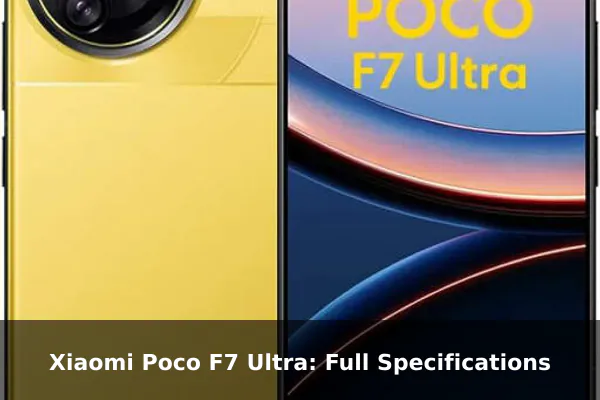
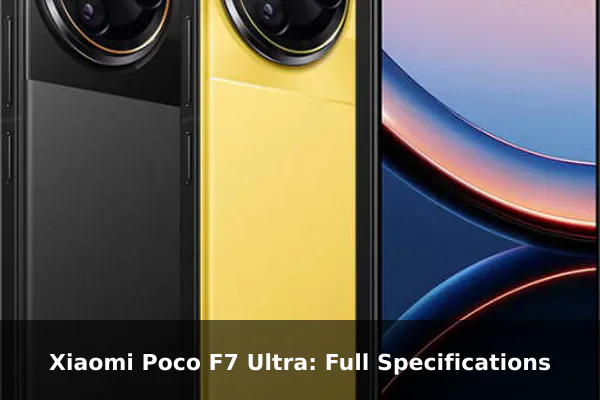
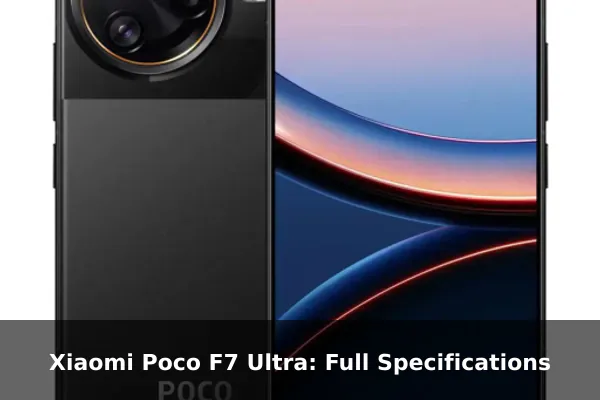
The F7 Ultra measures 160.3 x 75 x 8.4 mm and weighs 212 g, so it is a substantial slab rather than a featherweight. The trade-off is durability: a glass front backed by Poco Shield Glass (rated Mohs level 5), a glass back, and an aluminum frame. IP68 certification means it is dust tight and rated for immersion up to 2.5 m for 30 minutes, a reassurance that was historically reserved for pricier handsets. Buyers can choose between Black and Yellow finishes, the latter being a signature Poco look.
Display: Sharp, Bright, and Eye-Friendly
The 6.67-inch AMOLED panel is one of the phone’s strongest assets. It runs at a 1440 x 3200 resolution for roughly 526 ppi, refreshes at 120Hz, and supports Dolby Vision and HDR10+. Xiaomi quotes 1800 nits in high-brightness mode and a 3200-nit peak, while independent testing measured around 1506 nits in practice, still excellent for outdoor visibility. A high-frequency 3840Hz PWM dimming rate should also help users who are sensitive to screen flicker during low-light viewing.
Performance and Thermals
At the heart of the phone is the Qualcomm Snapdragon 8 Elite (SM8750-AB), built on a 3 nm process with an Oryon V2 CPU and Adreno 830 GPU. Qualcomm positions this as a top-tier platform, and the F7 Ultra’s benchmark figures back that up: an AnTuTu score above 2.5 million, a Geekbench 6 multi-core result near 8,900, and strong 3DMark Wild Life Extreme numbers. For context on the silicon, see Qualcomm’s Snapdragon 8 Elite overview. Paired with up to 16GB of RAM and UFS 4.1 storage, this is a phone with headroom for demanding games and years of updates.
Cameras: A Genuine Telephoto, Not Just a Filler Lens
Poco phones have often skimped on secondary cameras, so the F7 Ultra’s triple setup is notable. It leads with a 50 MP f/1.6 wide sensor with OIS, adds a 50 MP f/2.0 telephoto offering 2.5x optical zoom with its own OIS, and rounds out the system with a 32 MP ultrawide. A dedicated color spectrum sensor aids white balance, and video tops out at 8K@24fps. The telephoto in particular is what separates this from cheaper rivals, giving it flexibility for portraits and distant subjects that single- or dual-camera phones cannot match.
Battery Life and Charging
A 5300 mAh battery powers the F7 Ultra, and Xiaomi rates it for 120W wired charging that reaches a full charge in roughly 34 minutes, plus 50W wireless charging. Real-world endurance testing returned an active-use score of about 13.5 hours, which should comfortably see most users through a full day. The EU energy label lists a battery rated for around 1000 charge cycles, suggesting solid long-term longevity if the official figures hold.
Software and Long-Term Support
The phone ships with Android 15 under HyperOS 2, Xiaomi’s reworked interface. Software longevity matters as much as raw speed on a flagship, so it is worth tracking Xiaomi’s stated update commitments via the official HyperOS resources before purchase. HyperOS 2 brings a cleaner aesthetic and deeper device integration, though buyers who prefer minimal software should be aware it is a feature-rich, customization-heavy layer.
Connectivity and Extras
Connectivity is comprehensive: Wi-Fi 7, Bluetooth 6.0 with a wide codec list including aptX Lossless and LHDC 5, dual-frequency GPS, NFC, and an increasingly rare infrared port for controlling appliances. Snapdragon Sound and Hi-Res audio support cater to wireless listeners, although there is no 3.5mm headphone jack or microSD expansion. Stereo speakers measured a strong loudness result in testing, making the phone well suited to media playback.
Who Should Buy the Poco F7 Ultra
This phone is aimed at performance enthusiasts and mobile gamers who want flagship silicon, a high-resolution display, and fast charging without paying premium-brand prices. As The Verge’s launch coverage highlights, the F7 Ultra’s value proposition is its main draw. It is less ideal for buyers who prioritize a compact, lightweight body, expandable storage, or the absolute best computational photography, where established camera flagships still lead.
Conclusion
The Xiaomi Poco F7 Ultra delivers a remarkably complete flagship experience, combining the Snapdragon 8 Elite, a bright QHD+ display, a versatile triple camera with a true telephoto, and rapid 120W charging in a durable IP68 body. Its weight and content-heavy software are minor caveats rather than dealbreakers. For anyone seeking near-flagship performance and features at a more accessible price, the F7 Ultra is an easy recommendation, provided you confirm current pricing and update commitments before buying, as those details can change by region.
References
- POCO Global – POCO F7 Ultra Specs – Primary manufacturer specification sheet for processor, memory, dimensions, display, cameras, battery, charging, network bands, sensors, OS, and package contents.
- POCO Global – POCO F7 Ultra Overview – Official product overview with feature claims and important notes on IP68 testing, charging, battery, display, camera, and lab-test disclaimers.
- Qualcomm – Snapdragon 8 Elite Mobile Platform – Official chipset reference for Snapdragon 8 Elite CPU, GPU, modem, Wi-Fi, AI, and platform capabilities used by the Poco F7 Ultra.
- Xiaomi Global – HyperOS – Official Xiaomi software reference useful for checking current HyperOS features and update schedule context for POCO F7 Ultra.
- The Verge – Poco F7 Ultra launch coverage – Reputable technology news source for launch timing, availability context, pricing context, and independent cross-check of headline specifications.
