
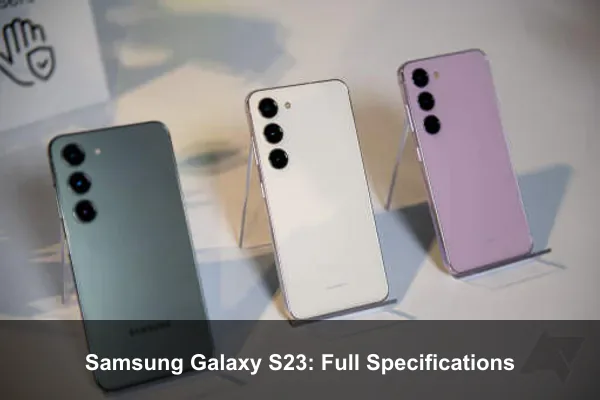
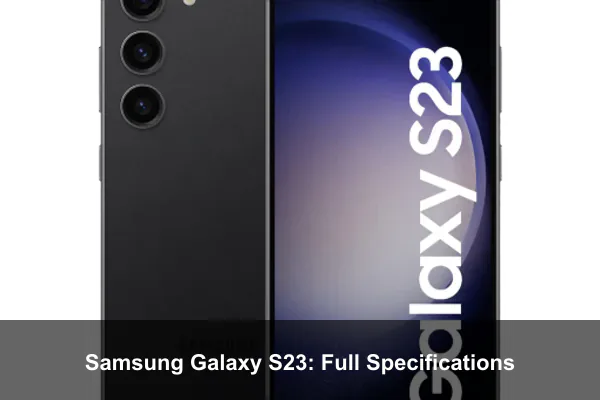
The Samsung Galaxy S23 arrived in February 2023 as the compact flagship in Samsung’s lineup, packing a tuned Snapdragon 8 Gen 2 for Galaxy, a 6.1-inch Dynamic AMOLED 2X panel, and a familiar triple-camera array into a body that weighs just 168 grams. It targets users who want top-tier performance without the bulk of a Plus or Ultra model.
This breakdown focuses on how the S23 holds up as a daily driver years after launch, what its hardware delivers in real use, and where it still makes sense as a value pick at today’s pricing.
Full Specifications
Network
| Technology: | GSM / CDMA / HSPA / EVDO / LTE / 5G |
| 2G bands: | GSM 850 / 900 / 1800 / 1900 |
| CDMA 800 / 1900 & TD-SCDMA | |
| 3G bands: | HSDPA 850 / 900 / 1700(AWS) / 1900 / 2100 |
| CDMA2000 1xEV-DO | |
| 4G bands: | 1, 2, 3, 4, 5, 7, 8, 12, 13, 17, 18, 19, 20, 25, 26, 28, 32, 38, 39, 40, 41, 66 – International |
| 1, 2, 3, 4, 5, 7, 8, 12, 13, 20, 25, 26, 28, 38, 39, 40, 41, 46, 48, 66, 71 – USA | |
| 5G bands: | 1, 2, 3, 5, 7, 8, 12, 20, 25, 28, 38, 40, 41, 66, 75, 77, 78 SA/NSA/Sub6 – International |
| 1, 7, 25, 28, 41, 66, 71, 78, 258, 260, 261 SA/NSA/Sub6/mmWave – USA | |
| Speed: | HSPA, LTE (up to 7CA), 5G |
Launch
| Announced: | 2023, February 01 |
| Status: | Available. Released 2023, February 17 |
Body
| Dimensions: | 146.3 x 70.9 x 7.6 mm (5.76 x 2.79 x 0.30 in) |
| Weight: | 168 g (5.93 oz) |
| Build: | Glass front (Gorilla Glass Victus 2), glass back (Gorilla Glass Victus 2), aluminum frame |
| SIM: | Nano-SIM + eSIMNano-SIM + Nano-SIM + eSIM (max 2 at a time) |
| IP68 dust tight and water resistant (immersible up to 1.5m for 30 min) Armor aluminum frame |
Display
| Type: | Dynamic AMOLED 2X, 120Hz, HDR10+, 1200 nits (HBM), 1750 nits (peak) |
| Size: | 6.1 inches, 90.1 cm2 (~86.8% screen-to-body ratio) |
| Resolution: | 1080 x 2340 pixels, 19.5:9 ratio (~425 ppi density) |
| Protection: | Corning Gorilla Glass Victus 2 |
Platform
| OS: | Android 13, up to 4 major Android upgrades, One UI 6.1.1 |
| Chipset: | Qualcomm SM8550-AC Snapdragon 8 Gen 2 (4 nm) |
| CPU: | Octa-core (1×3.36 GHz Cortex-X3 & 2×2.8 GHz Cortex-A715 & 2×2.8 GHz Cortex-A710 & 3×2.0 GHz Cortex-A510) |
| GPU: | Adreno 740 |
Memory
| Card slot: | No |
| Internal: | 128GB 8GB RAM, 256GB 8GB RAM, 512GB 8GB RAM |
| UFS 3.1 – 128GB only UFS 4.0 |
Main Camera
| Triple: | 50 MP, f/1.8, 24mm (wide), 1/1.56″, 1.0µm, dual pixel PDAF, OIS 10 MP, f/2.4, 70mm (telephoto), 1/3.94″, 1.0µm, PDAF, OIS, 3x optical zoom 12 MP, f/2.2, 13mm, 120˚ (ultrawide), 1/2.55″ 1.4µm, Super Steady video |
| Features: | LED flash, auto-HDR, panorama |
| Video: | 8K@24/30fps, 4K@30/60fps, 1080p@30/60/120/240fps, HDR10+, stereo sound rec., gyro-EIS |
Selfie camera
| Single: | 12 MP, f/2.2, 26mm (wide), 1/3.2″, 1.12µm, dual pixel PDAF |
| Features: | HDR, HDR10+ |
| Video: | 4K@30/60fps, 1080p@30fps |
Sound
| Loudspeaker: | Yes, with stereo speakers |
| 3.5mm jack: | No |
| 32-bit/384kHz audio Tuned by AKG |
Comms
| WLAN: | Wi-Fi 802.11 a/b/g/n/ac/6e, tri-band, Wi-Fi Direct |
| Bluetooth: | 5.3, A2DP, LE |
| Positioning: | GPS, GLONASS, BDS, GALILEO |
| NFC: | Yes |
| Radio: | No |
| USB: | USB Type-C 3.2, OTG |
Features
| Sensors: | Fingerprint (under display, ultrasonic), accelerometer, gyro, proximity, compass, barometer |
| Samsung DeX, Samsung Wireless DeX (desktop experience support) Circle to Search |
Battery
| Type: | Li-Ion 3900 mAh |
| Charging: | 25W wired, PD3.0, 50% in 30 min 15W wireless (Qi) 4.5W reverse wireless |
Misc
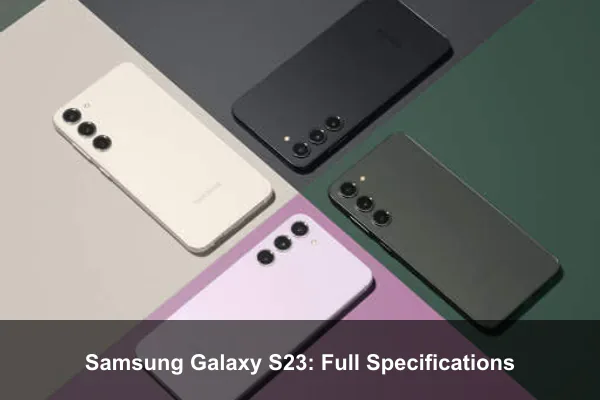
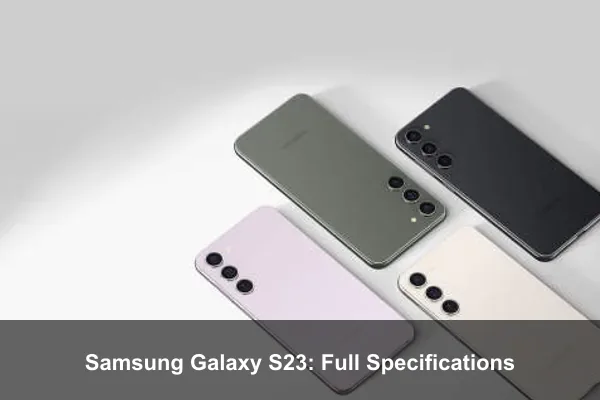
| Colors: | Phantom Black, Cream, Green, Lavender, Graphite, Lime |
| Models: | SM-S911B, SM-S911B/DS, SM-S911U, SM-S911U1, SM-S911W, SM-S911N, SM-S9110, SM-S911E, SM-S911E/DS |
| SAR: | 0.95 W/kg (head) 0.88 W/kg (body) |
| SAR EU: | 0.96 W/kg (head) 1.30 W/kg (body) |
| Price: | € 299.00 / $ 254.00 / £ 249.99 / ₹ 46,500 |
Our Tests
| Performance: | AnTuTu: 1231075 (v9) GeekBench: 4950 (v5.1) GFXBench: 110fps (ES 3.1 onscreen) |
| Display: | 1198 nits max brightness (measured) |
| Camera: | Photo / Video |
| Loudspeaker: | -27.0 LUFS (Good) |
| Battery: | Active use score 11:27h |
| Battery (old): | Endurance rating 101h |
Price and Availability
The Samsung Galaxy S23 offers a compelling combination of features and performance. While the base price is around €299, the actual cost may vary depending on your location and retailer. Below, you’ll find the approximate price of the Samsung Galaxy S23 converted into various currencies. Please note that these are estimates based on recent exchange rates as of May 27, 2026 and may not reflect the exact price you’ll find at a retailer.
- United States: $348
- Japan: ¥55,381
- United Kingdom: £258
- Australia: A$485
- Canada: C$480
- Taiwan: NT$10,933
- Denmark: kr2.231
- Saudi Arabia: ﷼1,304
- South Korea: ₩524,153
- Germany: €299
- Brazil: R$1.748
- Vietnam: ₫9.094.323
- Kenya: KSh 45,078
- India: ₹33,250
- Indonesia: Rp 6.181.179
- Nigeria: ₦473,018
- Pakistan: ₨96,976
- Philippines: ₱21,406
- Bangladesh: ৳৪২,৭০৪
Value Proposition in the Current Market
With the Galaxy S23 now selling around €299 / $254 / £249.99 / ₹46,500, it has shifted from premium flagship to one of the most affordable Snapdragon 8 Gen 2 phones you can buy. That price brings a true flagship SoC, IP68 rating, wireless charging, and four years of Android upgrades, a combination that mid-range phones at the same price simply cannot match.
Compact Design and Build Quality
At 146.3 x 70.9 x 7.6 mm and 168 g, the S23 is one of the few remaining truly one-hand-friendly Android flagships. The aluminum armor frame is paired with Gorilla Glass Victus 2 on both the front and back, and IP68 certification allows submersion up to 1.5 meters for 30 minutes. Color choices include Phantom Black, Cream, Green, Lavender, and the exclusive Graphite and Lime finishes.
Display Experience
The 6.1-inch Dynamic AMOLED 2X panel runs at 120Hz with a 1080 x 2340 resolution (425 ppi). Peak brightness is rated at 1750 nits, with our measured value hitting 1198 nits, comfortable enough for outdoor reading. HDR10+ support and the high screen-to-body ratio of 86.8% make the compact footprint feel larger in use than its dimensions suggest.
Performance and Thermals
The Snapdragon 8 Gen 2 for Galaxy clocks its prime Cortex-X3 core at 3.36 GHz, paired with the Adreno 740 GPU. AnTuTu scores reach 1,231,075 (v9) with a GeekBench 5.1 result of 4,950 and 110 fps in GFXBench ES 3.1 onscreen, numbers that remain competitive with current-gen mid-flagships. Storage starts at UFS 3.1 on the 128GB variant and steps up to UFS 4.0 on 256GB and 512GB tiers, all paired with 8GB RAM.
Camera System in Daily Use
The triple rear setup pairs a 50MP f/1.8 main with OIS, a 10MP f/2.4 3x telephoto, and a 12MP f/2.2 ultrawide. Video tops out at 8K at 24/30fps, with stabilized 4K at 60fps as the practical sweet spot. The 12MP front camera with dual pixel PDAF handles 4K at 60fps for vloggers. It’s a versatile, conservative system that prioritizes consistency over experimental hardware.
Battery Life and Charging
The 3900 mAh Li-Ion cell delivers an active-use score of 11 hours and 27 minutes, helped by the efficient 4nm chip and modest display resolution. Charging is the weak point at 25W wired (50% in 30 minutes), with 15W Qi wireless and 4.5W reverse wireless filling out the spec sheet. Compared to Chinese rivals offering 80W+, this is conservative.
Software and Long-Term Support
The S23 ships with One UI 6.1.1 on top of Android and is promised up to four major Android upgrades, with Circle to Search and Samsung DeX desktop mode included. That support window means the device should remain current well into 2027, an unusually long runway for a phone at this price point.
Connectivity
Wi-Fi 6E with tri-band support, Bluetooth 5.3, NFC, and USB Type-C 3.2 with OTG cover the modern essentials. 5G coverage includes both Sub6 and mmWave on US variants. The ultrasonic under-display fingerprint reader remains one of the fastest and most reliable in-display sensors available.
Who Should Buy the Galaxy S23
This phone suits buyers who prefer compact handsets, value long software support, and want a stable, polished flagship experience without paying flagship prices. It is less suited to power users who prioritize fast charging or want the biggest possible screen, who should look at the S23+ or newer Ultra models instead.
Conclusion
The Samsung Galaxy S23 is one of the smartest value picks for anyone wanting a small, premium Android phone with years of guaranteed updates. If a compact form factor and software longevity matter more to you than the latest 100W charging or a periscope zoom, the S23 at its current price is hard to beat.
