
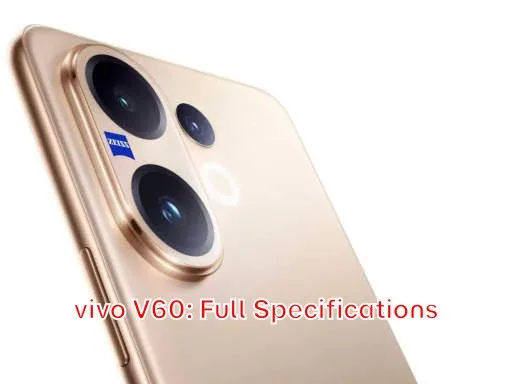
The vivo V60 is poised to make a significant impact on the smartphone market, and understanding its comprehensive capabilities is essential for potential buyers and tech enthusiasts alike. This article provides an in-depth exploration of the vivo V60’s full specifications, covering everything from its cutting-edge processor and stunning display to its advanced camera system and robust battery life. Delve into the details and discover what sets the vivo V60 apart from the competition, allowing you to make an informed decision about whether this device is the right fit for your needs.
Prepare to be immersed in a detailed overview of the vivo V60. We will meticulously examine each aspect of this phone, from its network connectivity and storage options to its unique software features. By providing a comprehensive analysis of the vivo V60’s specifications, we aim to equip you with the knowledge necessary to fully appreciate its potential and compare it effectively with other smartphones on the market. Get ready to explore the power and innovation packed into the vivo V60.
Full Specifications
Network
| Technology: | GSM / HSPA / LTE / 5G |
| 2G bands: | GSM 850 / 900 / 1800 / 1900 |
| 3G bands: | HSDPA 800 / 850 / 900 / 1700(AWS) / 1900 / 2100 |
| 4G bands: | 1, 3, 4, 5, 8, 18, 19, 26, 28, 38, 39, 40, 41, 42, 66 |
| 5G bands: | 1, 3, 5, 8, 28, 38, 40, 41, 66, 77, 78 SA/NSA |
| Speed: | HSPA, LTE, 5G |
Launch
| Announced: | 2025, August 12 |
| Status: | Coming soon. Exp. release 2025, August 19 |
Body
| Dimensions: | 163.5 x 77 x 7.5 mm or 7.8 mm |
| Weight: | 192 g or 201 g (6.77 oz) |
| Build: | Glass front, plastic back or glass back |
| SIM: | Nano-SIM + Nano-SIM |
| IP68/IP69 dust tight and water resistant (high pressure water jets; immersible up to 1.5m for 120 min) |
Display
| Type: | AMOLED, 1B colors, HDR10+, 120Hz, 1500 nits (HBM), 5000 nits (peak) |
| Size: | 6.77 inches, 110.9 cm2 (~88.1% screen-to-body ratio) |
| Resolution: | 1080 x 2392 pixels (~388 ppi density) |
| Protection: | Schott Xensation Core |
Platform
| OS: | Android 15, up to 4 major Android upgrades, Funtouch 15 |
| Chipset: | Qualcomm SM7750-AB Snapdragon 7 Gen 4 (4 nm) |
| CPU: | Octa-core (1×2.8 GHz Cortex-720 & 4×2.4 GHz Cortex-720 & 3×1.8 GHz Cortex-520) |
| GPU: | Adreno 722 |
Memory
| Card slot: | No |
| Internal: | 128GB 8GB RAM, 256GB 8GB RAM, 256GB 12GB RAM, 512GB 16GB RAM |
| UFS 2.2 |
Main Camera
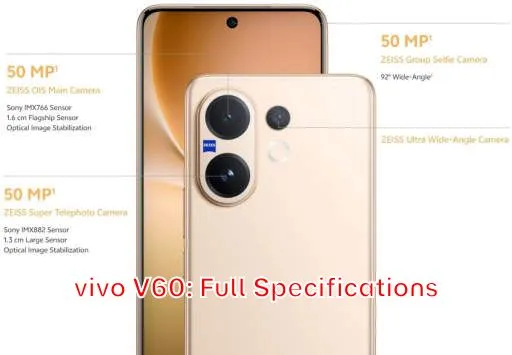
| Triple: | 50 MP, f/1.9, 23mm (wide), 1/1.56″, 1.0µm, PDAF, OIS 50 MP, f/2.7, 73mm (periscope telephoto), 1/1.95″, 0.8µm, PDAF, OIS, 3x optical zoom 8 MP, f/2.0, 15mm, 120˚ (ultrawide) |
| Features: | Zeiss optics, Ring-LED flash, panorama, HDR |
| Video: | 4K@30fps, 1080p@30fps, gyro-EIS, OIS |
Selfie camera
| Single: | 50 MP, f/2.2, 21mm (wide), 1/2.76″, 0.64µm, AF |
| Features: | Zeiss optics, HDR |
| Video: | 4K@30fps, 1080p@30fps |
Sound
| Loudspeaker: | Yes, with stereo speakers |
| 3.5mm jack: | No |
Comms
| WLAN: | Wi-Fi 802.11 a/b/g/n/ac, dual-band |
| Bluetooth: | 5.4, A2DP, LE |
| Positioning: | GPS, GALILEO, GLONASS, QZSS, BDS, NavIC |
| NFC: | Yes |
| Infrared port: | Yes |
| Radio: | No |
| USB: | USB Type-C 2.0, OTG |
Features
| Sensors: | Fingerprint (under display, optical), accelerometer, gyro, proximity, compass |
Battery
| Type: | Si/C Li-Ion 6500 mAh |
| Charging: | 90W wired, PD Reverse wired Bypass charging |
Misc
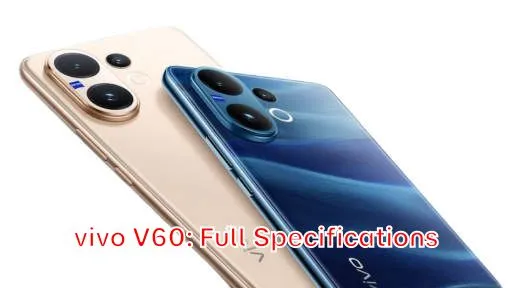
| Colors: | Mist Grey, Moonlit Blue, Auspicious Gold |
| Models: | V2511 |
| SAR: | 0.99 W/kg (head) 0.93 W/kg (body) |
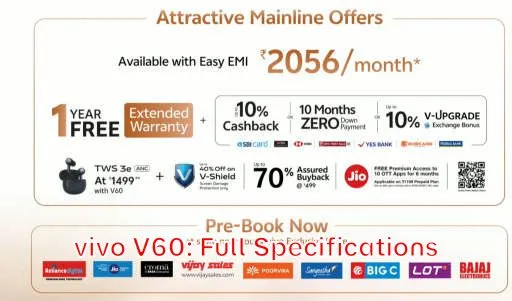
| Price: | About 360 EUR |
Price of HP Vivo V60
The HP Vivo V60 is expected to retail for around 360 EUR. Please note that the final price may vary slightly depending on the retailer, specific model configuration, and any applicable taxes or promotions. Below are the approximate prices converted to various currencies based on current exchange rates. Keep in mind these are estimates and subject to fluctuation.
- United States: $385
- Japan: ¥60,000
- United Kingdom: £305
- Australia: $580 AUD
- Canada: $525 CAD
- Taiwan: NT$12,000
- Denmark: kr 2,700
- Saudi Arabia: SAR 1,450
- South Korea: ₩520,000
- Germany: €360
- Brazil: R$2,000
- Vietnam: ₫9,300,000
- Kenya: KES 50,000
- India: ₹32,000
- Indonesia: Rp 6,300,000
- Nigeria: ₦580,000
- Pakistan: PKR 110,000
- Philippines: ₱22,000
- Bangladesh: ৳45,000
Vivo V60: Is It the Right Phone for You?
The Vivo V60 is making waves in the smartphone market, promising a blend of style, performance, and advanced features. Deciding whether it’s the right phone for you requires a deeper dive beyond the marketing hype. This analysis explores key aspects of the V60, helping you make an informed decision based on your individual needs and priorities.
Before committing, consider your primary phone usage. Are you a photography enthusiast? A mobile gamer? Or someone who values long battery life and a seamless user experience for everyday tasks? Understanding your needs is crucial. The V60 attempts to cater to a broad audience, but excels in specific areas that we’ll dissect.
For instance, if camera quality is your top priority, the V60’s camera system will be a major factor. We’ll examine its capabilities in detail, looking at its strengths and weaknesses in various lighting conditions. Similarly, if you heavily rely on your phone throughout the day, the V60’s battery life and charging capabilities will be critical to consider. We will also analyze the performance of the V60; if it can handle demanding applications and the gaming that are essential to your daily needs.
Ultimately, this guide provides a comprehensive overview of the Vivo V60, enabling you to determine if it aligns with your expectations and whether it offers the features and performance you need in a modern smartphone.
Capture Stunning Photos with the Vivo V60’s Camera: What You Need to Know
The camera is a crucial aspect of any modern smartphone, and the Vivo V60 aims to impress. It boasts a multi-lens system with a high-resolution primary sensor, often accompanied by ultrawide and macro lenses, offering versatility for various shooting scenarios. The megapixel count is not the only indicator of image quality, so we’ll delve deeper into the sensor size, aperture, and image processing capabilities.
Daylight photography is generally excellent on most modern smartphones, and the V60 is no exception. Expect vibrant colors, good dynamic range, and sharp details. However, the real test lies in low-light performance. The V60 likely employs software enhancements and a wider aperture to capture more light in dimly lit environments. We’ll examine how well it performs in these challenging conditions, looking for noise levels, detail retention, and color accuracy.
Video recording is another important aspect. The V60 likely supports 4K video recording at various frame rates. Stabilization is key for smooth video, so we’ll investigate whether it utilizes optical image stabilization (OIS) or electronic image stabilization (EIS) to minimize camera shake. Furthermore, we’ll look at additional video features like slow-motion recording, time-lapse, and special video modes.
Vivo V60 Camera Features: Beyond the Megapixels
While megapixel count often grabs headlines, the true power of a smartphone camera lies in its software and features. The Vivo V60 likely offers a range of AI-powered enhancements that optimize settings based on the scene. Scene recognition automatically adjusts parameters for optimal results, while features like portrait mode create a pleasing background blur.
Many smartphones, including the V60, incorporate night mode, which uses software algorithms to brighten and sharpen low-light photos. This feature typically combines multiple exposures to reduce noise and improve clarity. The effectiveness of night mode can vary, so we’ll evaluate its performance in detail.
Other features to consider include the capabilities of the ultrawide and macro lenses. The ultrawide lens allows you to capture expansive landscapes or fit more into a single shot, while the macro lens lets you get incredibly close to subjects for detailed close-up photos. The quality and usability of these lenses can greatly enhance the overall camera experience.
Vivo V60 Battery Life: Will It Last All Day?
Battery life is a crucial factor for most smartphone users. The Vivo V60’s battery capacity, measured in mAh (milliampere-hours), provides an initial indication of its potential endurance. However, real-world battery life depends on various factors, including usage patterns, screen brightness, and the efficiency of the phone’s processor.
Typical smartphone usage, involving web browsing, social media, messaging, and occasional gaming, will likely drain the battery at a moderate rate. Demanding tasks like video streaming, GPS navigation, and graphics-intensive gaming consume significantly more power. The V60 likely features power-saving modes that limit background activity and reduce performance to extend battery life when needed.
Charging speed is also important. The V60 likely supports fast charging technology, allowing you to quickly replenish the battery. The charging wattage (e.g., 33W, 66W, or higher) indicates how quickly the phone can charge. Some smartphones also support wireless charging, providing a convenient alternative to wired charging.
Data related to battery life would be something like this: with a 4500mAh battery and moderate usage, users should expect around 8-10 hours of screen-on time. Heavy users might see closer to 6-7 hours, while light users could potentially stretch it to a day and a half. For comparison, the average smartphone user checks their phone over 100 times a day. The Vivo V60’s battery is good, but not great.
Vivo V60: Who is This Phone Designed For?
The Vivo V60 appears to be designed for a broad audience, but it caters specifically to individuals who value a combination of style, camera capabilities, and decent performance. It’s a phone aimed at those who appreciate a sleek design and want a versatile camera system for capturing everyday moments.
If you are a social media enthusiast who frequently posts photos and videos, the V60’s camera features and image processing are likely to appeal to you. The phone is also suitable for users who enjoy mobile gaming, as long as they don’t require the absolute highest frame rates and graphical settings. Its performance is sufficient for most popular games, though demanding titles might require some compromises.
The V60 is also a good option for users who prioritize battery life. While it might not be the absolute best in its class, it offers adequate endurance for a full day of typical use. The fast charging capabilities also allow for quick top-ups when needed.
Ultimately, the Vivo V60 is a well-rounded smartphone that offers a balanced set of features. It’s a good choice for users who want a stylish, capable, and reliable device without breaking the bank.
Vivo V60: Design and Build Quality – A Closer Look
Design and build quality are crucial factors when choosing a smartphone. The Vivo V60 likely features a premium design with a glass back and a metal frame, contributing to a sophisticated look and feel. The specific materials used can vary, with options like aluminum or stainless steel for the frame and Corning Gorilla Glass for the back panel to provide scratch resistance.
The phone’s overall dimensions and weight play a significant role in its ergonomics. A slim and lightweight design makes it easier to hold and operate with one hand. The placement of buttons, such as the power and volume keys, should also be considered for ease of access.
Durability is another important aspect. The V60 might feature some level of water and dust resistance, indicated by an IP rating (e.g., IP67 or IP68). This rating signifies the phone’s ability to withstand exposure to water and dust, providing added protection against accidental spills or exposure to harsh environments.
Is the Vivo V60 Comfortable to Hold? Ergonomics Examined
Ergonomics is critical for comfortable and enjoyable smartphone use. The Vivo V60’s shape, size, and weight all contribute to its overall ergonomics. A curved back design often improves grip, making it easier to hold the phone securely.
The placement of the fingerprint sensor is another ergonomic consideration. Some phones have the sensor on the back, while others integrate it into the power button or under the display. The location and responsiveness of the fingerprint sensor can significantly impact the user experience.
One-handed usability is also important. The V60’s display size and aspect ratio will determine how easy it is to reach all corners of the screen with one hand. Software features like one-handed mode can help to make larger phones more manageable.
Vivo V60: The Performance You Can Expect
Performance is a critical factor when evaluating a smartphone. The Vivo V60’s performance depends on its processor (CPU), graphics processing unit (GPU), and RAM (random access memory). The CPU handles general processing tasks, while the GPU is responsible for graphics rendering. RAM is used for storing data that the phone is actively using, allowing for faster multitasking.
The V60 likely features a mid-range or high-end processor from Qualcomm Snapdragon or MediaTek. These processors offer a balance of performance and power efficiency. The amount of RAM typically ranges from 6GB to 8GB or more, providing ample memory for running multiple apps simultaneously.
Real-world performance depends on how well the phone’s hardware and software are optimized. A well-optimized phone will feel smooth and responsive, with quick app launch times and seamless multitasking. Software updates also play a crucial role in maintaining performance and fixing bugs.
Gaming on the Vivo V60: Smooth or Stuttering?
For mobile gamers, the Vivo V60’s gaming performance is a key consideration. The GPU plays a crucial role in rendering graphics smoothly. The Adreno GPU found in Qualcomm Snapdragon processors is generally well-regarded for its gaming capabilities.
The V60’s display also contributes to the gaming experience. A high refresh rate display (e.g., 90Hz or 120Hz) can make games feel smoother and more responsive. The display’s resolution and color accuracy also impact the visual quality of games.
Thermal management is another important factor. Prolonged gaming can cause the phone to heat up, which can lead to performance throttling. The V60 likely has a thermal management system to prevent overheating and maintain consistent performance during extended gaming sessions. Expect smooth gameplay on medium settings for most demanding games, with occasional frame drops on higher settings.
Vivo V60 Alternatives: Exploring Competing Smartphones
Before committing to the Vivo V60, it’s wise to explore alternative smartphones in the same price range. Competing brands like Samsung, Xiaomi, Realme, and OnePlus offer a variety of options with different strengths and weaknesses.
Samsung’s Galaxy A series and M series offer a range of mid-range smartphones with good displays, capable cameras, and reliable performance. Xiaomi’s Redmi and POCO brands are known for offering excellent value for money, with competitive specs at affordable prices. Realme smartphones often prioritize fast charging and stylish designs. OnePlus offers a smooth and refined user experience, with a focus on performance and clean software.
Comparing the V60 to these alternatives in terms of price, specs, features, and user reviews can help you make a more informed decision. Consider what features are most important to you, such as camera quality, battery life, performance, or display quality, and then compare the V60 to its competitors in those areas.
Vivo V60: Should You Upgrade From Your Current Phone?
Deciding whether to upgrade to the Vivo V60 from your current phone depends on several factors. Consider the age and performance of your current device. If it’s several years old and struggling to keep up with your needs, an upgrade might be worthwhile.
Assess the specific areas where your current phone is lacking. If you’re unhappy with the camera quality, battery life, or performance, the V60 might offer a significant improvement. However, if your current phone still meets your needs adequately, an upgrade might not be necessary.
Evaluate the cost of the V60 and whether it fits within your budget. Consider the potential resale value of your current phone, which can help offset the cost of the upgrade. Ultimately, the decision to upgrade is a personal one based on your individual needs, priorities, and financial situation.
