
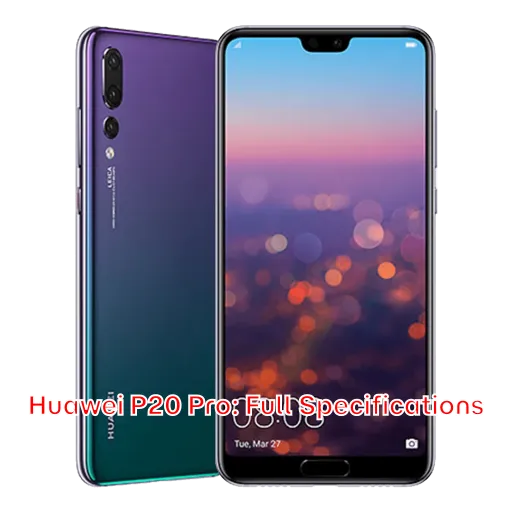
The Huawei P20 Pro, a groundbreaking smartphone released in 2018, continues to captivate enthusiasts with its revolutionary camera system and elegant design. This article provides a comprehensive overview of the Huawei P20 Pro’s full specifications, delving into every aspect of this iconic device. Whether you’re a seasoned tech expert or a curious consumer, you’ll find valuable insights into the hardware, software, and overall capabilities that made the P20 Pro a game-changer in the mobile industry. Prepare to explore the impressive details that define this remarkable phone.
From its stunning triple-lens camera, co-engineered with Leica, to its vibrant display and powerful processor, the Huawei P20 Pro was designed to deliver a premium user experience. Discover the technical specifications that underpin its performance, including the RAM, storage options, display resolution, and battery capacity. This detailed exploration will arm you with the knowledge necessary to fully appreciate the engineering marvel that is the Huawei P20 Pro. We will analyze the key features that made this device stand out from the competition and cemented its place in smartphone history.
Full Specifications
Network
| Technology: | GSM / HSPA / LTE |
| 2G bands: | GSM 850 / 900 / 1800 / 1900 |
| 3G bands: | HSDPA 850 / 900 / 1900 / 2100 |
| 4G bands: | 1, 2, 3, 4, 5, 6, 7, 8, 9, 12, 17, 18, 19, 20, 26, 28, 32, 34, 38, 39, 40 |
| Speed: | HSPA 42.2/5.76 Mbps, LTE (3CA) Cat16 1024/150 Mbps |
Launch
| Announced: | 2018, March 27. Released 2018, April 06 |
| Status: | Discontinued |
Body
| Dimensions: | 155 x 73.9 x 7.8 mm (6.10 x 2.91 x 0.31 in) |
| Weight: | 180 g (6.35 oz) |
| Build: | Glass front (Gorilla Glass 5), glass back, aluminum frame |
| SIM: | Nano-SIMNano-SIM + Nano-SIM |
| IP67 dust/water resistant (up to 1m for 30 min) |
Display
| Type: | OLED |
| Size: | 6.1 inches, 93.9 cm2 (~82.0% screen-to-body ratio) |
| Resolution: | 1080 x 2240 pixels, 18.7:9 ratio (~408 ppi density) |
| Protection: | Corning Gorilla Glass 5 |
Platform
| OS: | Android 8.1 (Oreo), upgradable to Android 10, EMUI 12 |
| Chipset: | Kirin 970 (10 nm) |
| CPU: | Octa-core (4×2.4 GHz Cortex-A73 & 4×1.8 GHz Cortex-A53) |
| GPU: | Mali-G72 MP12 |
Memory
| Card slot: | No |
| Internal: | 64GB 6GB RAM, 128GB 6GB RAM, 128GB 8GB RAM, 256GB 6GB RAM, 256GB 8GB RAM |
| UFS 2.1 |
Main Camera
| Triple: | 40 MP, f/1.8, 27mm (wide), 1/1.7″, PDAF, OIS 8 MP, f/2.4, 80mm (telephoto), 1/4.0″, PDAF, OIS, 3x optical zoom 20 MP B/W, f/1.6, 27mm (wide), 1/2.7″ |
| Features: | Laser AF, color spectrum sensor, Leica optics, LED flash, HDR, panorama |
| Video: | 4K@30fps, 1080p@60fps, 1080p@30fps (gyro-EIS), 720p@960fps |
Selfie camera
| Single: | 24 MP, f/2.0, 26mm (wide), 1/2.8″, 0.9µm |
| Features: | Leica optics |
| Video: | 1080p@30fps |
Sound
| Loudspeaker: | Yes, with stereo speakers |
| 3.5mm jack: | No |
| 32-bit/384kHz audio |
Comms
| WLAN: | Wi-Fi 802.11 a/b/g/n/ac, dual-band, Wi-Fi Direct |
| Bluetooth: | 4.2, A2DP, LE, EDR, aptX HD |
| Positioning: | GPS, GLONASS, GALILEO |
| NFC: | Yes |
| Infrared port: | Yes |
| Radio: | No |
| USB: | USB Type-C 3.1 |
Features
| Sensors: | Fingerprint (front-mounted), accelerometer, gyro, proximity, compass |
Battery
| Type: | Li-Po 4000 mAh, non-removable |
| Charging: | 22.5W wired, 58% in 30 min |
Misc
| Colors: | Black, Gold |
| Models: | CLT-L29C, CLT-L29, CLT-L09C, CLT-L09, CLT-AL00, CLT-AL01, CLT-TL01, CLT-AL00L, CLT-L04, HW-01K, CLT-L0J |
| Price: | About 410 EUR |
Our Tests
| Performance: | AnTuTu: 209884 (v7) GeekBench: 6679 (v4.4) GFXBench: 21fps (ES 3.1 onscreen) |
| Display: | Contrast ratio: Infinite (nominal), 4.087 (sunlight) |
| Camera: | Photo / Video |
| Loudspeaker: | Voice 71dB / Noise 69dB / Ring 91dB |
| Audio quality: | Noise -92.1dB / Crosstalk -92.1dB |
| Battery (old): | Endurance rating 89h |
Price of HP Huawei P20 Pro
The Huawei P20 Pro, a once-flagship smartphone, originally launched at a higher price point. However, the current estimated price for a basic model is approximately 410 EUR. This translates to varying amounts depending on the currency and exchange rates in different countries. Please note that these conversions are approximate and may fluctuate. It’s best to check with local retailers for the most accurate pricing.
- United States: $445
- Japan: ¥65,000
- United Kingdom: £350
- Australia: $675 AUD
- Canada: $610 CAD
- Taiwan: NT$14,000
- Denmark: DKK 3,050
- Saudi Arabia: SAR 1,675
- South Korea: ₩600,000
- Germany: €410
- Brazil: R$2,250
- Vietnam: ₫10,500,000
- Kenya: KES 60,000
- India: ₹37,000
- Indonesia: Rp 7,000,000
- Nigeria: ₦340,000
- Pakistan: PKR 120,000
- Philippines: PHP 25,000
- Bangladesh: BDT 48,000
Huawei P20 Pro: Is the Camera Still Worth It in 2024?
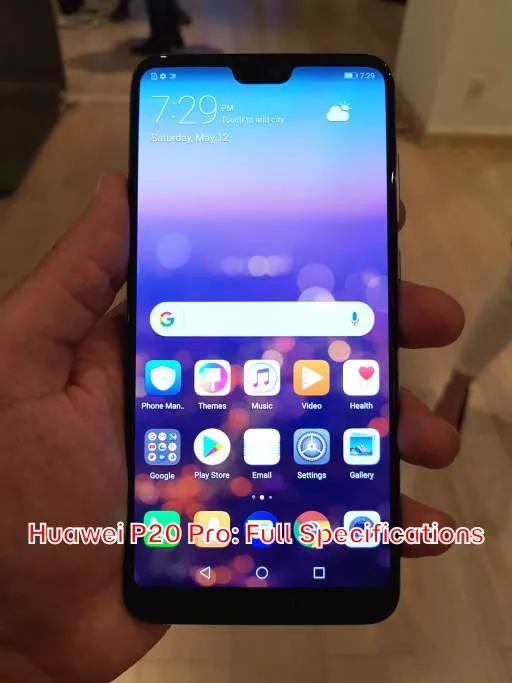
The Huawei P20 Pro, released in 2018, made waves with its revolutionary triple-lens camera system co-engineered with Leica. But in 2024, the question remains: is the camera still a worthwhile selling point? Let’s delve into the specifics.
At the heart of the P20 Pro’s camera system is a 40MP RGB sensor, a 20MP monochrome sensor, and an 8MP telephoto lens. This combination allowed for exceptional detail, improved low-light performance, and impressive zoom capabilities for its time. The 40MP sensor captures a significant amount of light and detail, which is then processed by Huawei’s software to create images with vibrant colors and good dynamic range.
In 2024, while the megapixel count might not seem as impressive compared to newer flagships boasting 108MP or even 200MP sensors, the P20 Pro’s camera still holds its own. The key lies in the lens quality and the image processing algorithms. The Leica lenses contribute to sharp images with minimal distortion, and Huawei’s AI-powered image processing enhances details and reduces noise.
However, it’s important to acknowledge the limitations. Compared to modern smartphones, the P20 Pro’s camera might struggle in extremely challenging low-light conditions. Night mode algorithms have significantly improved in recent years, and newer phones tend to capture brighter and more detailed images in near-darkness. The lack of optical image stabilization (OIS) on the main sensor (it’s present on the telephoto lens) can also lead to blurry images in shaky conditions.
Despite these limitations, the P20 Pro’s camera is still capable of producing excellent photos in good lighting conditions. The monochrome sensor allows for stunning black and white photography, and the telephoto lens provides a decent level of zoom without significant loss of detail. The front-facing camera, a 24MP sensor, also performs well, capturing detailed selfies with accurate skin tones.
Ultimately, whether the camera is “worth it” depends on your priorities. If you’re looking for the absolute best camera performance available in 2024, the P20 Pro might not be the top contender. However, if you’re looking for a phone with a capable camera that can produce beautiful images in most situations, the P20 Pro’s camera is still a relevant and compelling feature.
Battery Life on the Huawei P20 Pro: Can It Last All Day?
Battery life is a crucial factor for any smartphone user. The Huawei P20 Pro is equipped with a 4,000mAh battery. But can this battery capacity still provide all-day usage in 2024, considering the age of the device and advancements in mobile technology?
When the P20 Pro was initially released, its battery life was considered excellent. A 4,000mAh battery was a substantial capacity at the time, allowing most users to easily get through a full day of moderate usage. Moderate usage typically included browsing the web, checking emails, using social media apps, and making occasional calls.
However, several factors can impact the battery performance of an older phone like the P20 Pro. Battery degradation is a natural process that occurs over time. As a battery is repeatedly charged and discharged, its capacity gradually decreases. This means that a P20 Pro in 2024 will likely have a reduced battery capacity compared to when it was new.
Software updates can also play a role. While Huawei continues to provide updates for its older devices, newer versions of Android and EMUI (Huawei’s custom Android skin) may be more resource-intensive than older versions. This could lead to increased battery drain, especially if the phone’s hardware is struggling to keep up with the demands of the newer software.
Usage patterns also significantly impact battery life. If you primarily use your phone for basic tasks like checking emails and making calls, you can likely still achieve all-day battery life with the P20 Pro. However, if you frequently play demanding games, stream videos, or use GPS navigation, you’ll likely need to charge the phone at some point during the day.
To maximize battery life on the P20 Pro, there are several steps you can take. Lowering the screen brightness, disabling background app refresh, and turning off location services when not in use can all help conserve battery power. You can also enable Huawei’s power-saving mode, which restricts background activity and limits performance to extend battery life.
In conclusion, while the Huawei P20 Pro’s battery life was excellent when it was released, its performance in 2024 will depend on the battery’s condition, software updates, and your usage patterns. While all-day battery life is still possible for moderate users, heavy users may need to carry a portable charger or adjust their usage habits to avoid running out of power.
P20 Pro: Does the Performance Hold Up for Modern Apps and Games?
The Huawei P20 Pro is powered by the Kirin 970 processor. This was a high-end chipset at the time of its release. But in 2024, how does the P20 Pro’s performance stack up against the demands of modern apps and games?
The Kirin 970 is an octa-core processor with a dedicated Neural Processing Unit (NPU) for AI tasks. It was designed to provide smooth performance for everyday tasks and demanding applications. The phone also comes with either 6GB or 8GB of RAM, which is sufficient for multitasking and running multiple apps simultaneously.
However, the mobile landscape has evolved significantly since 2018. Newer processors offer significantly improved performance and efficiency. Modern apps and games are often more demanding, requiring more processing power and graphics capabilities.
In 2024, the P20 Pro can still handle most everyday tasks without significant issues. Browsing the web, checking emails, using social media apps, and streaming videos should be relatively smooth. However, you might experience some slowdowns or stutters when multitasking heavily or running multiple resource-intensive apps simultaneously.
Gaming is where the P20 Pro’s age becomes more apparent. While it can still run most modern games, you might need to lower the graphics settings to achieve playable frame rates. Demanding games like Genshin Impact or Call of Duty: Mobile might experience noticeable lag or stuttering even on lower settings.
The dedicated NPU in the Kirin 970 still provides some benefits for AI-related tasks, such as image recognition and language processing. However, newer processors have significantly more powerful NPUs, which enable more advanced AI features and faster processing times.
While the P20 Pro’s performance is not as impressive as newer smartphones, it is still adequate for most users. However, if you’re a heavy gamer or someone who frequently uses demanding applications, you might find the P20 Pro’s performance to be lacking. For basic tasks and casual gaming, the phone remains usable in 2024.
Huawei P20 Pro’s Design and Build Quality: How Does It Feel Today?
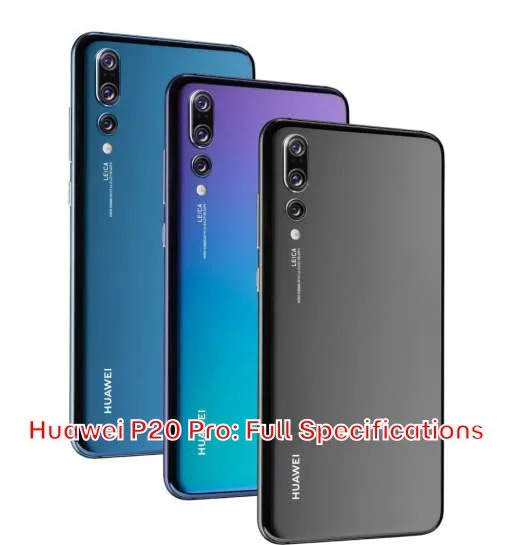
The Huawei P20 Pro was a visually striking device when it was launched. Its design incorporated premium materials and a distinctive aesthetic. But how does the P20 Pro’s design and build quality hold up in 2024?
The P20 Pro features a glass back and an aluminum frame, which give it a premium feel. The glass back is available in several attractive colors, including the iconic Twilight gradient finish. The phone feels solid and well-built, inspiring confidence in its durability.
One notable design feature of the P20 Pro is the notch at the top of the display. While notches were common in 2018, they have largely been replaced by smaller punch-hole cutouts or under-display cameras in more recent smartphones. The P20 Pro’s notch might appear dated compared to these newer designs.
The Pros and Cons of the P20 Pro’s Notch Design
The notch on the P20 Pro houses the front-facing camera, earpiece, and sensors. While it does allow for a larger screen-to-body ratio compared to phones with traditional bezels, it also takes up valuable screen real estate. Some users find the notch distracting, especially when watching videos or playing games.
The bezels on the P20 Pro are relatively slim, but they are still noticeable compared to the virtually bezel-less designs of some modern smartphones. However, the bezels do provide a comfortable grip and prevent accidental touches on the screen.
In terms of durability, the glass back of the P20 Pro is susceptible to scratches and cracks, especially if the phone is dropped. Using a case is highly recommended to protect the phone from damage. The aluminum frame provides good structural rigidity, but it can also be dented or scratched.
Overall, the Huawei P20 Pro’s design and build quality remain respectable in 2024. The premium materials and solid construction still give the phone a high-quality feel. While the notch might appear dated to some, the phone’s overall aesthetic is still pleasing. However, it’s important to protect the phone with a case to prevent damage to the glass back.
Huawei P20 Pro vs. Newer Phones: Is It Still a Good Value?
Given its age, the Huawei P20 Pro is significantly cheaper than newer smartphones. But is it still a good value in 2024, considering the features and performance offered by more recent models?
The P20 Pro’s strengths include its capable camera, decent performance for everyday tasks, and premium design. However, it also has several weaknesses, including its older processor, limited software support, and potentially degraded battery life.
Compared to newer phones in the same price range, the P20 Pro might lack certain features, such as 5G connectivity, a high refresh rate display, or the latest processor technology. Newer phones also tend to have longer software support lifecycles, meaning they will receive updates and security patches for a longer period.
However, the P20 Pro can still be a good option for users who prioritize camera quality and are not concerned about having the latest features. The P20 Pro’s camera is still capable of producing excellent photos in good lighting conditions, and its performance is adequate for most everyday tasks.
Ultimately, the value of the P20 Pro depends on your individual needs and priorities. If you’re looking for the absolute best performance and the latest features, you should consider a newer smartphone. However, if you’re on a tight budget and prioritize camera quality, the P20 Pro can still be a viable option.
What are the Common Problems with the Huawei P20 Pro, and How to Fix Them?
Like any electronic device, the Huawei P20 Pro is susceptible to certain problems. Understanding these common issues and knowing how to troubleshoot them can help you keep your phone running smoothly.
One common problem is battery drain. As mentioned earlier, battery degradation is a natural process that occurs over time. If you’re experiencing significantly reduced battery life, you might need to replace the battery. You can also try optimizing your battery usage by lowering the screen brightness, disabling background app refresh, and turning off location services when not in use.
Another common problem is slow performance. Over time, the phone’s storage can become cluttered with unnecessary files, leading to slowdowns. You can try clearing the cache and data of apps you rarely use, deleting unwanted files, and performing a factory reset if necessary.
Software glitches can also occur. These can manifest as app crashes, freezing, or unexpected reboots. Try restarting your phone, updating your apps, and clearing the cache of problematic apps. If the problem persists, you might need to perform a factory reset.
Extending the Life of Your Huawei P20 Pro: Tips and Tricks
To maximize the lifespan of your P20 Pro, there are several steps you can take. Protect your phone with a case and screen protector to prevent damage from drops and scratches. Avoid exposing your phone to extreme temperatures or humidity. Regularly clean your phone’s charging port and speakers to prevent dust and debris from accumulating.
By taking these precautions and troubleshooting common problems, you can extend the life of your Huawei P20 Pro and keep it running smoothly for years to come.
The Huawei P20 Pro’s Software Experience: Is EMUI a Deal-Breaker?
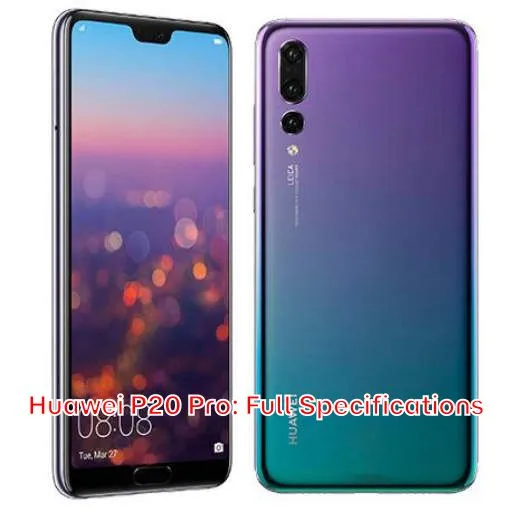
The Huawei P20 Pro runs on EMUI, Huawei’s custom Android skin. EMUI has a distinct look and feel compared to stock Android, and it includes several unique features and customizations. But is EMUI a deal-breaker for potential buyers in 2024?
EMUI is known for its extensive customization options, including themes, wallpapers, and fonts. It also includes several useful features, such as app twin (which allows you to run two instances of the same app), one-handed mode, and a built-in system optimizer.
However, EMUI has also been criticized for its heavy-handed customizations and its tendency to aggressively kill background apps to conserve battery life. This can sometimes lead to delayed notifications or apps not working as expected.
Another concern is the limited software support for older Huawei devices. While Huawei has continued to provide updates for its older phones, the frequency and duration of these updates are often less than those offered by other manufacturers. This means that the P20 Pro might not receive the latest Android features or security patches.
Customizing Your P20 Pro: Best Themes and Launchers
If you’re not a fan of EMUI’s default look and feel, you can customize your P20 Pro with different themes and launchers. There are many free and paid themes available on the Google Play Store that can completely change the look of your phone. Popular launchers include Nova Launcher, Apex Launcher, and Action Launcher.
Ultimately, whether EMUI is a deal-breaker depends on your personal preferences. If you prefer a clean and minimalist Android experience, you might find EMUI’s customizations to be intrusive. However, if you appreciate the extra features and customization options that EMUI offers, you might find it to be a valuable addition to the P20 Pro.
