
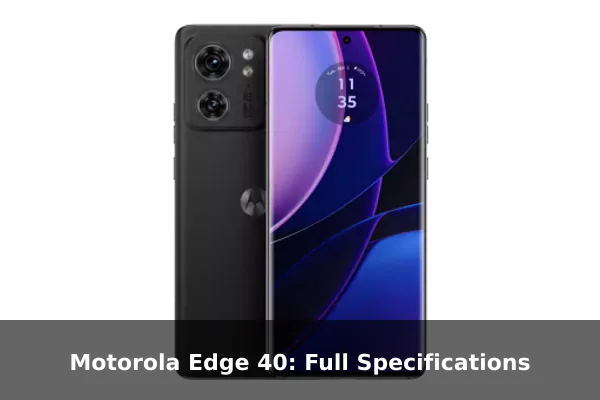
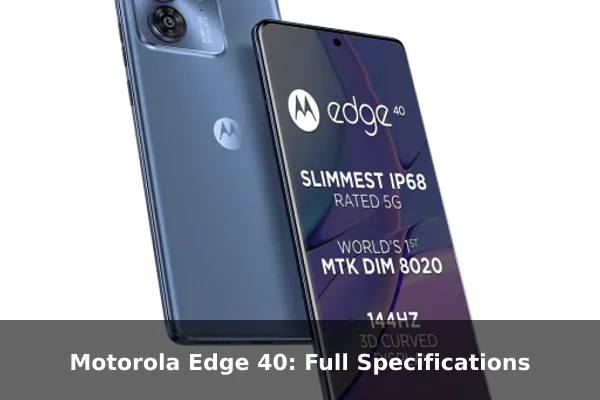
The Motorola Edge 40 is a slim Android 5G phone built around a fast 144Hz pOLED display, IP68 protection, a Dimensity 8020 chipset, and a camera system led by a bright f/1.4 50MP main sensor. It sits in an interesting space for buyers who want a premium-feeling Motorola Edge device without stepping up to the larger Pro models.
Its strongest angle is balance: a lightweight body, wireless charging, useful 5G band support, stereo speakers, and a high-refresh display in a phone that remains easy to carry. The full specifications table will cover every line item, while this article explains what those specs mean in daily use.
Full Specifications
Network
| Technology: | GSM / HSPA / LTE / 5G |
| 2G bands: | GSM 850 / 900 / 1800 / 1900 |
| 3G bands: | HSDPA 850 / 900 / 1700(AWS) / 1900 / 2100 |
| 4G bands: | 1, 2, 3, 4, 5, 7, 8, 12, 13, 17, 20, 26, 28, 32, 38, 39, 40, 41, 42, 43, 66 |
| 5G bands: | 1, 2, 3, 5, 7, 8, 20, 28, 38, 40, 41, 66, 77, 78 SA/NSA/Sub6 |
| Speed: | HSPA, LTE (CA), 5G |
Launch
| Announced: | 2023, May 04 |
| Status: | Available. Released 2023, May 04 |
Body
| Dimensions: | 158.4 x 72 x 7.6 mm (6.24 x 2.83 x 0.30 in) |
| Weight: | 167 g or 171 g (5.89 oz) |
| Build: | Glass front, aluminum frame, plastic back or eco leather back |
| SIM: | Nano-SIMNano-SIM + eSIMNano-SIM + Nano-SIM |
| IP68 dust tight and water resistant (immersible up to 1.5m for 30 min) |
Display
| Type: | P-OLED, 144Hz, HDR10+, 1200 nits (peak) |
| Size: | 6.55 inches, 103.6 cm2 (~90.8% screen-to-body ratio) |
| Resolution: | 1080 x 2400 pixels, 20:9 ratio (~402 ppi density) |
Platform
| OS: | Android 13, up to 2 major Android upgrades |
| Chipset: | Mediatek Dimensity 8020 (6 nm) |
| CPU: | Octa-core (4×2.6 GHz Cortex-A78 & 4×2.0 GHz Cortex-A55) |
| GPU: | Mali-G77 MC9 |
Memory
| Card slot: | No |
| Internal: | 128GB 8GB RAM, 256GB 8GB RAM |
| UFS 3.1 |
Main Camera
| Dual: | 50 MP, f/1.4, (wide), 1/1.55″, 1.0µm, multi-directional PDAF, OIS 13 MP, f/2.2, 120˚ (ultrawide), 1/3.0″, 1.12µm, AF |
| Features: | Dual-LED flash, HDR, panorama |
| Video: | 4K@30fps, 1080p@30/60/120fps, 720p@960fps, HDR10, gyro-EIS |
Selfie camera
| Single: | 32 MP, f/2.4, (wide), 1/3.0″, 0.7µm |
| Features: | HDR |
| Video: | 4K@30fps, 1080p@30/120fps |
Sound
| Loudspeaker: | Yes, with stereo speakers |
| 3.5mm jack: | No |
Comms
| WLAN: | Wi-Fi 802.11 a/b/g/n/ac/6e, tri-band, Wi-Fi Direct |
| Bluetooth: | 5.2, A2DP, LE |
| Positioning: | GPS, GLONASS, GALILEO, BDS |
| NFC: | Yes |
| Radio: | No |
| USB: | USB Type-C 2.0, OTG |
Features
| Sensors: | Fingerprint (under display, optical), accelerometer, gyro, proximity, compass |
| Smart Connect (Ready For) support |
Battery
| Type: | Li-Po 4400 mAh |
| Charging: | 68W wired 15W wireless |
Misc
| Colors: | Nebula Green, Lunar Blue, Eclipse Black, Viva Magenta |
| Models: | XT2303-2 |
| Price: | € 210.09 / $ 419.99 / £ 230.07 / ₹ 29,999 |
Our Tests
| Performance: | AnTuTu: 688347 (v9) GeekBench: 3320 (v5.1), 3603 (v6) GFXBench: 33fps (ES 3.1 onscreen) |
| Display: | 1043 nits max brightness (measured) |
| Camera: | Photo / Video |
| Loudspeaker: | -24.2 LUFS (Very good) |
| Battery (old): | Endurance rating 98h |
Price and Availability
The Motorola Edge 40 offers a compelling combination of features and performance. While the base price is around €210, the actual cost may vary depending on your location and retailer. Below, you’ll find the approximate price of the Motorola Edge 40 converted into various currencies. Please note that these are estimates based on recent exchange rates as of September 3, 2026 and may not reflect the exact price you’ll find at a retailer.
- United States: $243
- Japan: ¥38,729
- United Kingdom: £180
- Australia: A$340
- Canada: C$338
- Taiwan: NT$7,727
- Denmark: kr1.570
- Saudi Arabia: ﷼913
- South Korea: ₩331,764
- Germany: €210
- Brazil: R$1.250
- Vietnam: ₫6.302.396
- Kenya: KSh 31,514
- India: ₹23,110
- Indonesia: Rp 4.319.156
- Nigeria: ₦327,824
- Pakistan: ₨67,525
- Philippines: ₱15,219
- Bangladesh: ৳২৯,৮৪৮
Why Should You Buy the Motorola Edge 40?
The Motorola Edge 40 is best understood as a compact premium-midrange phone rather than a pure performance device. Its appeal comes from features that are often split across different price bands: IP68 dust and water resistance, a 144Hz pOLED display, 68W wired charging, 15W wireless charging, UFS 3.1 storage, and a lightweight aluminum-frame design. For users comparing it with bulkier gaming phones or cheaper midrange models, the Edge 40 makes a strong case through everyday comfort and polish.
The device is also more practical than its slim profile suggests. The 4400mAh battery is not the largest in its class, but Motorola pairs it with fast wired charging and wireless charging, which helps offset the capacity. The phone also includes Smart Connect support, formerly associated with Motorola Ready For, giving it a productivity angle for users who want easier screen sharing or desktop-style workflows with compatible displays and accessories.
Design and Build Quality
At 158.4 x 72 x 7.6 mm, the Motorola Edge 40 is notably thin, and its 167 g or 171 g weight depends on the back finish. The Lunar Blue version is listed at the lighter weight, while the other finishes use a slightly heavier back material. The combination of a glass front, aluminum frame, and either plastic or eco leather back gives the phone a more refined hand feel than many basic midrange devices.
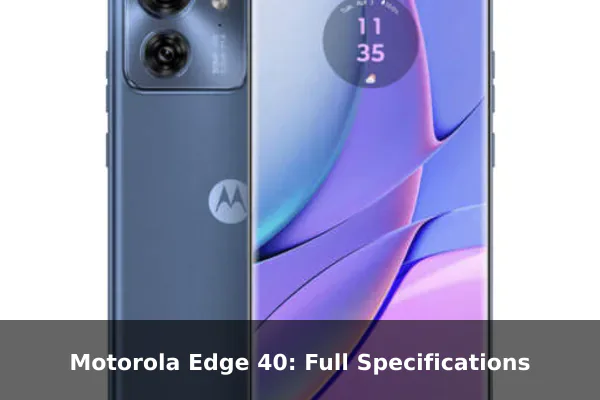
The IP68 rating is one of the key design advantages. It means the phone is dust tight and rated for immersion in water up to 1.5 meters for 30 minutes under controlled conditions. That does not make it indestructible, and water resistance can reduce over time, but it is still a meaningful protection level for accidental spills, rain, and brief water exposure. Color choices include Nebula Green, Lunar Blue, Eclipse Black, and Viva Magenta, giving the phone more visual personality than the usual black-and-silver lineup.
Display Experience
The 6.55-inch pOLED panel is one of the Edge 40’s headline features. It uses a 1080 x 2400 resolution in a 20:9 aspect ratio, producing about 402 pixels per inch, which is sharp enough for text, streaming, maps, and social feeds. The approximately 90.8 percent screen-to-body ratio also helps the device feel modern without making it too large to manage.
The 144Hz refresh rate is higher than the 120Hz panels common in many midrange phones, so supported interface animations and games can feel especially fluid. HDR10+ support is useful for compatible video content, while the listed 1200-nit peak brightness and measured 1043-nit maximum brightness suggest good outdoor visibility for this class. Buyers who prioritize display smoothness, curved-screen styling, and strong contrast will find this one of the phone’s strongest areas.
Performance and Storage
The MediaTek Dimensity 8020 is a 6nm 5G chipset with an octa-core CPU: four Cortex-A78 cores at up to 2.6GHz and four Cortex-A55 cores at up to 2.0GHz. That configuration is aimed at fast everyday performance, efficient multitasking, and solid upper-midrange gaming rather than flagship-level sustained graphics power. The Mali-G77 MC9 GPU supports demanding games, though thermal limits and game optimization will still matter.
Benchmark data gives useful context. The phone is listed with an AnTuTu v9 score of 688347, GeekBench scores of 3320 on v5.1 and 3603 on v6, plus a GFXBench ES 3.1 onscreen result of 33fps. Those numbers place it comfortably above entry-level 5G phones and many older midrange models. Storage choices are 128GB or 256GB, both with 8GB RAM and UFS 3.1 storage. There is no microSD card slot, so buyers who record a lot of 4K video should strongly consider the 256GB version.
Camera System
The rear camera setup is simple but well chosen. The main camera uses a 50MP sensor with a very bright f/1.4 aperture, optical image stabilization, multi-directional PDAF, a 1/1.55-inch sensor size, and 1.0 micrometer pixels. That combination is designed to gather more light, lock focus quickly, and reduce blur in handheld photos. The second rear camera is a 13MP ultrawide with a 120-degree field of view and autofocus, which also makes it useful for close-up macro-style shooting.
Video support is competitive for the category. The rear camera can record 4K at 30fps, 1080p at up to 120fps, and 720p at 960fps, with HDR10 and gyro-EIS support. The 32MP front camera also records 4K at 30fps, which is useful for higher-resolution selfies and creator-style clips. The camera system is not a zoom-focused setup, since there is no dedicated telephoto lens, but the main-plus-ultrawide pairing is practical for travel, food, architecture, groups, and everyday photography.
Battery and Charging
The 4400mAh Li-Po battery is moderate by 2026 Android standards, especially when many larger phones use 5000mAh or higher capacities. However, the Edge 40 offsets that with efficient hardware, a relatively slim build, and fast charging support. The listed old endurance rating of 98 hours is a useful sign that the phone can handle typical mixed usage well, though real battery life will depend heavily on refresh-rate behavior, 5G use, brightness, navigation, gaming, and camera recording.
Charging is a major strength. The 68W wired charging support is quick enough to make short top-ups genuinely useful, and 15W wireless charging remains uncommon in many phones at this level. For buyers who keep a wireless charger on a desk or bedside table, that feature can make the phone feel more premium in daily use. The trade-off is that the USB-C port is USB 2.0, so wired data transfers are not as fast as on phones with USB 3.x support.
Software and Smart Features
The Motorola Edge 40 launched with Android 13 and is listed for up to two major Android upgrades. Motorola’s Android approach is typically close to stock Android, with added Moto gestures, customization tools, security features, and device connection functions. For users who dislike heavy software skins, that lighter interface can be a selling point.
Smart Connect support adds another layer. It allows the phone to work more flexibly with larger screens and compatible devices, making it more useful for presentations, media playback, productivity, and desktop-like phone workflows. The under-display optical fingerprint sensor keeps unlocking modern and clean, while the sensor list covers the expected basics: accelerometer, gyro, proximity sensor, and compass.
Connectivity and Network Support
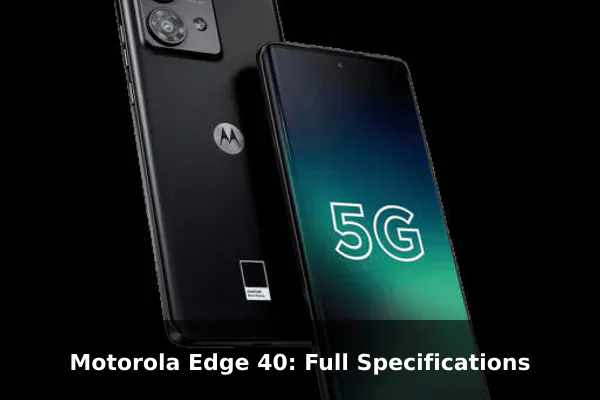
The Edge 40 supports GSM, HSPA, LTE, and 5G, with broad 4G and sub-6GHz 5G band coverage. Its 5G support includes SA and NSA modes, plus important bands such as n77 and n78, which are widely used in many 5G markets. As always, buyers should check their exact regional model and carrier band support before purchasing an imported unit.
Wireless connectivity is strong. The phone includes Wi-Fi 802.11 a/b/g/n/ac/6e with tri-band support, Bluetooth 5.2, NFC, GPS, GLONASS, GALILEO, and BDS. NFC is especially useful for contactless payments and quick pairing where supported. There is no FM radio and no 3.5mm headphone jack, so wired-audio users will need USB-C audio or Bluetooth headphones. Stereo speakers are included, and the tested loudspeaker result of -24.2 LUFS is rated very good.
Who Should Buy It?
The Motorola Edge 40 is a good fit for buyers who want a stylish Android phone with a strong screen, real water resistance, fast charging, wireless charging, and a capable main camera. It is especially appealing if you value a lightweight body more than having the biggest battery or the most aggressive gaming hardware. It also suits users moving from older 4G phones who want broad 5G support without choosing a huge device.
It is less ideal for buyers who need expandable storage, a headphone jack, a dedicated telephoto camera, or long software support comparable to the best long-update Android brands. Heavy mobile gamers may also prefer a larger phone with more thermal headroom. But for users focused on daily speed, display quality, build, charging convenience, and clean software, the Motorola Edge 40 remains a well-rounded specification package.
Conclusion
The Motorola Edge 40 combines a slim IP68 body, 144Hz pOLED display, Dimensity 8020 performance, a stabilized 50MP main camera, stereo speakers, 68W wired charging, and 15W wireless charging. Its main compromises are the lack of microSD support, no headphone jack, no telephoto camera, and only two listed major Android upgrades. Recommended for buyers who want a refined, lightweight Android 5G phone with strong everyday features.
References
- Motorola official product page – motorola edge 40 – Primary manufacturer product page for the Motorola Edge 40’s official positioning, design, display, camera, battery, and charging claims.
- Motorola Support – motorola edge 40 specifications – Official Motorola support specification sheet with detailed hardware specs including display, dimensions, cameras, battery, connectivity, bands, sensors, and IP rating.
- Motorola News – Introducing the motorola edge 40 – Official launch announcement useful for release context and confirming headline features such as IP68 protection, 50MP camera system, Dimensity 8020, 4400mAh battery, 68W charging, and 15W wireless charging.
- MediaTek Dimensity 8020 official product page – Official chipset documentation for verifying CPU, GPU, process, modem, Wi-Fi, Bluetooth, storage, display, and camera capabilities of the Dimensity 8020 used in the phone.
- GSMArena – Motorola Edge 40 specifications – Well-known smartphone specification database useful as an independent cross-check for dimensions, variants, bands, cameras, battery, and release details.
