
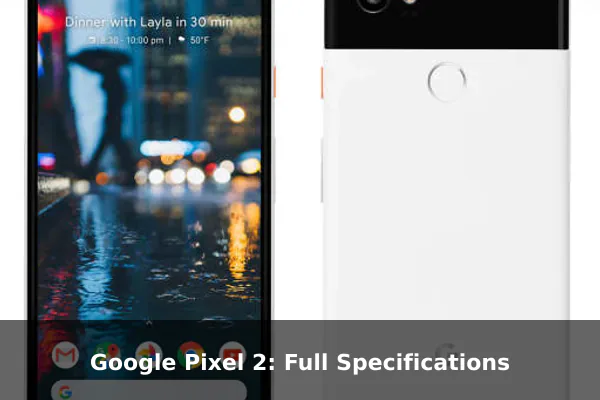
Google Pixel 2 is a compact Android flagship from Google, announced on October 4, 2017 and released on October 17, 2017. It focuses on a clean software experience, a sharp AMOLED display, stereo speakers, IP67 resistance, and Google’s single-camera computational photography approach.
Unlike many modern phones that prioritize large screens and multiple rear cameras, the Pixel 2 is best understood as a smaller reference-style device built around speed, image processing, and long-term Android updates for its generation. It is now discontinued, so its appeal is mainly historical, collector-focused, or for users comparing older Pixel hardware.
Full Specifications
Network
| Technology: | GSM / CDMA / HSPA / EVDO / LTE |
| 2G bands: | GSM 850 / 900 / 1800 / 1900 |
| CDMA 800 / 1900 | |
| 3G bands: | HSDPA 850 / 900 / 1700(AWS) / 1900 / 2100 |
| CDMA2000 1xEV-DO | |
| 4G bands: | 1, 2, 3, 4, 5, 7, 8, 12, 13, 17, 20, 25, 26, 28, 29, 30, 32, 38, 40, 41, 66 |
| Speed: | HSPA 42.2/5.76 Mbps, LTE (3CA) Cat15 800/75 Mbps |
Launch
| Announced: | 2017, October 04. Released 2017, October 17 |
| Status: | Discontinued |
Body
| Dimensions: | 145.7 x 69.7 x 7.8 mm (5.74 x 2.74 x 0.31 in) |
| Weight: | 143 g (5.04 oz) |
| Build: | Glass front (Gorilla Glass 5), aluminum/glass back, aluminum frame |
| SIM: | Nano-SIM + eSIM |
| IP67 dust/water resistant (up to 1m for 30 min) |
Display
| Type: | AMOLED |
| Size: | 5.0 inches, 68.9 cm2 (~67.9% screen-to-body ratio) |
| Resolution: | 1080 x 1920 pixels, 16:9 ratio (~441 ppi density) |
| Protection: | Corning Gorilla Glass 5 |
Platform
| OS: | Android 8.0 (Oreo), upgradable to Android 11 |
| Chipset: | Qualcomm MSM8998 Snapdragon 835 (10 nm) |
| CPU: | Octa-core (4×2.35 GHz Kryo & 4×1.9 GHz Kryo) |
| GPU: | Adreno 540 |
Memory
| Card slot: | No |
| Internal: | 64GB 4GB RAM, 128GB 4GB RAM |
| UFS 2.1 |
Main Camera
| Single: | 12.2 MP, f/1.8, 27mm (wide), 1/2.55″, 1.4µm, dual pixel PDAF, OIS |
| Features: | Laser AF, Dual-LED flash, HDR, panorama |
| Video: | 4K@30fps (gyro-EIS), 1080p@30/60/120fps (gyro-EIS), 720p@240fps (gyro-EIS) |
Selfie camera
| Single: | 8 MP, f/2.4, 27mm (wide), 1/3.2″, 1.4µm |
| Features: | HDR |
| Video: | 1080p@30fps |
Sound
| Loudspeaker: | Yes, with stereo speakers |
| 3.5mm jack: | No |
Comms
| WLAN: | Wi-Fi 802.11 a/b/g/n/ac, dual-band, Wi-Fi Direct, DLNA |
| Bluetooth: | 5.0, A2DP, LE, aptX HD |
| Positioning: | GPS, GLONASS, BDS, GALILEO |
| NFC: | Yes |
| Radio: | No |
| USB: | USB Type-C 3.1 |
Features
| Sensors: | Fingerprint (rear-mounted), accelerometer, gyro, proximity, compass, barometer |
Battery
| Type: | Li-Ion 2700 mAh, non-removable |
| Charging: | 10.5W wired (capped), PD2.0 |
Misc
| Colors: | Kinda Blue, Just Black, Clearly White |
| Models: | G011A |
| Price: | About 610 EUR |
Our Tests
| Performance: | GeekBench: 6437 (v4.4) GFXBench: 26fps (ES 3.1 onscreen) |
| Display: | Contrast ratio: Infinite (nominal), 4.023 (sunlight) |
| Camera: | Photo / Video |
| Loudspeaker: | Voice 70dB / Noise 77dB / Ring 81dB |
| Audio quality: | Noise -93.3dB / Crosstalk -66.2dB |
| Battery (old): | Endurance rating 75h |
Price and Availability
The Google Pixel 2 offers a compelling combination of features and performance. While the base price is around €610, the actual cost may vary depending on your location and retailer. Below, you’ll find the approximate price of the Google Pixel 2 converted into various currencies. Please note that these are estimates based on recent exchange rates as of August 11, 2026 and may not reflect the exact price you’ll find at a retailer.
- United States: $704
- Japan: ¥112,130
- United Kingdom: £521
- Australia: A$997
- Canada: C$980
- Taiwan: NT$22,697
- Denmark: kr4.553
- Saudi Arabia: ﷼2,640
- South Korea: ₩995,440
- Germany: €610
- Brazil: R$3.605
- Vietnam: ₫18.294.038
- Kenya: KSh 91,074
- India: ₹67,185
- Indonesia: Rp 12.559.422
- Nigeria: ₦957,560
- Pakistan: ₨195,560
- Philippines: ₱43,099
- Bangladesh: ৳৮৬,৯৭৮
Value and Positioning
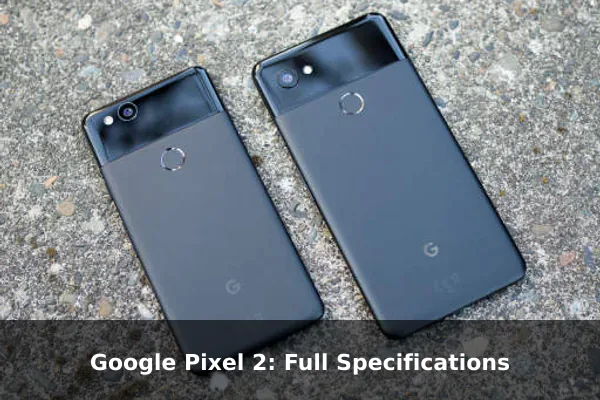
The Google Pixel 2 launched as a premium compact phone, with the source price listed at about 610 EUR. That placed it firmly in flagship territory for 2017, but its value was never about having the largest screen or the biggest battery. Its main pitch was Google’s own software, fast updates, a strong camera pipeline, and a manageable body size.
Today, the Pixel 2 should be judged differently. It is discontinued and no longer a current-support device, so it is not ideal as a primary phone for users who need fresh security patches, app longevity, or modern 5G connectivity. Its strongest value is for buyers who want an older Pixel for testing, collection, photography comparison, or lightweight offline use.
Design and Build Quality
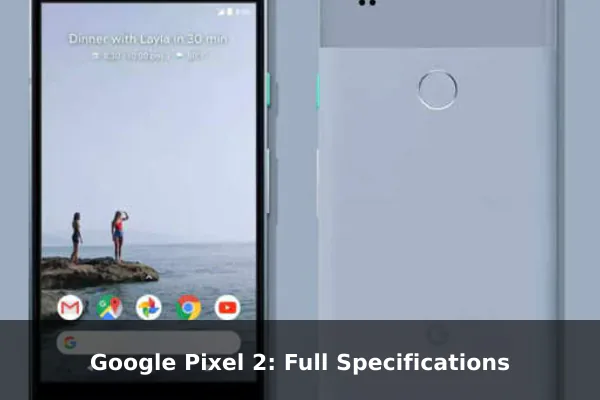
The Pixel 2 uses a compact 145.7 x 69.7 x 7.8 mm body and weighs 143 g, making it much easier to handle than most modern large-screen smartphones. The construction combines a Gorilla Glass 5 front, aluminum frame, and aluminum/glass rear design. It has a distinctive two-tone Pixel identity, especially in Kinda Blue, Just Black, and Clearly White finishes.
Google also included IP67 dust and water resistance, rated for up to 1 meter for 30 minutes. That was an important flagship feature at launch and still improves confidence for accidental splashes. The rear-mounted fingerprint sensor keeps unlocking simple and fast, though users coming from newer phones may miss in-display sensors or face-unlock systems.
Display Experience
The phone has a 5.0-inch AMOLED display with a 1080 x 1920 resolution, a classic 16:9 aspect ratio, and around 441 ppi density. The screen is smaller than current mainstream panels, but it remains sharp for reading, messaging, navigation, and media playback. AMOLED contrast gives it deep blacks, and the listed nominal contrast ratio is infinite.
The older 16:9 layout is worth noting. It makes the Pixel 2 feel more traditional than taller 18:9, 19.5:9, or 20:9 phones. Some users may appreciate the familiar shape, while others may find the bezels large by modern standards. Gorilla Glass 5 protection adds durability, but any used unit should still be checked for screen wear, burn-in, and glass damage.
Performance and Hardware
Inside, the Pixel 2 runs on the Qualcomm Snapdragon 835, a 10 nm flagship chipset with an octa-core Kryo CPU and Adreno 540 GPU. It was a high-end platform in its time, and the listed test results include GeekBench 6437 on version 4.4 and 26fps in GFXBench ES 3.1 onscreen. Storage options are 64GB or 128GB, both paired with 4GB of RAM and UFS 2.1 storage.
For basic tasks, the hardware can still feel responsive if the battery is healthy and the software environment is clean. However, 4GB RAM and the older chipset are limitations for heavy multitasking, demanding modern games, and long-term app support. There is also no microSD card slot, so buyers must choose storage carefully, especially because the 64GB version can feel tight today.
Camera Character
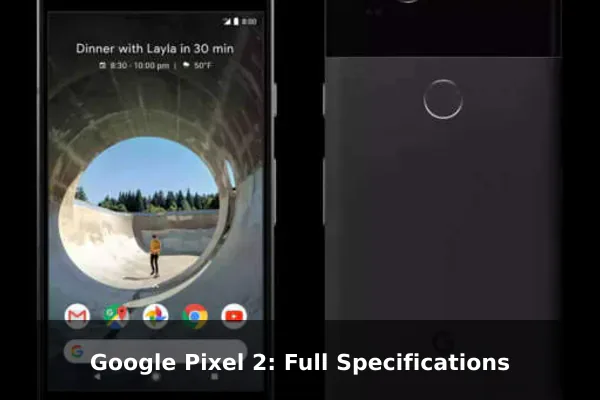
The Pixel 2 uses a single 12.2 MP rear camera with f/1.8 aperture, 27mm wide field of view, dual pixel PDAF, optical image stabilization, laser autofocus, HDR, panorama, and dual-LED flash. Instead of relying on multiple lenses, Google leaned heavily on image processing. That approach helped define the Pixel camera identity and made the Pixel 2 an important device in smartphone photography history.
Video support includes 4K at 30fps, 1080p at 30, 60, and 120fps, plus 720p at 240fps, all listed with gyro-EIS. The 8 MP front camera supports HDR and 1080p recording at 30fps. It lacks modern conveniences such as ultrawide, telephoto, cinematic modes, and advanced night-video tools, but it remains a useful reference point for how strong computational photography became with simple camera hardware.
Battery and Charging
The Pixel 2 has a 2700 mAh non-removable battery. The listed older endurance rating is 75 hours, which was respectable for a compact flagship with a 5.0-inch display. Charging is listed as 10.5W wired with PD2.0 support, so it does not match the speeds expected from many newer Android phones.
Battery condition matters more than the original capacity now. Because the phone is an older discontinued model, a used Pixel 2 may have significantly reduced battery health. Anyone considering one should treat battery replacement history as a key buying factor, especially if the phone will be used for navigation, photography, hotspot use, or frequent LTE data.
Software and Update Status
The Pixel 2 shipped with Android 8.0 Oreo and is listed as upgradable to Android 11. That was one of its major strengths: it received direct Google software updates during its support window and helped establish the Pixel line as the cleanest Android update path outside developer devices.
The trade-off is that official support has ended. Google’s update support information lists Pixel 2 and Pixel 2 XL among devices that no longer receive Android version or security updates. For a specs-focused buyer, that changes the recommendation: the hardware may still be interesting, but the phone is not a sensible choice for users who prioritize current security maintenance.
Connectivity and Everyday Features
The Pixel 2 supports GSM, CDMA, HSPA, EVDO, and LTE networks, with extensive LTE band coverage for its era and LTE Cat15 speeds listed at up to 800/75 Mbps. It uses Nano-SIM plus eSIM, which was forward-looking at launch. Wireless features include Wi-Fi 802.11 a/b/g/n/ac, Bluetooth 5.0 with aptX HD, GPS, GLONASS, BDS, GALILEO, NFC, and USB Type-C 3.1.
There is no FM radio and no 3.5mm headphone jack, so wired audio requires USB-C or an adapter. Stereo speakers are included, and the listed loudspeaker results are 70dB voice, 77dB noise, and 81dB ring. Sensor coverage is strong, with a rear fingerprint reader, accelerometer, gyro, proximity sensor, compass, and barometer.
Who Should Buy the Pixel 2?
The Pixel 2 suits users who specifically want a compact older Google phone, a clean Android reference device, or a historically important Pixel camera model. It can also be useful for developers, collectors, and readers comparing how Google’s phone design evolved from the early Pixel generation to later models such as the Pixel 7, Pixel 7a, and Pixel 9 Pro XL.
It is less suitable for buyers who need modern battery life, long software support, 5G, a large display, expandable storage, or multiple camera focal lengths. In a practical buying comparison, the Pixel 2 is more of a legacy flagship than a mainstream daily-driver recommendation.
Conclusion
Google Pixel 2 remains a notable compact flagship because it combined a sharp AMOLED screen, Snapdragon 835 hardware, IP67 protection, stereo speakers, eSIM support, and a highly influential 12.2 MP camera system. Its biggest weakness today is not the core spec sheet but age: official updates have ended, the battery may be worn, and newer phones offer larger displays, 5G, and more versatile cameras.
Recommended only for collectors, Pixel fans, testing, or light secondary use; for a main phone, choose a newer supported Pixel or Android model.
References
- Google Pixel Phone Help – Pixel phone hardware tech specs – Primary Google reference for Pixel 2 specifications including display, cameras, processor, RAM, storage, dimensions, battery, audio, wireless, network support, colors, and in-box items.
- Google Pixel Phone Help – Safety & regulatory manual for Pixel 2 and Pixel 2 XL – Official Google regulatory source for Pixel 2 SAR values, FCC/Canada/EU compliance, HAC rating, radio frequency information, safety notes, and IP67-related regulatory context.
- Google Official Blog – Ask more of your phone: Google Pixel 2 – Official launch announcement confirming Pixel 2 positioning, launch context, available sizes, colors, Android Oreo, core features, and Google’s own product claims.
- Qualcomm – Snapdragon 835 Mobile Platform – Primary chipset manufacturer reference for the Snapdragon 835 platform used in the Pixel 2, useful for verifying SoC, GPU, modem, imaging, and connectivity capabilities.
- Google Pixel Phone Help – Pixel software update support – Official Google support page confirming Pixel 2 and Pixel 2 XL are no longer receiving Android version or security updates.
