
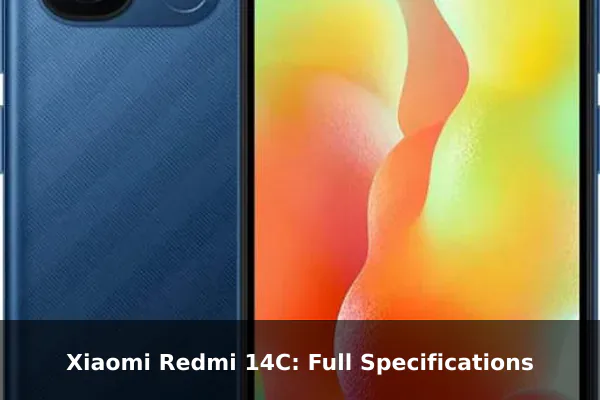
The Xiaomi Redmi 14C is a budget 4G smartphone built around a large display, a big battery, expandable storage, and everyday Android usability. It targets buyers who want a practical phone for messaging, video, social apps, maps, and light photography without paying for 5G or flagship extras.
Its strongest angle is simple value: a 6.88-inch 120Hz screen, Helio G81 Ultra chipset, 50 MP main camera, 5160 mAh battery, USB-C, microSD support, and a 3.5 mm headphone jack. That makes the Redmi 14C more about long daily use and low ownership cost than raw performance.
Full Specifications
Network
| Technology: | GSM / HSPA / LTE |
| 2G bands: | GSM 850 / 900 / 1800 / 1900 |
| 3G bands: | HSDPA 850 / 900 / 2100 |
| 4G bands: | 1, 3, 5, 7, 8, 20, 28, 38, 40, 41 |
| Speed: | HSPA, LTE |
Launch
| Announced: | 2024, August 30 |
| Status: | Available. Released 2024, August 30 |
Body
| Dimensions: | 171.9 x 77.8 x 8.2 mm (6.77 x 3.06 x 0.32 in) |
| Weight: | 204 / 207 / 211 g (7.20 oz) |
| Build: | Glass front (Gorilla Glass 3), plastic frame, glass back or silicone polymer (eco leather) back |
| SIM: | Nano-SIM + Nano-SIM |
| Dust and splash resistant |
Display
| Type: | IPS LCD, 120Hz, 450 nits (typ), 600 nits (HBM) |
| Size: | 6.88 inches, 112.4 cm2 (~84.0% screen-to-body ratio) |
| Resolution: | 720 x 1640 pixels (~260 ppi density) |
| Protection: | Corning Gorilla Glass 3 |
Platform
| OS: | Android 14, HyperOS |
| Chipset: | Mediatek Helio G81 Ultra (12 nm) |
| CPU: | Octa-core (2×2.0 GHz Cortex-A75 & 6×1.8 GHz Cortex-A55) |
| GPU: | Mali-G52 MC2 |
Memory
| Card slot: | microSDXC (dedicated slot) |
| Internal: | 64GB 4GB RAM, 128GB 4GB RAM, 128GB 6GB RAM, 128GB 8GB RAM, 256GB 4GB RAM, 256GB 8GB RAM |
| eMMC 5.1 |
Main Camera
| Dual: | 50 MP, f/1.8, 28mm (wide), 1/2.96″, PDAF or 50 MP, f/1.8, 28mm (wide), 1/2.76″, 0.64µm, PDAF QVGA, f/3.0 |
| Features: | LED flash, HDR |
| Video: | 1080p@30fps |
Selfie camera
| Single: | 13 MP, f/2.0, (wide), 1/3.06″ |
| Features: | HDR |
| Video: | 1080p@30fps |
Sound
| Loudspeaker: | Yes |
| 3.5mm jack: | Yes |
Comms
| WLAN: | Wi-Fi 802.11 a/b/g/n/ac, dual-band, Wi-Fi Direct |
| Bluetooth: | 5.4, A2DP, LE |
| Positioning: | GPS, GLONASS, GALILEO, BDS |
| NFC: | Yes (market/region dependent) |
| Radio: | FM radio |
| USB: | USB Type-C 2.0, OTG |
Features
| Sensors: | Fingerprint (side-mounted), accelerometer, compass |
| Virtual proximity sensing |
Battery
| Type: | 5160 mAh |
| Charging: | 18W wired, PD |
Misc
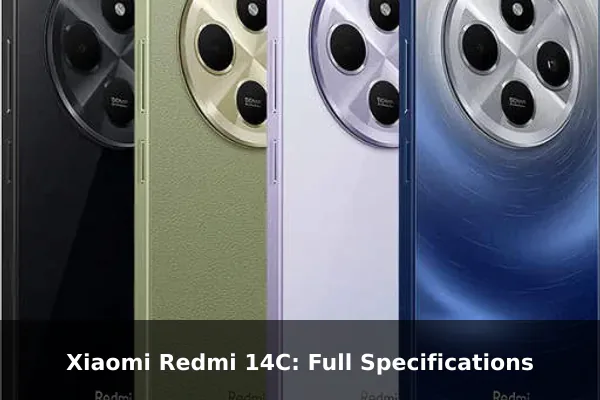
| Colors: | Midnight Black, Sage Green, Dreamy Purple, Starry Blue |
| Models: | 2411DRN47C, 2409BRN2CA, 2409BRN2CG, 2409BRN2CY |
| SAR EU: | 0.99 W/kg (head) 0.90 W/kg (body) |
| Price: | € 89.04 / $ 110.70 / £ 83.70 |
Price and Availability
The Xiaomi Redmi 14C offers a compelling combination of features and performance. While the base price is around €89, the actual cost may vary depending on your location and retailer. Below, you’ll find the approximate price of the Xiaomi Redmi 14C converted into various currencies. Please note that these are estimates based on recent exchange rates as of July 26, 2026 and may not reflect the exact price you’ll find at a retailer.
- United States: $101
- Japan: ¥16,594
- United Kingdom: £76
- Australia: A$145
- Canada: C$143
- Taiwan: NT$3,277
- Denmark: kr664
- Saudi Arabia: ﷼380
- South Korea: ₩148,353
- Germany: €89
- Brazil: R$514
- Vietnam: ₫2.662.137
- Kenya: KSh 13,136
- India: ₹9,783
- Indonesia: Rp 1.814.353
- Nigeria: ₦137,941
- Pakistan: ₨28,143
- Philippines: ₱6,264
- Bangladesh: ৳১২,৫০৩
Value Position
The Redmi 14C sits in Xiaomi’s entry-level Redmi range, and its specification mix makes that clear. Instead of chasing premium materials, 5G modems, high-resolution OLED panels, or advanced multi-camera hardware, it focuses on the features many budget buyers use every day: a large screen, reliable 4G connectivity, expandable storage, long battery life, and a familiar Android interface.
That value-first approach is important because low-cost phones often need to balance one strong headline feature against several compromises. Here, the Redmi 14C leans toward a broad everyday package. The 120Hz refresh rate gives the display a smoother feel than basic 60Hz panels, the 5160 mAh battery should suit long sessions away from a charger, and the dedicated microSD slot helps users avoid storage pressure over time.
Design and Build
The Redmi 14C is a large phone, measuring 171.9 mm tall and weighing between 204 g and 211 g depending on the finish. It is not designed to be especially compact, so buyers with smaller hands should expect two-handed use. In return, the bigger body gives room for a large display and battery, which are two of the device’s main selling points.
The build combines a Gorilla Glass 3 front, a plastic frame, and either a glass back or an eco-leather-style silicone polymer back. That back-finish variation matters because it can affect grip, hand feel, and weight. Dust and splash resistance is also listed, but this should be treated as basic daily protection rather than a reason to expose the phone to water intentionally.
Display Experience
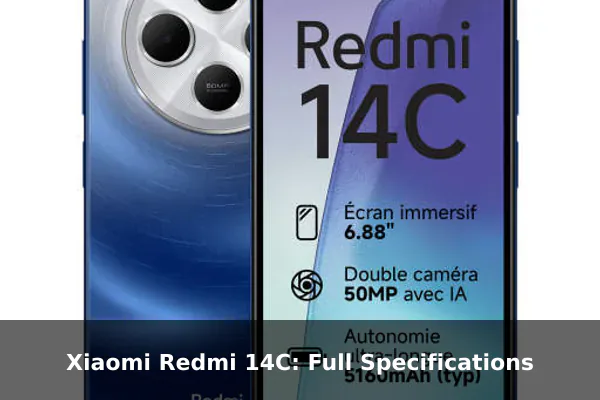
The 6.88-inch IPS LCD is one of the Redmi 14C’s most important features. It is large enough for video, reading, browsing, maps, and split attention between apps, while the 120Hz refresh rate can make scrolling and interface movement feel more fluid than typical entry-level displays.
The trade-off is resolution. At 720 x 1640 pixels and around 260 ppi, the panel is not as sharp as Full HD alternatives. Text and fine interface details may look softer, especially on such a large screen. Brightness is rated at 450 nits typical and 600 nits in high brightness mode, so it should be usable indoors and in moderate outdoor light, though not in the same class as higher-end displays with much brighter panels.
Performance Hardware
Xiaomi pairs the Redmi 14C with the MediaTek Helio G81 Ultra, a 12 nm 4G chipset using two Cortex-A75 performance cores and six Cortex-A55 efficiency cores. This is a sensible match for calling, messaging, web browsing, social media, streaming, payments where supported, navigation, and casual games.
Users should keep expectations realistic for heavy multitasking and demanding gaming. The Mali-G52 MC2 GPU and eMMC 5.1 storage are typical entry-level choices, not performance-focused components. The phone is available in several memory configurations, including versions with 4 GB, 6 GB, or 8 GB of RAM and up to 256 GB of internal storage, so the higher RAM versions should feel more comfortable over time.
Camera Capabilities
The Redmi 14C uses a 50 MP wide main camera with PDAF, supported by a small auxiliary QVGA sensor. The main camera is the one that matters here. In good lighting, it should be suitable for everyday photos such as documents, food, people, pets, storefronts, and travel snapshots.
Video recording is limited to 1080p at 30 fps, which is acceptable for casual clips but not aimed at creators who need 4K capture, advanced stabilization, or strong low-light video. The 13 MP front camera also records 1080p at 30 fps and includes HDR support, making it suitable for video calls and basic social posts.
Battery and Charging
The 5160 mAh battery is a major advantage for the Redmi 14C. Combined with a modest-resolution LCD and an efficient everyday chipset, it should be well suited to users who prioritize endurance over speed. For students, delivery workers, commuters, and casual users, this battery size is one of the phone’s most practical features.
Charging is rated at 18W wired with Power Delivery support. That is useful, but not especially fast by current Xiaomi standards. Buyers should expect dependable charging rather than rapid top-ups. For best results, the phone makes more sense as an overnight or desk-charge device than as a quick-charge performance model.
Software and Daily Use
The Redmi 14C ships with Android 14 and Xiaomi’s HyperOS. This gives the phone a modern software base with Xiaomi’s own interface design, app management tools, customization options, and ecosystem features. For users upgrading from an older Redmi or Poco model, the layout should feel familiar.
As with many affordable Android phones, long-term smoothness will depend on the chosen RAM and storage version, installed apps, and background activity. Buyers who plan to keep the phone for several years should prioritize a higher RAM and storage configuration where available, especially if they use many messaging, shopping, banking, and social apps at the same time.
Connectivity and Practical Extras
The Redmi 14C is a 4G LTE phone with GSM and HSPA support, not a 5G model. That helps keep the cost down, but buyers in markets where 5G coverage and speed are important should compare carefully before choosing it. For many budget users, 4G remains enough for messaging, maps, calls, video streaming, and web use.
Its practical extras are strong for the class. The phone includes dual-band Wi-Fi, Bluetooth 5.4, GPS with multiple satellite systems, USB Type-C 2.0 with OTG, FM radio, a side-mounted fingerprint scanner, and a 3.5 mm headphone jack. NFC is listed as market or region dependent, so buyers should check the exact local variant if contactless payments are important.
Who Should Buy the Redmi 14C?
The Redmi 14C is best for buyers who want a large-screen Android phone for everyday tasks and do not need 5G, premium cameras, or high-end gaming performance. It makes sense for students, first-time smartphone buyers, secondary-phone users, family members who need a simple daily driver, or anyone replacing an older budget device.
It is less suitable for users who care about sharp Full HD display quality, compact dimensions, high-speed charging, advanced camera versatility, or heavy gaming. Its strongest case is not that it is the fastest or most advanced phone in its class, but that it covers the basics with a large screen, good battery capacity, expandable storage, and useful legacy features.
Conclusion
The Xiaomi Redmi 14C is a practical budget 4G phone with a big 120Hz display, large battery, expandable storage, headphone jack, and everyday Android performance. Choose it if you want an affordable large-screen Redmi for basic daily use, but look higher in Xiaomi’s lineup if you need 5G, sharper display quality, or stronger cameras.
References
- Xiaomi Global – Redmi 14C Specs – Primary manufacturer specifications for processor, memory variants, dimensions, display, cameras, battery, connectivity, sensors, OS, and package contents.
- Xiaomi UK – Redmi 14C Specs – Official regional specifications useful for checking market-specific configurations such as RAM/storage, NFC, charger-in-box notes, and network band differences.
- Global Certification Forum – Redmi 14C – Certification record for Redmi 14C model 2409BRN2CL, useful for verifying cellular network support and model identity.
- FCC Equipment Authorization (fcc.gov) – Official U.S. regulator database for FCC ID 2AFZZRN2CL/RN2CL, useful for verifying wireless authorization, model identity, radio details, and SAR filings.
- MediaTek Helio G81 Official Product Page – Official chipset source for Helio G81 CPU, GPU, memory, storage, camera, connectivity, and platform capabilities relevant to the Redmi 14C processor section.
